Aina Smart Ring with Screen and Joystick: Calls and Voice Control of AI

Aina smart ring combines screen, joystick, and mic to explore a wearable AI agent entry point.
Aina is a ring that integrates a screen, joystick, and microphone to let users summon and operate AI agents without a phone. Besides voice conversation, it supports calls and Mac dictation, positioning it as an input-extension peripheral. The article acknowledges the form-factor's value—always on the hand, natural gestures—but notes that screen visibility, joystick precision, noisy-environment voice recognition, public-speaking acceptability, and battery life remain key challenges, with usability still at the concept-demo stage.
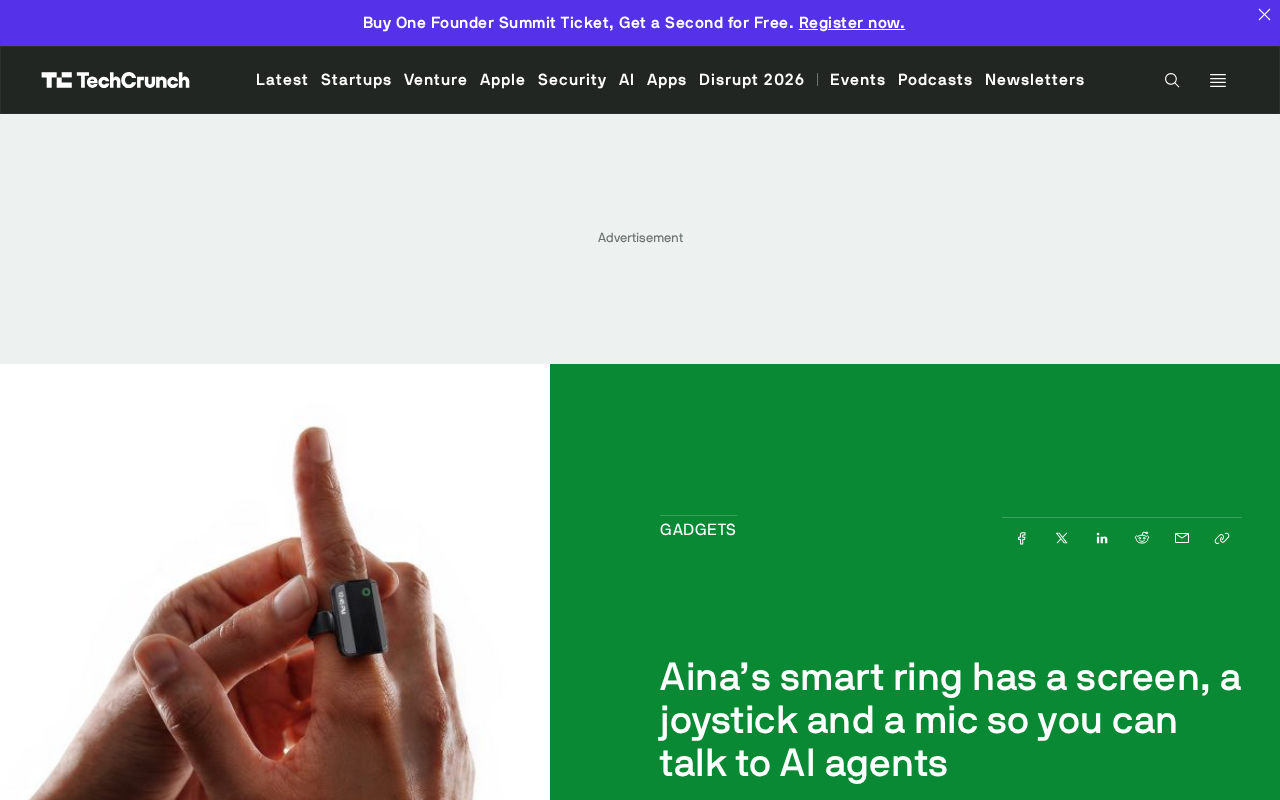
The smart ring category is undergoing an interesting split. While mainstream manufacturers are still polishing rings toward being "imperceptible health trackers," a product called Aina has chosen the opposite path: equipping the ring with a screen, joystick, and microphone to turn it into a portable control terminal that can summon an AI agent at any time.
Three Interaction Hardware Components Squeezed into One Ring
Aina's most obvious feature is compressing interaction components that normally belong to a watch or even a phone down to ring size. The screen handles information display, the joystick provides directional operation without a touchscreen, and the microphone takes on voice input—combined, these three point to the same goal: letting users complete conversations with an AI agent and issue commands without pulling out their phone.
The subtext of this design approach is that the entry point for invoking an AI agent shouldn't be locked inside a phone app. Voice wake-up is convenient but lacks visual feedback and precise control; pure physical buttons struggle to carry multi-level menus. The combination of screen, joystick, and voice is effectively replicating a complete but miniature input/output system within the extremely small volume of a ring.
AI agent refers to a software system capable of perceiving its environment, making autonomous decisions, and executing actions to accomplish specific goals, distinct from chatbots that only do single-turn Q&A. A typical agent can call external tools, maintain multi-turn context, break down tasks, and proactively initiate operations. Putting it into a wearable device means users need an always-available "summoning" entry point and a low-latency command channel—this is precisely the context behind Aina's emphasis on screen feedback and precise joystick control: pure voice struggles to complete selection and confirmation in complex tasks, while physical control can provide deterministic input.
Calls, Dictation, and Mac Integration
Beyond voice conversation capability, Aina also supports making and receiving calls and can provide dictation assistance for Mac users. These two features position the ring closer to a "wearable peripheral" than an independent health device: it plays the role of an input extension for phones or computers.
For people who frequently work at a computer, wearing the dictation entry point on the hand could theoretically reduce the frequency of switching between keyboard, mouse, and phone. The call feature preserves basic communication availability when the phone isn't at hand. These are all designs built around "reducing device-switching costs" rather than attempting to let the ring replace the phone.
Dictation is an operating-system-level speech-to-text feature; macOS's built-in dictation can be triggered via a shortcut in any text field, converting speech to text in real time. For third-party hardware to provide similar capability, it typically needs to connect to the system as a Bluetooth input device or via companion software, and handle wake-up, focus switching, and automatic punctuation. For users who type for long periods, the value of dictation lies in bypassing the keyboard input path, but accuracy, latency, and privacy handling (on-device vs. cloud recognition) directly affect willingness to use it in practice.
The Experience Trade-offs Behind Miniaturization
Cramming a screen and joystick into a ring—beyond engineering difficulty, the bigger variable is actual user experience. The ring's wearing position means its screen area, viewing angle, and operating range are all extremely constrained, and the joystick's precision and durability face higher demands due to the reduced size. Voice interaction can bypass some of these problems, but recognition performance in noisy environments and the social acceptability of "talking to your ring" in public are realistic constraints this form factor must confront.
Another point to watch is power consumption. With screen, microphone, and wireless communication all squeezed into the ring simultaneously, battery life will directly determine whether it's a daily tool or a novelty toy. The original article doesn't disclose specific specs, which leaves the product's practical usability temporarily at the level of a concept demo.
Power constraints of wearable devices are strongly related to volume: battery capacity roughly shrinks with the cube of volume, while always-on displays, continuous microphone pickup, and wireless communication are all high-power-drain elements. Common countermeasures include low-power displays (such as memory LCD or ultra-low-power OLED), voice activity detection (VAD)-triggered wake-up, and offloading complex computation to a paired phone or computer. These strategies in turn affect response speed and offline availability, so battery life isn't just a hardware spec issue—it's a precondition for whether the interaction design can hold up.
Another Possibility for the Ring Form Factor
Aina's value isn't in proving that a ring can do these things, but in raising a question worth discussing: what should the hardware entry point for an AI agent look like? Watches are limited by wrist movement, earbuds have only an audio channel, and phones are versatile but require actively taking them out. The ring's advantage is that it's always on the hand and its movements are natural—if the interaction design is sufficiently restrained, it could become the most convenient way to invoke AI.
Whether this path can succeed depends on the degree to which battery life, interaction precision, and ecosystem integration are delivered. For now, Aina looks more like a bold form-factor exploration, pushing wearables from "recording body data" toward another direction: "controlling the digital world."
One-line Summary
Aina smart ring integrates a screen, joystick, and microphone to explore a portable hardware entry point for AI agents.
Paragraph Summary
Aina is a product that integrates a screen, joystick, and microphone into a ring form factor, aiming to let users summon and operate an AI agent without pulling out their phone. Beyond voice conversation, it also supports making calls and providing dictation assistance for Mac, positioning it closer to an input-extension peripheral for phones and computers than an independent health device. The article affirms the significance of this form-factor exploration: a ring is always on the hand with natural movements and could become the most convenient entry point for invoking AI. However, the screen visibility, joystick precision, voice recognition in noisy environments, social acceptability of speaking in public, and battery life issues brought by miniaturization remain key variables for whether the product can land—currently, its practical usability is still at the concept-demo level.
Related articles

9 AI Subscription Plans Compared: The Real Cost Per 100M Tokens Revealed
Bilibili creator tests 9 AI subscription plans from Volcano, Alibaba, Tencent, Baidu, Zhipu, Xiaomi, MiniMax and more, converting them all to real cost per 100M tokens, breaking down fixed-quota vs. three-tier coefficient billing and how caching, time-of-day discounts, and window limits affect actual quota.

Vibe Coding for Beginners: Expressing Intent Instead of Handwriting Code
What is Vibe Coding? A 137-episode Bilibili course defines it: the core is expressing intent, not writing code. This article analyzes Vibe Coding's productivity logic, target audience, and entry expectations to help beginners decide if it's worth learning.

LangChain Beginner's Guide: An Agent Development Roadmap from LangGraph to Deep Agents
Clarify the encapsulation relationship among LangChain, LangGraph, and Deep Agents, and master the learning path and selection logic for agent development frameworks—suitable for beginners in large model development.