Claude User's Promotional Credits Expire a Day Early: Billing Discrepancy Sparks Debate

Claude user's $47.51 promo credits expired a day early, likely due to timezone or billing logic issues.
An Anthropic Claude user found their $47.51 in promotional credits — labeled "Expires September 19" — wiped from their account on September 18, leaving a balance of -$1.87. The one-day discrepancy likely stems from a UTC timezone mismatch or a boundary condition bug in the expiration logic. The article uses this case to advise users to spend credits before the listed date, document changes with screenshots, and monitor auto-reload settings, while calling on Anthropic to ensure displayed expiration dates match actual system enforcement.
What Happened: Promotional Credits Vanish One Day Early
An Anthropic Claude user reported on Reddit that promotional credits labeled "Expires September 19" were wiped from their account on September 18 — a full day before the stated expiration date.
Two account screenshots provided by the user tell the story clearly. The earlier screenshot showed a balance of $47.52, of which $47.51 was promotional credit set to expire September 19, 2026. In the later screenshot, the account balance had dropped to -$1.87 (reflecting $1.87 in usage), with the promotional credits gone entirely.
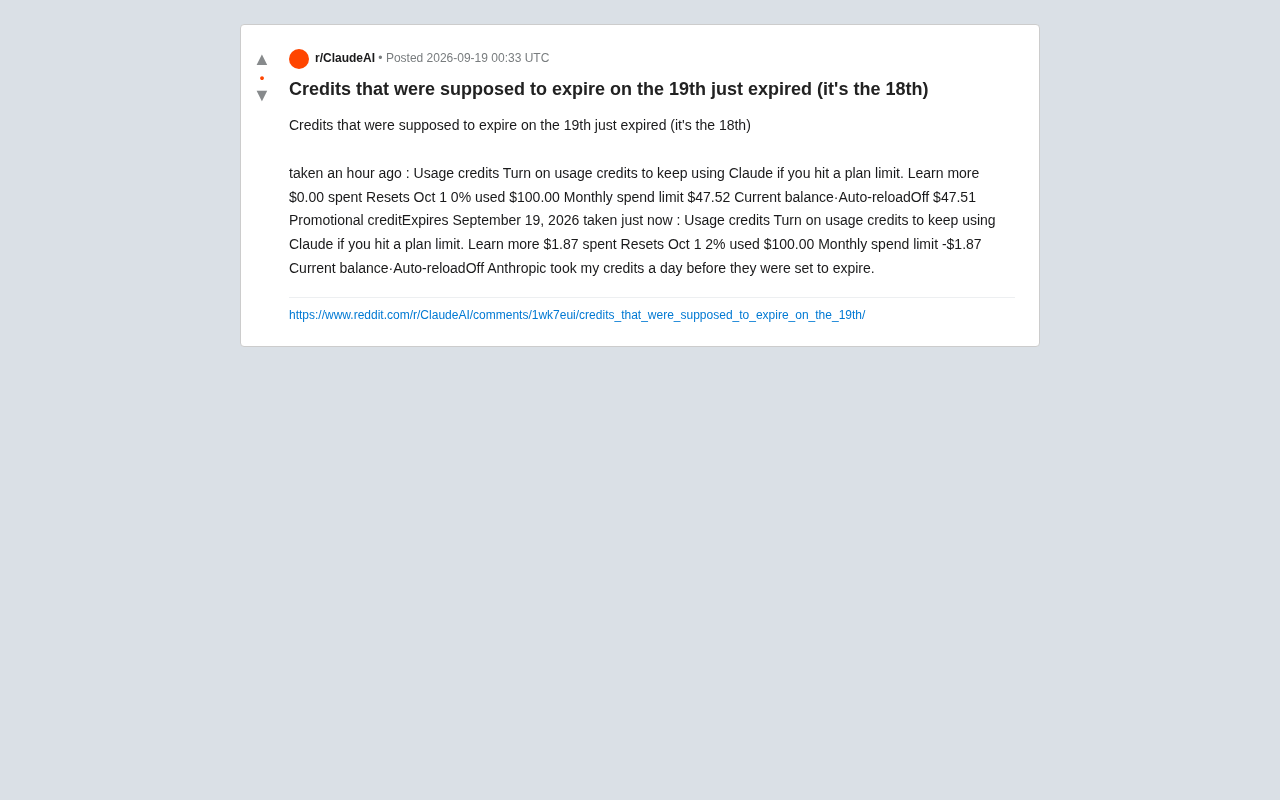
The user's complaint was straightforward: "Anthropic took my credits a day before they were set to expire."
The Core Question: Where Did That One Day Go?
On the surface, this looks like a simple one-day discrepancy. But for a user relying on those promotional credits to use Claude, the sudden disappearance of nearly $47.50 had a real impact on their experience. Even more concerning, the account balance turned negative — meaning usage after the credits expired was already being billed at the standard rate.
From a technical standpoint, there are a few likely explanations for this kind of issue:
Timezone Handling Discrepancies
The most common explanation is a timezone mismatch. If Anthropic's backend calculates expiration based on UTC or US Pacific Time, while the expiration date displayed to users reflects their local timezone, edge cases can produce a situation where credits appear to expire on the 18th even though the interface shows "September 19."
UTC (Coordinated Universal Time) is the standard time reference used by most software systems worldwide. It runs 8 hours behind Beijing time and 8 hours ahead of US Pacific Standard Time (7 hours during daylight saving). Take San Francisco, where Anthropic is headquartered: when midnight arrives on September 18 Pacific Time, it's already 7 or 8 AM on September 19 in UTC. If the system stores and evaluates expiration times in UTC at the database level, but the frontend simply displays "Expires September 19" without specifying a timezone, users in different regions can end up with very different actual deadlines than they expect. For the user in this case, if the system treated UTC midnight as the expiration moment, it would have been early evening on September 18 in Pacific Time — making the credits feel like they disappeared a full day early. The fix for this is well-established in the SaaS industry: display the exact expiration timestamp with a timezone (e.g., "Expires Sep 19, 2026 at 11:59 PM PT") to eliminate any ambiguity.
Conflicts Between Billing Cycles and Expiration Logic
The screenshots show that the account's usage resets on October 1, while the promotional credits were set to expire September 19 — two separate timelines. How the system handles the boundary condition of "expiration day" — whether credits remain valid through the end of that day or expire at its start — depends entirely on implementation, and different approaches yield very different outcomes for users.
What This Means for Users: Handle Promotional Credits Carefully
This incident, while minor in isolation, highlights a commonly overlooked issue with subscription-based AI services: the expiration rules for promotional credits, trial allowances, and other temporary benefits are often unclear.
A few practical takeaways for users:
- Don't wait until the last day to use expiring credits: If you have promotional credits nearing expiration, use them ahead of the listed date rather than waiting until the final day shown. Timezone and billing logic may not align with your expectations.
- Take screenshots as documentation: This Reddit user was able to clearly document the balance dropping from $47.52 to negative by capturing two screenshots in sequence — solid evidence for any potential dispute.
- Pay attention to auto-reload and spending limit settings: Options like "Auto-reload Off" and "$100.00 Monthly spend limit" visible in the screenshots are important safeguards against unexpected charges.
The Transparency Responsibility Falls on the Platform
From the service provider's perspective, a promotional credit's expiration mechanism should ensure that what's displayed matches what's actually enforced. When the interface explicitly says "Expires September 19," users reasonably expect to retain access to those credits throughout that day. Expiring credits even one day early — however unintentional — is a violation of user expectations.
This is currently a single user report from Reddit, so it's impossible to determine whether this was an isolated technical glitch or a systemic issue with the billing logic. Users who encounter similar situations are encouraged to file a complaint through official support channels and include timestamped screenshot evidence.
For a fast-growing AI company like Anthropic, the accuracy and transparency of its billing system directly affects user trust. A one-day credit discrepancy may seem trivial, but in an era when users are increasingly sensitive about AI subscription billing, any dispute deserves to be taken seriously.
In the SaaS and subscription services sector, billing transparency is increasingly attracting regulatory attention. The US Federal Trade Commission (FTC) has issued multiple warnings in recent years about hidden charges and opaque terms in subscription services, while the EU's Digital Services Act sets explicit requirements for price display consistency on digital platforms. From a legal standpoint, a mismatch between "the expiration date shown in the interface" and "the actual moment the system enforces expiration" could potentially constitute a misleading commercial practice. Even if the timezone discrepancy was an unintentional byproduct of technical implementation, if it systematically causes users to lose paid-for value, it could invite collective complaints or regulatory scrutiny. As an AI company that emphasizes safety and integrity, Anthropic has an additional brand-level reason to ensure that its billing UI reflects the same transparency it holds as a core value.
Related articles

Workbuddy for Absolute Beginners: How a Desktop AI Agent Fits Into Real Workflows
A beginner's guide to the Workbuddy desktop AI agent: installation, claiming credits, file management, and building automated workflows—compared with CodeX for fit and cost, helping professionals shift from AI question-askers to AI managers.

OpenAI's New Agent Stack: Computer Use, Decisions API, and Ultra-Fast Workflows
OpenAI Dev Day unveiled a new agent stack: Computer Use outperforms humans, Decisions API delivers ultra-low-latency classification via Luna, Agents API opens the same Computer Use capabilities, and GPT-6.1 Sol costs only one-seventh of Astra. Core updates, benchmark data, and developer insights.

Liang Wenfeng Open-Sources DeepInfo Inference Framework, Takes On U.S. Ban
DeepSeek open-sources its DeepInfo inference framework after its models, featuring GPU/CPU cross-pipelining, small-model prediction with large-model verification, and full Huawei Ascend and NVIDIA chip support—facing the U.S. federal ban head-on. This article analyzes its significance for AI deployment and open-source strategy.