Claude Writes Its Own MCP Connector to SolidWorks, Generates CAD Parts in 7 Minutes

A user had Claude write an MCP connector directly to SolidWorks, generating CAD parts from natural language in 7 minutes.
A Reddit user shared that they had Claude write an MCP connector for their SolidWorks installation, after which a single natural-language command yields a usable CAD part model in about 7 minutes. The workflow is already used to quickly model products bought on platforms like Amazon that lack CAD files, eliminating manual measurement. The article explains how the MCP protocol serves as a bridge for standardized interaction between AI and external tools, enabling Claude to directly call SolidWorks APIs for sketching, extruding, and more. The same case was widely praised in r/ClaudeAI but heavily downvoted in r/SolidWorks, reflecting differing priorities around accuracy, editability, and engineering standards between the AI community and professional CAD users.
From Amazon Parts to CAD Models in One Sentence
In the r/ClaudeAI community on Reddit, a user shared an eye-catching workflow: they had Claude write an MCP connector for their SolidWorks installation, and afterward, simply telling Claude "make me these parts in SolidWorks" yields usable CAD models in about 7 minutes.
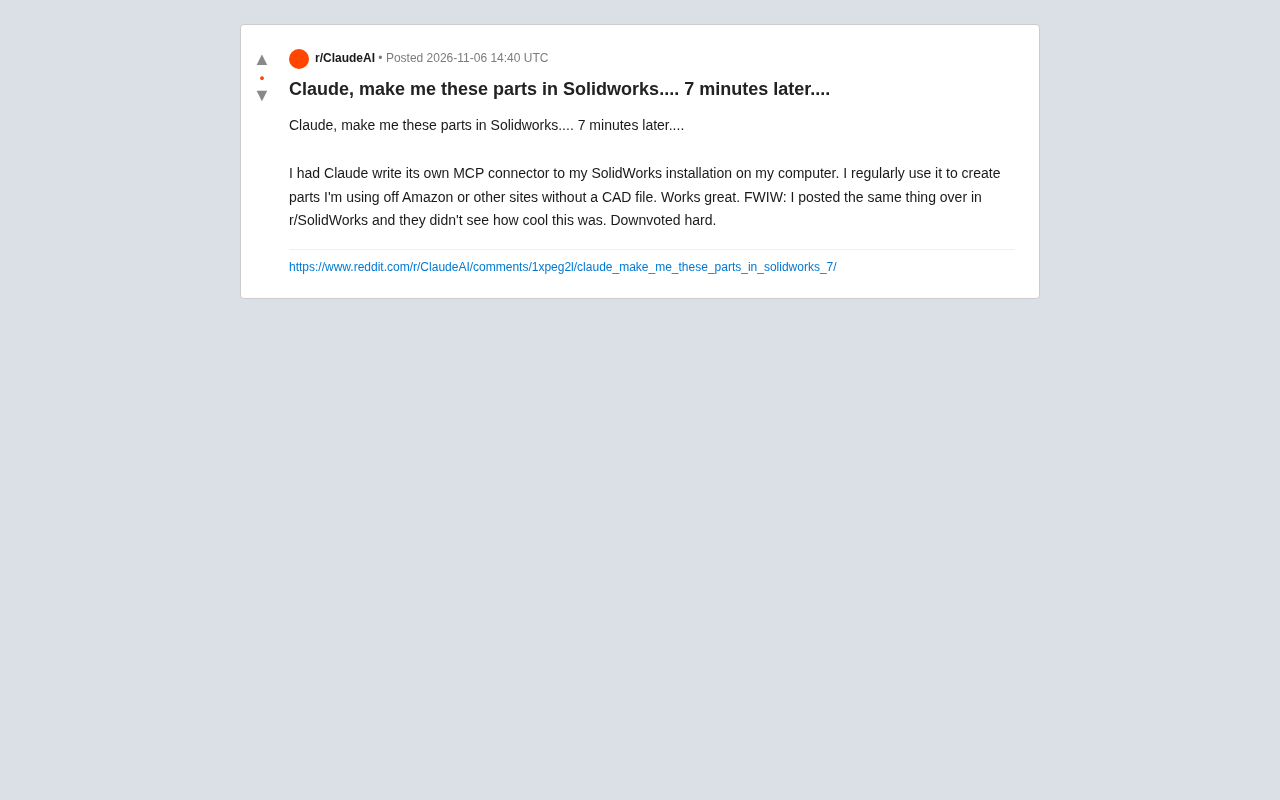
The user says they frequently need to create CAD files for parts purchased from Amazon or other websites, but many products don't come with ready-made models. This used to require manual measurement and modeling; now, through a Claude-driven automated pipeline, the whole process is compressed into a few minutes.
The MCP Protocol: Letting Claude Directly "Operate" Software
The core of this case is MCP (Model Context Protocol). Simply put, MCP is a protocol that standardizes how AI models interact with external tools and data sources. Rather than waiting for an official plugin, the user had Claude write a connector itself that communicates directly with the locally installed SolidWorks.
This approach breaks down the traditional boundaries of CAD work. Claude is no longer just offering modeling advice or generating code snippets—it can actually call SolidWorks APIs to perform operations like creating sketches, extruding, and cutting. The user only needs to describe the requirement, and the model plus connector handle the rest.
MCP was proposed and open-sourced by Anthropic in late 2024, using a client-server architecture: an AI application (such as Claude Desktop) acts as the client, communicating with local or remote MCP servers via standardized JSON-RPC messages. The server encapsulates the capabilities of external systems into three types of primitives—tools (callable functions), resources (readable data), and prompt templates. Developers don't need to adapt separately for each AI product; implementing an MCP server once makes it callable by all models that support the protocol. Compared with earlier Function Calling, its advantages lie in cross-model, cross-application interoperability and secure isolation between local processes. In this case, the connector Claude generated is essentially an MCP server that wraps SolidWorks' COM API into a toolset Claude can call.
Parts in 7 Minutes: A Significant Efficiency Gain
According to the original post, the entire process from issuing the command to getting the part takes about 7 minutes. That speed is quite impressive for simple to moderately complex parts, especially when the original part has no CAD file and must be modeled from scratch.
The user emphasizes "Works great," indicating this workflow has been integrated into their daily routine rather than being a one-off demo. They regularly use Claude to create parts purchased on platforms like Amazon that lack CAD files, saving the tedious step of manual measurement.
SolidWorks provides a COM (Component Object Model)-based automation API that allows external programs to control the software via scripts, performing operations such as creating new documents, drawing sketches, adding dimensional constraints, extruding bosses, and cutting. Traditionally, such automation required engineers to write macros in VBA or C#. In this case, the connector Claude generated acts precisely as a translation layer between natural language and this API: the model parses the user's description into a sequence of API calls, which SolidWorks then executes. It's worth noting that going from a purchased part to a CAD model usually also involves accuracy issues in reverse modeling—visual estimation or photos alone can hardly guarantee dimensional tolerances, which is one reason professional CAD users remain skeptical.
Polarized Community Reaction: Rave Reviews on r/ClaudeAI, Cold Shoulder on r/SolidWorks
Interestingly, the same share received vastly different feedback in two communities. On r/ClaudeAI, this case is seen as a typical example of AI empowering traditional desktop software; on r/SolidWorks, however, users "downvoted hard," saying they didn't find it impressive.
This contrast may reflect differing attitudes toward AI's involvement in professional tools across groups. CAD engineers may care more about model accuracy, editability, and engineering standards, while the AI community values automation potential and innovation more. Either way, the trend of letting AI directly operate professional software has emerged, and the discussion around it is just beginning.
In engineering practice, a usable CAD model requires not only correct geometry but also a reasonable feature tree structure, parametric constraints, correct mating references, and material properties to support subsequent modifications and assembly. If an AI-generated model has a disordered feature order or lacks constraints, it may "look right" but be difficult to incorporate into a formal design process. Moreover, if dimensions for reverse modeling are estimated solely from images, errors can reach the millimeter level, failing to meet mechanical fit requirements. The lukewarm reaction in the r/SolidWorks community stems partly from these engineering-standard concerns rather than a simple rejection of new technology.
Related articles

AI Detection False Positive Controversy: Writer Accused of Using AI, Who Should Bear the Burden of Proof?
A 2026 Commonwealth Short Story Prize regional winner was flagged by Pangram as 100% AI-generated but cleared after drafts were reviewed. The case exposes AI detection false positives and the burden-of-proof dilemma facing creators.

How Stanford Teaches AI-Native Engineering: Inside CS146S
Stanford's CS146S course confronts AI one-click assignment generation, exploring AI-native engineering education. Mihail Eric shares how to treat AI as an engineering partner and build system design and code review skills, offering a new model for engineering education.

Stanford's AI-Native Engineering Course: How to Teach Programming in the Age of Agents
Stanford CS146S course reform: Mihail Eric brings open-source maintainers into the classroom, having students propose changes in unfamiliar real codebases, exploring AI-native engineering teaching in the age of agents, shifting from writing code to cultivating engineering decision-making skills.