Claudecookie: A Tool for Converting and Validating Claude Code Credentials from Browser Cookies

Claudecookie extracts, validates, and mints Claude Code credentials from browser cookies — useful but security-sensitive.
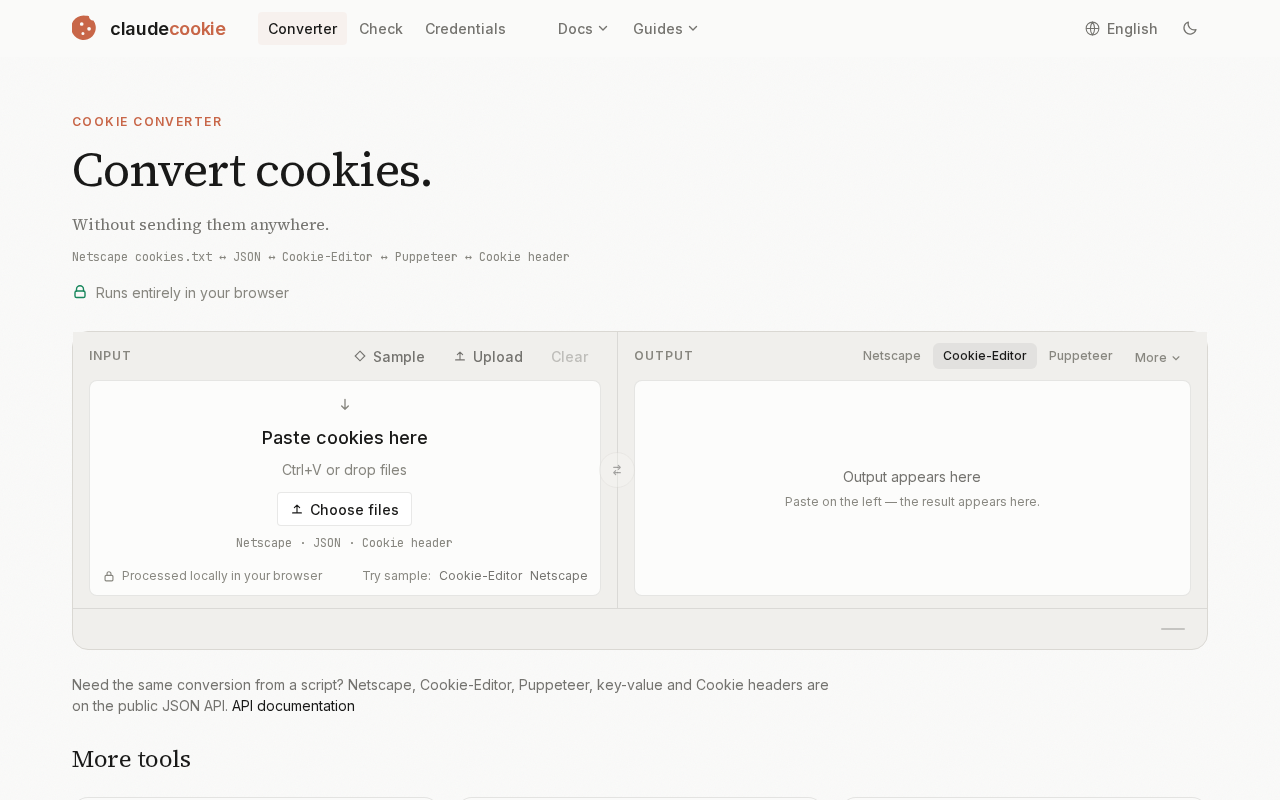
Claudecookie is a developer tool that appeared on Hacker News, designed to convert browser session cookies into Claude Code CLI-compatible credentials, with built-in validity checking and token minting to form a complete extract→validate→mint workflow. Its primary value lies in simplifying credential migration across environments and automating CI/CD or remote server integrations. However, because it handles sensitive identity credentials, it carries risks including credential leakage, potential violations of Anthropic's Terms of Service, and fragility due to authentication mechanism changes. Users should review its source code and network behavior before adoption, and test only in isolated environments.
What Is Claudecookie
Claudecookie is a developer tool that recently appeared on Hacker News, centered around credential management for Claude Code. According to the project's description, it supports three core operations: converting credentials from cookies, checking credential validity, and minting (generating) Claude Code credentials.
For developers who rely on Anthropic's Claude Code in their daily programming workflow, credential management is one of those unglamorous but necessary tasks. While credentials are traditionally handled through official login flows and API key management, Claudecookie offers an alternative approach using browser cookies as the entry point.
It's worth noting that the project currently has minimal traction on Hacker News (just 3 points and 0 comments), and publicly available information is very limited. This article is based on the functional positioning described in its title — for implementation details, you'll need to consult the project's actual documentation.
Breaking Down the Three Core Features
Based on its name alone, Claudecookie's functionality can be broken down into a clear, linear workflow.
Convert
The tool allows users to extract session information from browser cookies and convert it into a credential format compatible with Claude Code. This means developers can reuse an existing browser session without going through the full authentication flow again — a pattern commonly seen in automation scripts and CLI tool integrations.
At a technical level, browser cookies are small text-based credentials issued by a server to maintain session state over stateless HTTP. When a user logs into Claude.ai, the browser stores a cookie containing a session token, which is automatically sent with every subsequent request to verify identity. The "convert from cookie" approach works by reading the browser's local cookie storage (such as Chrome's SQLite Cookies database file) or using a browser extension to export the current session's cookie string, then reformatting the authentication fields into the configuration format expected by the Claude Code CLI (typically written to a local config file or environment variable). This is conceptually similar to how developers use curl's --cookie flag to pass browser session data when debugging APIs.
Check
Credential validation is a critical component of any tool in this category. The Check function is designed to verify whether a converted credential is still valid or has expired, preventing broken workflows caused by stale credentials during actual API calls. For long-running automation tasks, this kind of pre-flight validation can significantly reduce debugging overhead.
Mint
Mint typically refers to generating a new, immediately usable access token from existing credential material. Combined with the previous two steps, the entire flow forms a closed loop: extract from cookie → validate → mint a usable credential, ultimately enabling Claude Code CLI usage.
In the credential management context, "mint" borrows from the cryptocurrency world — it means deriving a new access token with its own independent lifecycle from an existing trusted source (like a session cookie). Such tokens are typically JWTs (JSON Web Tokens) or opaque strings with shorter expiration times and more granular permission scopes. Compared to directly using a long-lived session cookie, this approach better aligns with the principle of least privilege. In OAuth 2.0 terminology, this is similar to "token exchange" — trading one type of credential for another suited to a specific use case. If Claudecookie's Mint step follows this pattern, the generated credential can be used in CLI or automation scripts without exposing the original cookie, somewhat reducing the risk of primary session compromise.
Potential Use Cases and Value
The primary value of tools like this lies in development efficiency and automation integration. When developers need to share Claude Code access across multiple environments — local machines, CI/CD pipelines, remote servers — manually managing credentials is both tedious and error-prone. Cookie-based conversion theoretically simplifies credential migration across environments.
For developers building toolchains around Claude Code, a small utility dedicated to credential conversion and validation can serve as a reusable foundational component, eliminating the need to reinvent this wheel in every project.
Security Considerations Worth Taking Seriously
Extracting and converting authentication credentials from cookies inherently involves handling sensitive identity information — something that demands careful consideration before adopting any tool of this kind.
- Credential leakage risk: Cookies and generated tokens are equivalent to a logged-in session. If leaked, they could lead to account abuse. Before using any third-party credential tool, confirm that it does not upload credentials to external servers.
- Compliance concerns: Whether extracting and using session credentials through unofficial means complies with Anthropic's Terms of Service is something users must assess on their own. Bypassing official authentication flows may constitute a violation of usage agreements.
- Maintainability: Tools that depend on specific cookie structures are vulnerable to breaking whenever the server-side authentication mechanism changes, making long-term stability questionable.
Before adopting tools like this, it's advisable to thoroughly review the source code (if open source), and to test in an isolated environment first — avoid using your primary account credentials directly.
From an OS-level perspective, modern browsers protect local cookie databases with encryption (e.g., Chrome uses Keychain encryption on macOS and DPAPI on Windows), so direct access typically requires user authorization or a process running under the same user identity. This means Claudecookie reading cookies locally is not equivalent to a remote attack — but it also means any malicious process running with the same privileges could theoretically do the same thing. More importantly, supply chain security deserves attention: third-party tools installed via package managers like npm or pip can silently read and exfiltrate cookies during installation or runtime, and real-world examples of this attack vector have been documented. Before using Claudecookie, auditing its network request behavior (using tools like mitmproxy or system firewall rules) is just as important as reviewing its source code.
Summary
Claudecookie represents a category of practical utility tools emerging within the Claude Code ecosystem — addressing the specific pain point of credential management with an integrated convert-validate-mint workflow. It offers real value for developers looking to automate Claude Code integrations.
That said, given the limited public information, sparse community discussion, and sensitive nature of credential handling involved, readers should exercise caution before adopting it in practice — thoroughly evaluating both its security posture and compliance implications. As the Claude Code user base grows, the surrounding tooling ecosystem is likely to continue evolving, making this a space worth watching.
Related articles

Is the Agent Harness Dead? Cursor's Early Engineer Breaks Down the Real Architecture of AI Coding Agents
Cursor early engineer Jediah breaks down the real architecture of the agent harness: why "the harness is dead" is only half right, how the data flywheel lets the harness obsolete itself, and how Grokbot, software factories, and primitive design open new frontiers for agents.

Python Visitor Pattern and Better Alternatives Explained
A deep dive into Python's visitor pattern and four alternatives: method pattern, pattern matching, dictionary mapping, and functools.singledispatch. Choose the best decoupling design by change frequency.

357 Days of Deep Experience: Why Omarchy Made Me Stop Distro-Hopping
A 357-day deep dive into Omarchy: 59-second install, out-of-the-box audio and GPU support, the Quattro QuickShell rewrite migration pains, and why Arch users should try it.