ClaudeMem: Persistent Memory for AI Coding Assistants, Say Goodbye to Repeating the Same Mistakes

ClaudeMem uses a parallel second assistant to record and compress coding sessions, giving AI coding assistants persistent memory.
ClaudeMem is an open-source project that solves the problem of AI coding assistants starting "from scratch" each session and repeating mistakes. It launches a parallel "second assistant" to record the coding process in the background and uses AI to compress notes into concise memory fragments stored locally. The next session first provides a brief index and expands details on demand, balancing memory availability with response speed. The accompanying MemSearch skill offers three-layer retrieval—index, timeline, and details—to quickly locate project history. It is compatible with over 14 agents including Claude Code, Codex, Cursor, and OpenCode. Memory is stored locally by default, with optional cloud sync, but analytics is enabled by default and the hosted trial requires a credit card.
Why Does Your AI Coding Assistant Keep Repeating Yesterday's Mistakes?
If you frequently use AI coding assistants like Claude Code or Cursor, you may have encountered this situation: a bug you just fixed yesterday gets written back verbatim by the assistant today; an architectural decision discussed last week seems like it never heard of it this week. The root cause is that these assistants have no persistent memory—every session starts "from scratch."
An open-source project called ClaudeMem attempts to solve this pain point. According to a YouTube video, the project has gained over 118,000 stars on GitHub. It uses a "second assistant" to record your coding process in the background and compresses memories with AI, so the next session can quickly recover key context.

How ClaudeMem Works: A "Silent Auditor"-Style Memory System
ClaudeMem's core idea is clever: it doesn't directly modify the coding assistant you're using. Instead, it launches a parallel "second assistant" that quietly takes notes while you work. These notes are then compressed by AI into concise memory fragments stored locally.
When you start your next session, the system first provides a brief index, and only expands specific details when needed. This "on-demand retrieval" design ensures memory availability while avoiding loading too much information at once and slowing down response times.
According to the video, all memory data is stored on your machine by default. CloudSync is an optional feature that users must actively enable.
AI memory compression refers to using large language models to summarize and distill long texts such as raw conversation records and code changes into short, concise "memory fragments." Unlike simple truncation or keyword extraction, the compression process preserves semantic structure and causal relationships—for example, condensing a debugging session into "fixed a null pointer exception in function X under condition Y." This greatly reduces storage and loading overhead while allowing the next session to quickly understand the context of historical decisions. Compression quality directly determines memory usability—too aggressive loses key details, while too conservative defeats the purpose of lightweighting.
The MemSearch Skill: Three Steps to Mine Project History
ClaudeMem comes with a skill called MemSearch, which uses three steps to help you extract information from project history: Index, Timeline, and Details.
Simply put, first build a global index, then sort events chronologically, and finally drill into specific details. This hierarchical retrieval approach lets developers quickly locate the context of a particular fix or decision without having to sift through large amounts of raw records.

Hierarchical retrieval is a search strategy that unfolds layer by layer according to information granularity. In ClaudeMem, it manifests as first returning a global index (like a table of contents), then, after the user or assistant confirms relevance, pulling the timeline, and finally loading specific details. This approach draws on the "coarse ranking + fine ranking" idea in RAG (Retrieval-Augmented Generation) but places more emphasis on the time dimension. Its advantages are: each session only needs to load a small amount of highly relevant memory, avoiding injecting too much context at once, which would waste tokens and delay responses; meanwhile, the layer-by-layer confirmation process also makes retrieval results more controllable and explainable.
Compatibility: More Than Just Claude Code
Although it's called ClaudeMem, its scope goes far beyond Claude Code. According to the video, it supports ClaudeCode, Codex, Cursor, OpenCode, and more than 11 other AI coding agents. This means that no matter which tool you prefer, you can try integrating this memory system.
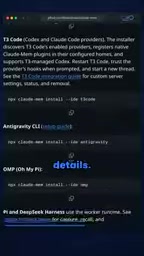
AI coding agent refers to an intelligent agent capable of understanding natural language instructions, autonomously planning, and executing coding tasks. Typical examples include Claude Code, Cursor, and Codex. They usually have the ability to read and write files, run commands, and call tools, but most products do not retain cross-session memory by default. ClaudeMem works in a "bypass" manner—it does not rely on a specific agent's internal interfaces but instead records the process by monitoring workspace activity or standard input/output, thus being compatible with multiple agents. This design lowers integration costs, but it also means that the completeness and real-time nature of memory are limited by the observable scope exposed by each agent.
A Few Details to Note
Before trying it out, there are a few points worth noting. First, analytics is enabled by default. If you're sensitive about privacy, you may need to manually disable it. Second, the hosted observer trial requires binding a credit card. If you don't want to pay, you can use only the local version.

These details are explicitly mentioned in the video, and developers can choose how to use it according to their needs.
Will Persistent Memory Become Standard for AI Coding Assistants?
ClaudeMem's popularity reflects a real need: AI coding assistants are becoming increasingly capable, but the "amnesia" problem seriously affects the collaborative experience. Through local storage, AI compression, and hierarchical retrieval, ClaudeMem offers a lightweight solution.
However, such tools also face challenges—memory accuracy, retrieval efficiency, and privacy boundaries all need continuous refinement. For developers plagued by "repeated bugs," ClaudeMem is worth a try.
Related articles

Prompt Engineering for Beginners: From Writing Prompts to Engineering Thinking
Starting from the essence and four functions of prompts, this article systematically explains the six-step process, four success criteria, learning value, and practical limitations of prompt engineering to help you build a complete understanding.

Anthropic Launches Nasdaq IPO: AI Giant's Listing and Risk Disclosures
Anthropic officially launches its Nasdaq IPO under ticker ANT, with market valuation expected to potentially exceed SpaceX's record. The prospectus devotes nearly 100 pages to AI risks, while first-half revenue grew over 14x but net losses widened sharply, reigniting the AI bubble debate.

Rust cURL Clone Uses 4,832 unsafe Blocks—Is the Memory Safety Myth Broken?
A Rust cURL clone uses 4,832 unsafe keywords, challenging Rust's memory safety narrative. We analyze what unsafe really means, compare Fil-C, and examine rewrite motives.