ClawdTime: The Long-Task CUA Agent That FaceTimes You When It Gets Stuck
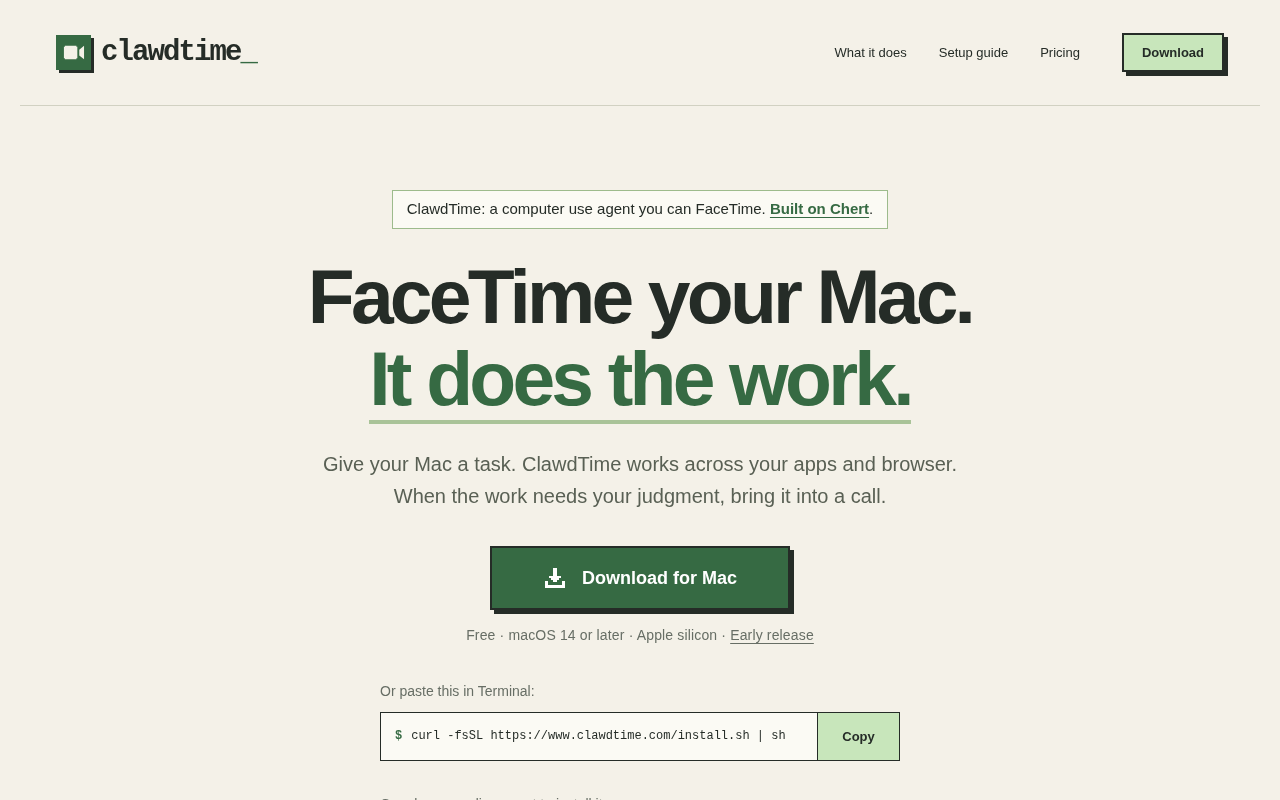
ClawdTime lets long-task CUA Agents call users via FaceTime for help when they get stuck.
This article introduces ClawdTime, a project on Hacker News Show HN—a CUA (Computer-Using Agent) tool for long tasks. Its core differentiator: when the Agent gets stuck during execution, it proactively calls the user via FaceTime so they can see the screen state in real time and give instructions, rather than relying on timeouts, retries, or after-the-fact logs. The article argues this design hits the pain point of silent failures in long-task Agents, representing a human-in-the-loop upgrade that turns humans from reviewers into runtime collaborators. It also notes the key challenge is the detection strategy for "when something counts as stuck," and that given limited information in the original post, technical details and usability remain to be verified.
An interesting product idea is emerging in the AI Agent space: rather than letting an Agent fail silently during long tasks, have it proactively "call" a human for help when it gets stuck. A Show HN project on Hacker News called ClawdTime is built around exactly this concept as a CUA (Computer-Using Agent) tool.
What Is ClawdTime
According to the Show HN post on Hacker News, ClawdTime positions itself as a "CUA Agent for long tasks," and its most distinctive feature is that when the Agent hits a blocker during execution and can't make progress, it proactively calls the user via FaceTime.
This framing hits a real pain point in today's Agent products. Long tasks often span multiple steps and multiple application interfaces, and any unexpected state at any step can send the Agent into a loop or a stall. The traditional approach is to set timeouts, retries, or failure alerts, but users typically can only review logs after the fact—missing the best window for intervention. ClawdTime turns "asking for help" into a real-time call, letting a human see the screen state on the spot, understand the blocker, and give instructions, which in theory can significantly shorten blockage time.
CUA (Computer-Using Agent) refers to AI agents capable of operating computer graphical interfaces the way humans do. Unlike Agents that mainly process text or call APIs, CUAs complete tasks by visually recognizing screen content and simulating mouse clicks and keyboard input, allowing them to work across applications and windows without relying on the target software to provide a programming interface. Notable explorations in this category include OpenAI's Operator and Anthropic's Computer Use. The strength of CUA is its generality, but the challenges are obvious too: interface states are volatile, element localization is error-prone, and errors accumulate gradually over long workflows—so the demands on robustness and exception-handling mechanisms are far higher than for task automation in closed environments.
Why "Calling for Help" Deserves Attention
The capability boundary of CUA (Computer-Using Agent) products depends largely on how they handle uncertainty. Getting them to autonomously execute simple, deterministic tasks isn't hard; what's hard is maintaining robustness across open interfaces and long, state-volatile workflows.
ClawdTime's approach treats humans as part of the Agent's runtime rather than after-the-fact reviewers. This aligns with the current "human-in-the-loop" trend in Agent design, but the interaction medium is upgraded from pop-ups and approval queues to real-time audio/video calls, making intervention far more immediate. For tasks that require cross-application operation, take a long time, and have unpredictable intermediate states, this model could reduce overall failure rates and manual rework costs.
Of course, this design also raises new questions: when exactly does something count as "stuck"? Too many false positives will annoy users with meaningless calls, while too many false negatives render the mechanism useless. The strategy and thresholds for detecting blockers will directly determine whether this product is actually usable.
Human-in-the-loop (HITL) is a common paradigm in human-computer collaboration and AI system design, referring to retaining human participation points in automated workflows where people review, correct, or make final decisions. In Agent scenarios, HITL typically manifests as plan confirmation before execution, approval pop-ups at key steps, or failure alert notifications. Traditional HITL intervention is often asynchronous—by the time users see a notification, the Agent may have been stalled for a long time or gone in the wrong direction. ClawdTime changes the intervention channel to a real-time call, essentially moving HITL from "after-the-fact review" forward to "runtime collaboration," shortening the latency from blocker to human intervention. This is also the core dimension for evaluating the value of such designs.
Stuck detection is a class of runtime monitoring problems in long-task Agents: the system needs to infer from behavioral signals whether the Agent can no longer make progress on its own. Common signals include multiple consecutive operations with no state change, repeated identical clicks or inputs, a page remaining on the same interface beyond a threshold, or an obvious mismatch between the task goal and current screen content. Detection that is too sensitive leads to frequent false positives, while detection that is too lax lets the Agent spin idly for long periods. More mature approaches combine rule-based thresholds with model self-assessment (having the Agent proactively report low confidence) and set up escalation strategies. The design quality of this component often determines user experience more than the help channel itself.
Information Is Limited at This Stage—Keep Expectations Realistic
It's worth noting that the public information in this Show HN post is very limited: only 4 points and 5 comments, and the original text does not disclose the technical architecture, supported platform scope, pricing model, or performance data. Therefore, it's currently impossible to judge its actual usability and maturity.
For developers following Agent products, ClawdTime is more worth observing as an inspiration in interaction design: making the human's real-time intervention channel more "human-like" may be a pragmatic direction for improving the reliability of long-task Agents. Whether it can evolve from an early Show HN demo into a stable, usable product will require more real-world usage feedback to verify.
FAQ
Which platforms does ClawdTime support?
The original material does not disclose the specific operating systems or application scope supported, so this cannot be confirmed at present.
How is the FaceTime help request triggered?
The post only states that the Agent initiates a FaceTime call when it gets stuck; the specific detection logic and trigger conditions are not public.
What types of tasks is it suited for?
Judging from its positioning as a "long-task CUA Agent," it primarily targets computer operation tasks with many steps, long duration, and volatile intermediate states, but there is no empirical data to support this.
One-line Summary
ClawdTime lets long-task CUA Agents call users via FaceTime for help when they get stuck.
Paragraph Summary
This article introduces ClawdTime, a project on Hacker News Show HN—a CUA (Computer-Using Agent) tool for long tasks. Its core differentiator: when the Agent gets stuck during execution and can't make progress, it proactively calls the user via FaceTime so they can see the screen state in real time and give instructions, rather than relying on timeouts, retries, or after-the-fact logs as traditional approaches do. The article argues this design hits the pain point of silent failures in long-task Agents, representing a human-in-the-loop interaction upgrade that turns humans from reviewers into runtime collaborators. It also points out that the key difficulty lies in the detection strategy for "when something counts as stuck," where both false positives and false negatives affect the experience. Given the limited information in the original post, technical details and usability remain to be verified.
Related articles

Iran Reportedly Used Starlink to Attack US Military Bases: The Double-Edged Sword of Tech Geopolitics
Iran allegedly used Starlink to help strike US bases in the Middle East, prompting SpaceX to enforce strict identity verification. An analysis of commercial satellite militarization risks and industry impact.

llama.cpp AMD Patch Tested: Generation Speed Jumps from 35 to 55 tokens/s
The llama.cpp RDNA Boost patch optimizes AMD GPUs: the author measured token generation rising from 35 to 55 tokens/s and prompt reading from 700 to 1300, without altering the model's expert selection logic.

Indian AI Coding Platform Rocket Shuts Down: Investor Withdrawal Deals the Final Blow
Indian AI coding platform Rocket shuts down after investors canceled a planned funding round, leaving only months of runway despite backing from Accel and Salesforce Ventures.