Clears Deep Dive: From AI Coding to an Agentic Platform for Autonomous Software Delivery
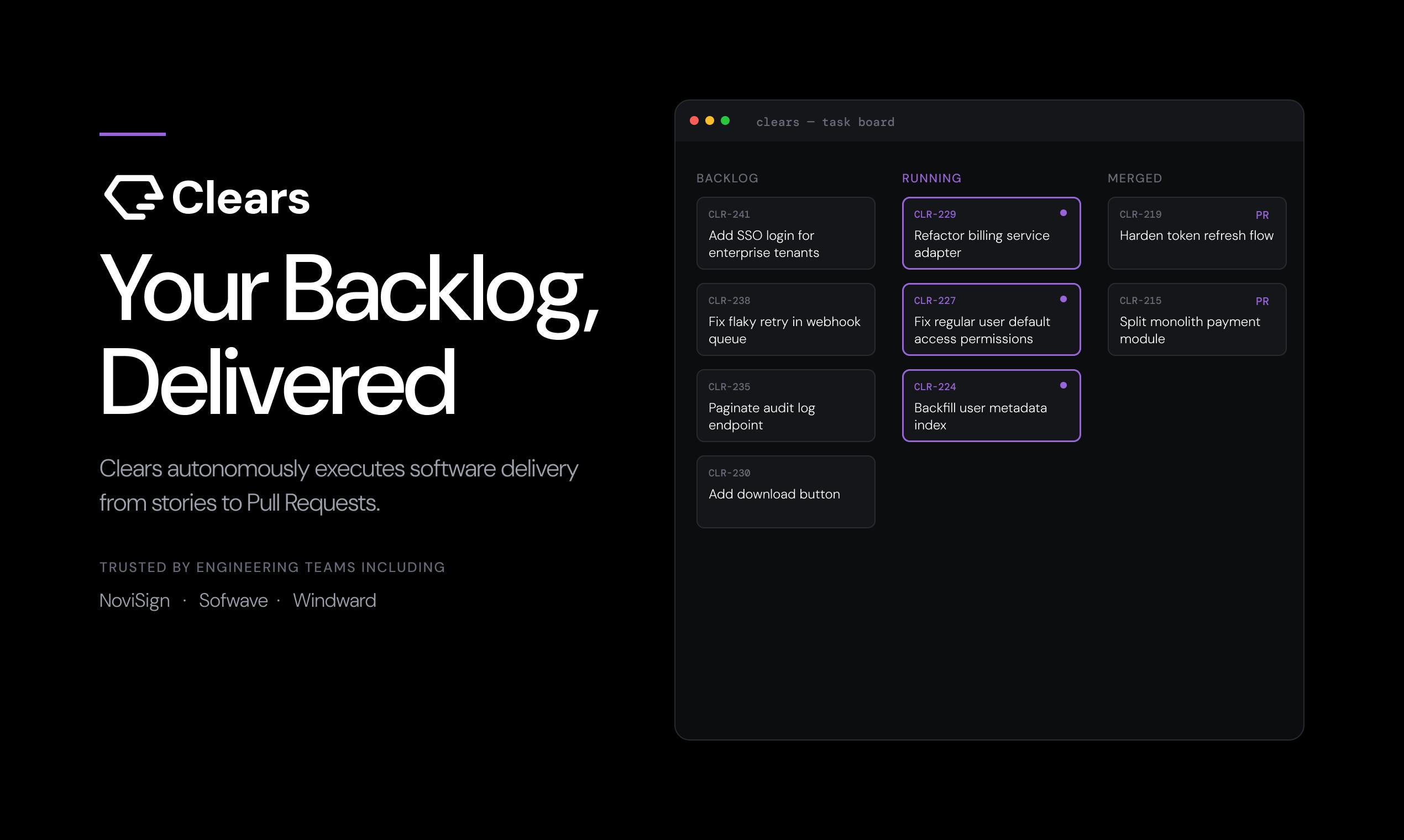
Clears aims to evolve AI from code generation to autonomous end-to-end software delivery across the full SDLC.
Clears is a new agentic execution platform targeting R&D organizations, positioning itself beyond traditional AI coding tools to cover the entire Software Development Life Cycle. By leveraging agentic workflows — including planning, tool use, reflection, and multi-agent collaboration — it aims to autonomously handle requirements decomposition, coding, testing, and deployment. While the vision is compelling, enterprise adoption faces significant challenges around reliability, trust and governance, and organizational transformation.
The Paradigm Shift from "AI Coding" to "Agentic Delivery"
Over the past two years, the explosion of AI coding tools has dramatically transformed how developers work. From Copilot-style code completion to AI Agents capable of autonomously building entire functions and modules, code generation is no longer the bottleneck.
GitHub Copilot launched in 2021, built on OpenAI's Codex model, delivering "completions" by predicting in real time what a developer would type next in their editor. At its core, this model is an advanced autocomplete tool — the developer retains full control. AI Agents, on the other hand, represent a higher level of autonomy: they don't just generate code snippets but can understand task objectives, formulate execution plans, invoke tools, process intermediate results, and self-correct. Architecturally, Agents are typically built on large language models (LLMs) with additional capability layers stacked on top — Planning, Memory, Tool Use, and Reflection. The emergence of projects like Devin and SWE-Agent marks AI coding's official transition from the "completion" era to the "autonomous execution" era.
Yet the real headache for engineering organizations is this: writing code is only a small part of software delivery.
Clears, which landed at #3 on Product Hunt (157 upvotes, 6 comments), takes direct aim at this much larger pain point. It positions itself as "an agentic execution platform for autonomous software delivery," with a decidedly ambitious tagline: Move beyond AI coding to Agentic Software Delivery.
The Core Problem Clears Addresses: The Fragmentation Crisis in R&D Delivery
According to its Product Hunt page, Clears targets R&D organizations, not individual developers. Its goal is to help teams "move from fragmented individual AI tools to agentic execution across the entire SDLC (Software Development Life Cycle)."
Buried in that sentence is an industry observation worth unpacking:
The "Fragmentation" Problem of Point AI Tools
Today, most teams adopt AI in a "tool-stacking" fashion — developers use one AI for code completion, testers use another to generate test cases, and ops teams plug in yet another set of automation scripts. These tools are siloed, with each stage's AI capabilities unable to pass context upstream or downstream. The result: local efficiency improves, but end-to-end delivery cycles don't meaningfully shorten.
The root cause of this fragmentation is that modern software delivery is inherently a highly complex collaborative process. The SDLC is one of software engineering's most foundational frameworks, dividing the entire journey of software — from concept to retirement — into standardized phases. Classic SDLC models include Waterfall, V-Model, and Spiral, as well as today's dominant Agile and DevOps models. In modern practice, the SDLC typically encompasses: Requirements Gathering & Analysis, System & Architecture Design, Implementation (Coding), Testing & Verification, Deployment & Release, and Operations Monitoring & Feedback (Maintenance/Operations). The DevOps movement further bridges development and operations into CI/CD (Continuous Integration / Continuous Delivery) automated pipelines. Yet even in highly automated DevOps environments, activities like requirements decomposition, code review, and test strategy formulation remain heavily dependent on human judgment — precisely the gap Clears aims to fill with intelligent agents.
From "Assistance" to "Execution": Clears' Key Differentiator
The keyword Clears emphasizes is execution, not assistance. This signals an intent for agents not merely to offer suggestions but to genuinely drive tasks forward autonomously — spanning the full SDLC chain from requirements decomposition, coding, and testing to integration and deployment. This aligns closely with the industry's hotly debated "Agentic Workflow" trend: evolving AI from a passive, responsive assistant into an autonomous executor capable of planning, acting, and self-correcting.
"Agentic Workflow" has been one of the hottest concepts in AI since 2024, championed by scholars like Andrew Ng. The core idea: rather than having an LLM generate a final result in one shot (zero-shot), let AI work through complex tasks via multi-step iterative processes — just like humans do. A typical Agentic Workflow incorporates four design patterns: Reflection (AI reviews and improves its own output), Tool Use (calling external APIs and services), Planning (decomposing complex tasks into subtasks), and Multi-agent Collaboration (Agents with different roles working in concert). In a software engineering context, this means you could design a "Product Manager Agent" for requirements decomposition, a "Developer Agent" for coding, a "QA Agent" for testing, and a "DevOps Agent" for deployment, all coordinating through shared context and message passing. This architecture is precisely the foundation of the vision Clears describes.
Why "Full SDLC Coverage" Is Clears' Core Value Proposition
The SDLC (Software Development Life Cycle) typically includes requirements analysis, design, development, testing, deployment, and maintenance. Clears differentiates itself by refusing to settle for a single stage — it aims to connect the entire pipeline end to end.
The logic is clear: the bottleneck in software delivery is rarely coding itself, but the handoffs and coordination between stages. A single feature going from requirement to production may pass through product, development, testing, and DevOps roles across multiple rounds of back-and-forth. Every handoff is a source of information loss and time drain.
If an agent platform can maintain unified context and objectives throughout the entire lifecycle, it could theoretically compress these handoff costs dramatically, achieving "autonomous software delivery." This is also why Clears categorizes itself under both Developer Tools and Artificial Intelligence.
Measuring engineering effectiveness (Engineering Effectiveness/Productivity) has long been a thorny problem in software engineering. Traditional metrics like lines of code (LOC) and commit counts have been proven to lack correlation with actual output. In recent years, DORA metrics (proposed by Google's DevOps Research and Assessment team) have become the industry standard, comprising four core dimensions: Deployment Frequency, Lead Time for Changes, Change Failure Rate, and Time to Restore Service. Additionally, the SPACE framework (jointly proposed by GitHub, Microsoft Research, and others) offers a more comprehensive measurement perspective across five dimensions: Satisfaction, Performance, Activity, Communication & Collaboration, and Efficiency. For a platform like Clears, value validation requires demonstrating substantive improvement in these metrics — especially Lead Time for Changes, which directly reflects end-to-end delivery speed from requirement to production and serves as the core validation metric for its "full SDLC coverage" claim.
Three Major Challenges for Enterprise Adoption
As a product that just debuted on Product Hunt, Clears paints a vision that undeniably hits an industry nerve. But the leap from "AI coding" to "autonomous software delivery" is far more difficult than code generation alone:
-
Reliability: A single incorrect code snippet is easy to catch, but when an agent autonomously drives the entire delivery pipeline, errors compound at every layer, leaving far less room for tolerance. In multi-step Agentic Workflows, a single misjudgment at an early stage — such as a misunderstood requirement or a flawed architectural decision — propagates down the pipeline, amplified by each subsequent step, potentially causing the entire deliverable to veer off target. This "error cascade" effect is well-understood in traditional software engineering (the famous "the later a defect is found, the more expensive it is to fix" principle) and becomes even more pronounced in autonomously executing agent systems.
-
Trust and Governance: Enterprise R&D environments have stringent requirements around permissions, auditing, and compliance. Allowing agents to "autonomously execute" deployments demands robust human-in-the-loop (HITL) mechanisms. Human-in-the-Loop refers to a design pattern that embeds human review and decision nodes within AI automated processes. In enterprise software delivery, HITL can be implemented in various ways: from basic manual approval gates (such as PR reviews before code merges or manual confirmations before deployments) to more granular confidence-threshold controls (automatically triggering human intervention when an Agent's confidence in a decision drops below a set threshold). In heavily regulated industries (finance, healthcare, government), audit trails are also a critical component of HITL — the system must maintain complete records of the rationale and process behind every automated decision to satisfy regulatory requirements. Finding the optimal balance between "autonomous execution" and "human oversight" is a core design question every Agentic AI platform must answer.
-
Organizational Fit: The real challenge isn't just technical — it's the restructuring of R&D processes. No matter how powerful the tool, if team collaboration models don't evolve, value remains locked up. Historical experience shows that the successful adoption of methodologies like DevOps and Agile is only about 30% tooling — organizational culture and process transformation account for the critical 70%. Introducing a full-SDLC agent platform means teams need to redefine role boundaries: when Agents can autonomously write test cases and handle deployment operations, how will the roles of QA engineers and operations engineers evolve? This organizational-level transformation is often more challenging than the technology implementation itself.
As of now, Clears has not publicly disclosed its specific technical architecture, supported languages/frameworks, or real-world enterprise case studies. The 157 upvotes indicate strong market appetite for this direction, but the product's actual maturity still awaits further validation.
Conclusion: Agentic AI Is Redefining Engineering Effectiveness
The emergence of Clears is a microcosm of the "Agentic AI" wave evolving from individual tools to organization-level platforms. The industry's focus is shifting from "Can AI write code?" to "Can AI deliver software?"
This shift is set against the broader backdrop of the entire AI application layer undergoing a paradigm transition from "Copilot" to "Autopilot." In this process, software engineering — with its highly structured tasks and clear feedback signals (Does the code compile? Do the tests pass? Is the deployment successful?) — stands as one of the vertical domains where Agentic AI is most likely to achieve breakthroughs first. Reports from Gartner, McKinsey, and other institutions project that by 2027, AI will participate in over 80% of software development activities, with an increasing share taking the form of "autonomous execution" rather than "assistive suggestions."
Regardless of whether Clears ultimately delivers on its promises, the direction it represents — letting agents handle end-to-end software delivery — is very likely to be the primary battleground for R&D tooling competition over the next several years. For engineering leaders, now may be exactly the right time to rethink "how AI creates value across the entire SDLC."
Related articles
GLM-OCR: How a 0.9B Parameter Lightweight Model is Disrupting Document Recognition
Deep dive into how GLM-OCR achieves document recognition performance comparable to 3B+ large models with only 0.9B parameters. Covers VLM-based OCR evolution, lightweight deployment advantages, and enterprise applications.
How Cloudflare Saved 100TB of Memory by Optimizing 1.1.1.1 DNS Caching: An Engineering Deep Dive
How Cloudflare optimized 1.1.1.1 DNS cache data structures and memory layout to save 100TB of memory across hundreds of global data centers.
AI Will Eventually Become Invisible: Is Human Craftsmanship the New Luxury?
When AI becomes invisible infrastructure like WiFi, human craftsmanship will become the true luxury. A deep analysis of scarcity economics and tech disenchantment.