CLI v3.0.76 Update: Model Catalog Cleanup and Third-Party Notices File
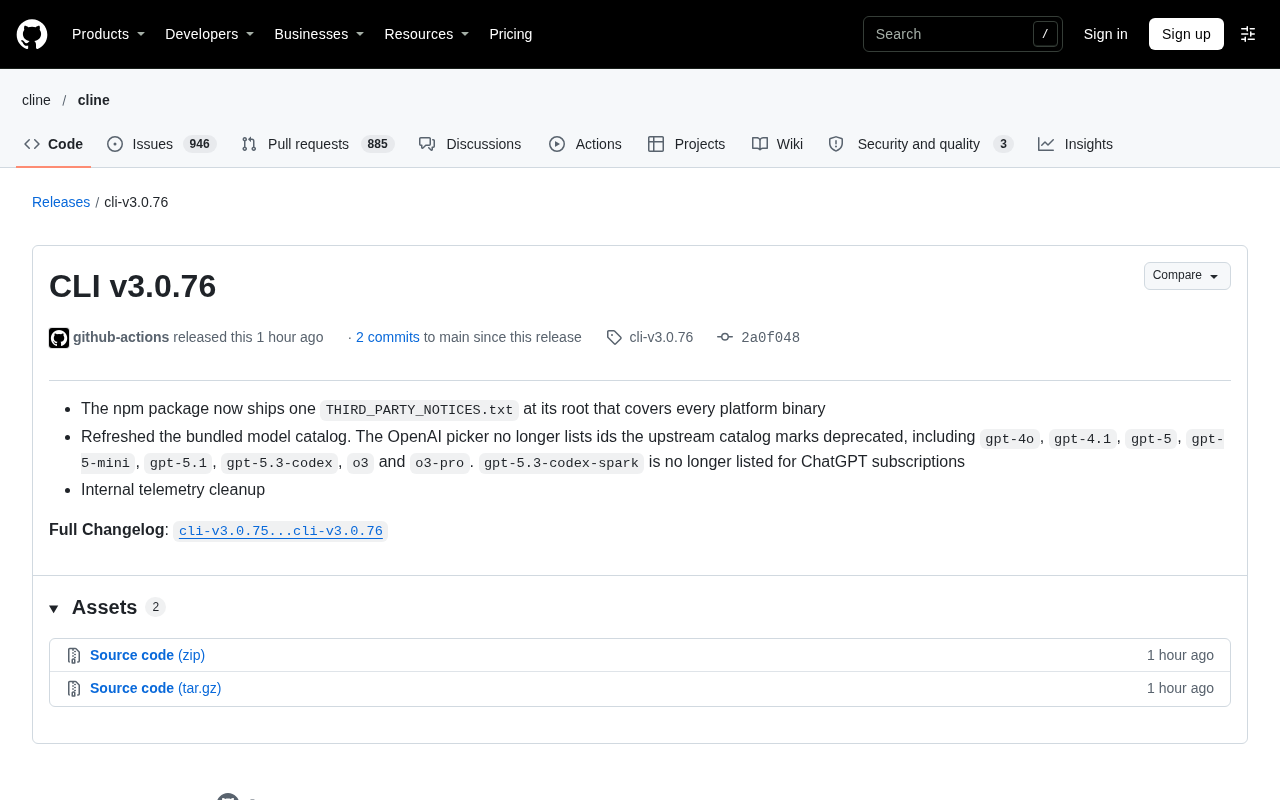
CLI v3.0.76 maintenance update: adds npm compliance files and syncs model catalog to drop deprecated models.
CLI v3.0.76 is a maintenance-and-sync release with no new features, but it fixes two common developer pain points. It adds THIRD_PARTY_NOTICES.txt to the npm package root covering all platform binaries for compliance reviews and license scans, and syncs the built-in model catalog with the upstream API so the OpenAI selector no longer shows deprecated IDs like gpt-4o, the gpt-5 series, and o3, while gpt-5.3-codex-spark is hidden from ChatGPT subscribers.
The CLI tool has released version v3.0.76. This update doesn't bring flashy features, but it addresses two things developers commonly trip over: filling in compliance files for the npm package and syncing the built-in model catalog with the upstream API.
Third-party notices file added to npm package root
The most practical change in v3.0.76 is that the npm package root now includes a THIRD_PARTY_NOTICES.txt covering binaries for all platforms.
Nobody usually reads these files, but when it comes to enterprise compliance reviews, open-source license scans, or legal archiving, their absence stalls the process. As a cross-platform tool, the CLI bundles binaries for multiple platforms. Consolidating third-party license information into a single file means teams taking over the project no longer have to dig through the dependency tree to piece together notices. For individual developers this change is invisible; for teams that need to pass compliance processes, it saves a round of manual verification.
The third-party notices file (THIRD_PARTY_NOTICES.txt) is a common artifact in open-source compliance practice. When software distribution includes third-party open-source components, their licenses (such as MIT, Apache-2.0, BSD) typically require retaining copyright notices and license texts. Aggregating all these notices into one file satisfies the "retain notices" obligation of the licenses and also makes it easier for compliance scanning tools to identify them. For CLI tools that bundle multi-platform binaries, since each binary may statically link different dependency libraries, centralized notices are clearer than scattering them across source code. Enterprise legal or open-source review processes (such as SPDX scanning) usually require such a file; otherwise releases may be blocked or legal risks introduced.
Model selector no longer shows deprecated OpenAI models
This update refreshes the built-in model catalog. The most direct change is that the OpenAI selector no longer lists model IDs marked as deprecated in the upstream catalog.
The cleaned-up list includes:
- gpt-4o, gpt-4.1
- gpt-5, gpt-5-mini, gpt-5.1
- gpt-5.3-codex
- o3, o3-pro
Additionally, gpt-5.3-codex-spark is no longer shown to ChatGPT subscribers.
The significance isn't in deleting a few names. Model deprecation is a routine action by the upstream API, but if the local CLI's model list isn't synced, developers may well select an ID that has already been retired, only to get an error after sending the request—and when troubleshooting, they might suspect network or key issues. Delegating the judgment of "which models are still usable" to the upstream catalog, with the CLI only syncing, reduces this kind of wasted debugging. It's worth noting that this cleanup follows upstream deprecation markers rather than the CLI team deciding on its own which models to retire, so the ultimate authority on model availability remains OpenAI's official catalog.
Impact on day-to-day model selection
If you're used to switching models directly in the CLI, the list will feel shorter after the update—especially in scenarios that relied on the gpt-4o series for default calls. Here it's important to distinguish between "the model itself being retired" and "the CLI no longer listing it": the former is decided by upstream, the latter is just UI syncing. Model IDs hardcoded in scripts or configs won't disappear because of this update, but when choosing models for new projects, it's best to go by the list currently shown in the selector to avoid picking IDs that have entered the deprecation channel.
Model deprecation is a standard practice for API providers managing model lifecycles. When new models are released or usage of old models declines, providers mark models as deprecated and stop serving them after a period. Deprecation markers are usually exposed through the API's model list endpoint, which clients can fetch dynamically. CLI tools embed a model catalog to provide an offline-usable selection list, but it needs periodic syncing with upstream; otherwise it will show invalid model IDs. The sync mechanism is typically implemented by pulling the upstream model list or changelog, ensuring the options users see are all currently available. This design delegates the authoritative source of model availability to upstream, reducing client maintenance burden and stale information.
Internal telemetry cleanup
Another item in the changelog is internal telemetry cleanup, without further details. Such changes are usually not user-facing and are maintenance work with limited direct impact on the experience, so there's no need to read too much into it.
Who this update is for
If you're an individual developer, the most practical benefit of this update is a cleaner model list and fewer pitfalls from deprecated models; if you're on a team that requires compliance reviews, the third-party notices file in the root directory saves a round of manual organization. Overall, v3.0.76 is a release focused on maintenance and syncing. It introduces no new features, but it resolves two long-standing small friction points. The full changes can be viewed via the changelog comparison from cli-v3.0.75...cli-v3.0.76.
One-line Summary
CLI v3.0.76 maintenance update: adds compliance files to the npm package and syncs the model catalog to remove deprecated models.
Paragraph Summary
CLI v3.0.76 is a release focused on maintenance and syncing. It introduces no new features, but resolves two things developers commonly trip over. First, a THIRD_PARTY_NOTICES.txt file is added to the npm package root, covering binaries for all platforms, facilitating enterprise compliance reviews, open-source license scans, and legal archiving. Second, the built-in model catalog is synced with the upstream API: the OpenAI selector no longer shows model IDs marked as deprecated upstream, including gpt-4o, the gpt-5 series, o3, and others, while gpt-5.3-codex-spark is no longer shown to ChatGPT subscribers. This update suits individual developers avoiding deprecated models and teams needing compliance reviews to simplify their processes.
Related articles

Hunter Rescues Educated Youth: The Mountain-Chasing System Launches a New Warm-Hearted Viral Drama Formula
Bilibili's early-access period short drama *Everyone Thinks I'm a Poor Hunter* opens with a snowy-night rescue of an educated youth. Hunter Chen Shan activates the mountain-chasing system, using realistic hypothermia first-aid details and mutual-probing character dynamics to deliver a warm-hearted period drama without the sleaze.

Riemann Hypothesis Proven by AI? The Truth Has Nothing to Do With Your Reality
34-year-old mathematician Levent Alpöge claims to have proven the Riemann Hypothesis and Generalized Riemann Hypothesis with Claude, releasing 17 million lines of formal verification code. This article sorts out the facts, debunks myths about RSA collapse and new material revolutions, and analyzes the true significance of mathematics-AI collaboration.

G3 Test Drive Gone Wrong: Why Is the "Dog Poop Gun" So Hard to Use?
Bilibili creator tests the G3 rifle, from skeleton barrel and 50-round drum to combat failure, calling it a "dog poop gun." Analyzing the gap between mods and real gameplay.