Cline Agents SDK 0.2.0 Released: AI Coding Agent Toolchain Evolves Further

Cline releases @cline/agents 0.2.0; the Agents SDK keeps iterating but release engineering remains rough.
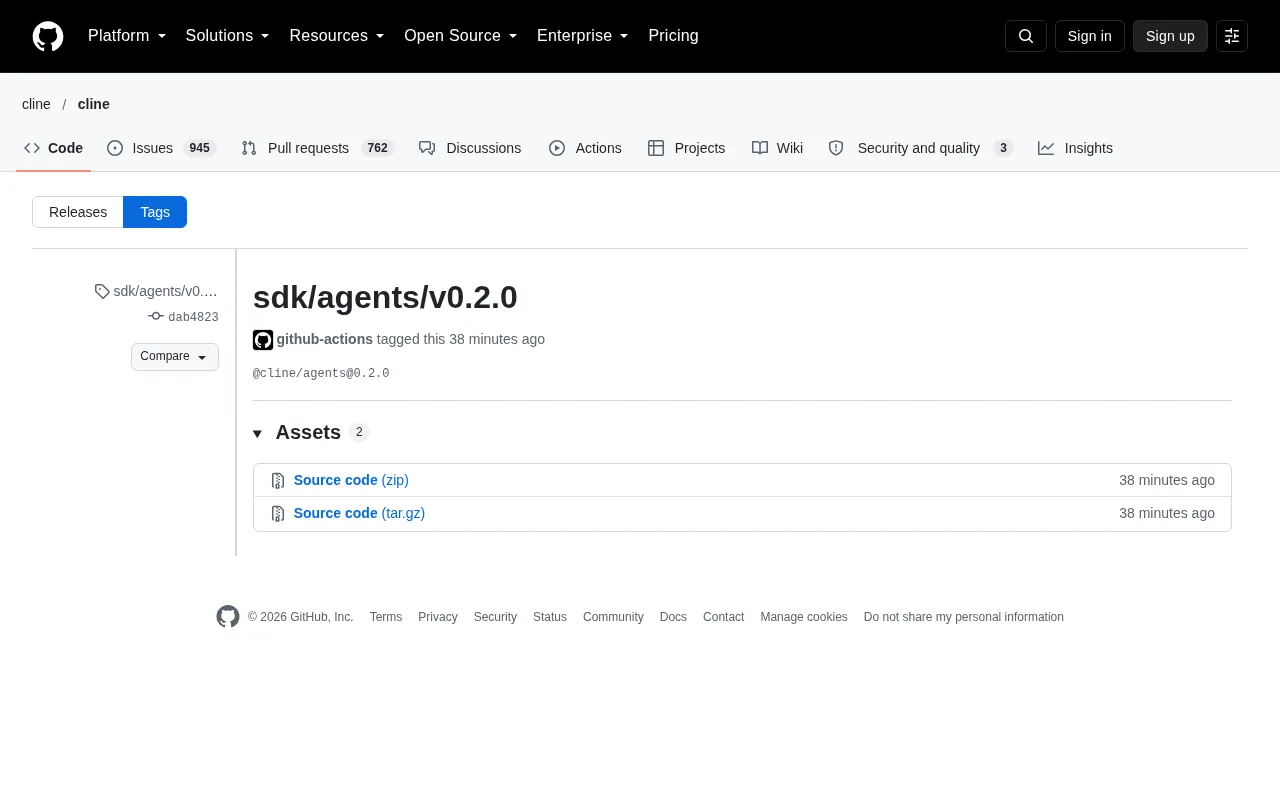
Cline quietly released the @cline/agents npm package 0.2.0, another early iteration of its Agents SDK, corresponding to commit dab4823, auto-tagged by github-actions with 2 build assets. The article reviews Cline's path from a VS Code plugin to abstracting core capabilities into an independent SDK, noting the SDK packages model calls, tool execution, and context management into programmable interfaces for building custom workflows like code review agents and automated refactoring scripts. It also flags concerns: the GitHub Releases page shows loading errors, and changelog auto-generation or rendering has issues, affecting upgrade decisions. The conclusion: 0.2.0 suits teams tolerant of interface fluctuations; production should pin versions and consult the compare view and commit history directly.
AI coding assistant Cline has quietly released version 0.2.0 of the @cline/agents npm package, another iteration of its Agents SDK. Although the version number is small, for developers relying on this SDK to build automated coding workflows, it signifies continued refinement of the underlying toolchain.
From IDE Plugin to Reusable SDK
Cline first entered developers' view as a VS Code plugin, focusing on calling large models directly within the editor to complete code writing, file operations, and terminal command execution. As use cases expanded, the team abstracted core capabilities into an independent Agents SDK, allowing developers to orchestrate agent behavior themselves outside the plugin.
The version cadence of the @cline/agents package reflects this strategy: 0.2.0 is an early iteration, and the interface is still being rapidly adjusted. This release appears on GitHub as a tag, automatically tagged by github-actions, with 2 build assets attached.
The core abstractions of an Agents SDK typically include three layers: the model layer handles integration with different LLM providers and processes streaming responses; the tool layer encapsulates file reading/writing, terminal execution, code retrieval, and other capabilities as functions callable by the model; the orchestration layer manages context, tool-call loops, and error retries across multi-turn conversations. So-called "agent behavior orchestration" essentially means letting developers define in code under what conditions the agent calls which tool, how tool results are fed back to the model, and when the task terminates. Compared with directly calling chat completion APIs, the SDK solidifies these loops and state management, so developers only need to describe tasks and available tools without reimplementing scheduling logic. This is also the technical foundation that enables Cline to reuse capabilities from within the plugin outside of it.
Interpreting the Release Information
From the release record, 0.2.0 corresponds to commit dab4823. The GitHub Releases page provides a comparison entry with the previous version, but an error prompt appears when the page loads, indicating problems in the automatic generation or rendering of release notes.
Such details have limited impact on users, but they expose the roughness of early-stage projects in release engineering. For teams planning to embed the SDK into production workflows, the reliability of changelogs directly affects upgrade decisions.
In the npm ecosystem, 0.x versions are considered "initial development stage" under semantic versioning; any minor version upgrade may contain incompatible breaking changes, unlike the post-1.0 convention where minor versions guarantee backward compatibility. Therefore, the jump from 0.1.x to 0.2.0 theoretically allows changes to interface signatures, export structures, and even package path names. For consumers, this means the actual protection of caret ranges (e.g., ^0.2.0) during the 0.x stage is limited; a safer approach is to pin exact versions and read commit diffs before upgrading. GitHub's auto-generated release notes depend on the discipline of tags and PR labels; if commit messages or labels are missing, the auto-generated changelog may be blank or fail to render.
Practical Implications for Developers
The value of the Agents SDK lies in packaging "model calls + tool execution + context management" into programmable interfaces. Developers can use it to build custom code review agents, automated refactoring scripts, or integrate with internal workflows.
Early versions like 0.2.0 are better suited for teams willing to track upstream changes and tolerate interface fluctuations. For critical business use, it is advisable to pin specific versions and follow commit records rather than relying on auto-generated release notes.
"Context management" is the most underestimated part of agent-type SDKs. In a multi-turn task, the model needs to see historical tool calls and their return values, but keeping everything quickly exhausts the context window and drives up costs. Common strategies include: truncating or summarizing earlier tool outputs, retaining only the most recent few turns of complete messages, and triggering compression when nearing the window limit. If the SDK provides configurable context strategies, developers can balance cost and accuracy in long tasks. In addition, sandbox boundaries for tool execution, timeouts and permission controls for command execution are engineering details that must be confirmed before embedding agents into production workflows; these often affect system stability more than model choice.
Directions Worth Watching
The AI coding agent space where Cline operates is highly competitive; extending from an editor plugin to an SDK is a key step in expanding its ecosystem coverage. If subsequent versions can fill in changelogs and provide stable API contracts, they will be more readily accepted by engineering teams.
Currently public information is limited; the specific changes in 0.2.0 need to be judged in conjunction with the repository's commit history. Developers are advised to check the compare view on GitHub directly for accurate code diffs.
One-line Summary
Cline releases @cline/agents 0.2.0; the Agents SDK continues to iterate but release engineering remains rough.
Paragraph Summary
Cline quietly released the @cline/agents npm package 0.2.0, another early iteration of its Agents SDK, corresponding to commit dab4823, automatically tagged by github-actions with 2 build assets. The article reviews Cline's path from a VS Code plugin to abstracting core capabilities into an independent SDK, noting that the SDK's value lies in packaging model calls, tool execution, and context management into programmable interfaces for building custom workflows such as code review agents and automated refactoring scripts. It also highlights concerns: the GitHub Releases page shows loading errors, and there are problems with auto-generating or rendering the changelog, which affects upgrade decisions relying on that information. The conclusion is that 0.2.0 is better suited for teams that can tolerate interface fluctuations; production environments should pin specific versions and directly consult the compare view and commit history.
Related articles

Last Week Tonight Exposé: The Dangerous Ties Between Politicians and White Supremacy
Last Week Tonight investigates Georgia Senate candidate Mike Collins and Florida candidate Marshall Rawson, exposing their multiple ties to white supremacists and the Republican Party's silent response.
AI Buzz Weekly: GPT-6.5 Leak, New Claude Model, and MiniMax's Cost-Effectiveness
This week's AI buzz roundup: suspected GPT-6.5 leak, Microsoft configs showing GPT-6.1 Tera, Anthropic's new model that can identify entire classes of bugs, disappointing early Gemini 4 Carbon results, and MiniMax M3.1 Flash beating Claude Opus 5 and GPT-5.6 Sol in benchmarks at extremely low cost.

AI Briefing: Gemini 4 Carbon Released, Ant Open-Sources Ling-3.1
AI Briefing: Google releases Gemini 4 Carbon qubit model, claiming to surpass Opus 5.5 with half-price tokens; Ant open-sources Ling-3.1-1019 for real-task Personal Agents; domestic AI drug discovery succeeds in 18 of 19 projects, hitting all 6 GPCR targets; zero-revenue company valued at $20B raises another $1B; Sichuan convenience store robot sales fail.