Cline Agents SDK v0.0.93 Release Overview

Cline Agents SDK releases v0.0.93, automatically published by GitHub Actions; developers advised to focus on commit diffs.
Cline's Agents SDK has released version v0.0.93, package name `@cline/[email protected]`, commit hash `1a5c3f8`. The release was automatically completed by github-actions, with 2 build assets, but no detailed release notes. The 0.0.x versioning strategy indicates the SDK is still in early rapid iteration, API may be unstable, and each minor version may introduce breaking changes. The article advises developers not to blindly upgrade by version number, but to judge actual changes through the corresponding commit diff, and provides strategies such as locking versions, focusing on commits, and subscribing to release notifications.
A Low-Key Version Iteration
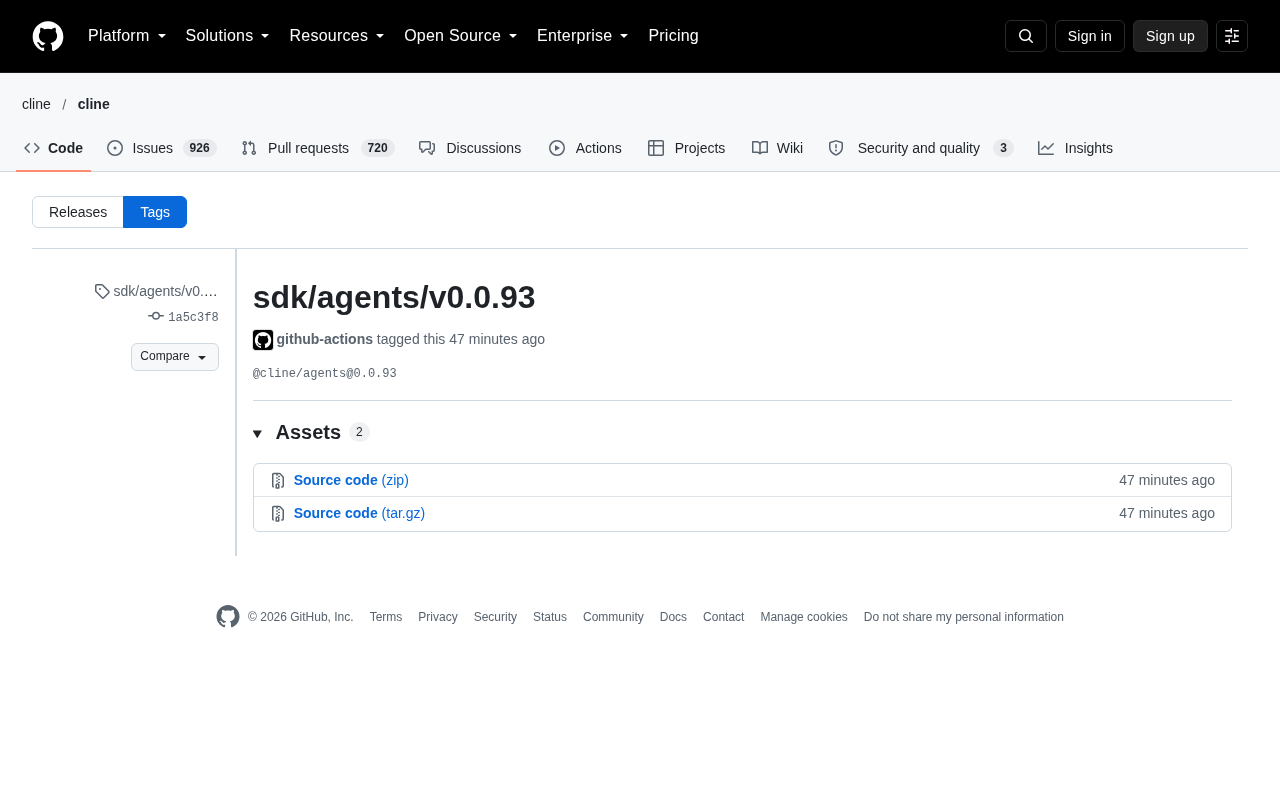
Cline's Agents SDK has released version v0.0.93, corresponding to the package name @cline/[email protected], with commit hash 1a5c3f8. This release was automatically completed by github-actions, timestamped 13 Oct 08:26, and includes 2 build assets.
From the release process perspective, this is a standard automated tag release, without detailed release notes or changelog descriptions. For developers following the Cline Agents SDK, the version number advancement itself is a signal: the project is continuously iterating.
What the Version Number Tells Us
@cline/agents uses a 0.0.x versioning strategy, indicating that the SDK is still in an early, rapid iteration phase. In semantic versioning, a major version number of 0 means the API is not yet stable, and every minor version may introduce breaking changes.
v0.0.93 itself is also worth noting—from 0.0.1 to 0.0.93, the project has undergone a large number of iterative releases. Each increment in version number typically corresponds to bug fixes, feature patches, or build process adjustments.
For teams already using this SDK in production, it is recommended to check the actual diff content before upgrading (which can be located in the repository via the commit 1a5c3f8), rather than blindly following version number upgrades.
Semantic Versioning (SemVer) is the most widely adopted versioning convention in software releases today, with the format MAJOR.MINOR.PATCH. The major version number (MAJOR) is incremented for breaking changes; the minor version number (MINOR) is incremented for backward-compatible new features; the patch number (PATCH) is incremented for backward-compatible bug fixes. The specification particularly notes: when the major version is 0 (i.e., 0.y.z), the project is considered to be in initial development, the public API is not considered stable, and any release may include breaking changes. Therefore, for 0.0.x versions like @cline/agents, even if the patch number increments, one cannot assume it is a safe small fix—users must read the actual code changes to judge the impact.
Maturity of the Automated Release Process
This release was automatically tagged and published by the github-actions bot, which is a standard practice in modern open-source projects. The benefits of automation are obvious:
- Consistency: Each release follows the same build and packaging process, reducing human error
- Traceability: Each version corresponds to a clear commit hash, making it easy to trace issues
- Efficiency: Developers only need to merge code, and the release process is triggered automatically
The presence of 2 build assets indicates that the SDK provides at least two distribution formats (possibly different module formats or build artifacts for different platforms), which benefits integration flexibility for users.
GitHub Actions release automation is typically defined through workflow files in the repository (e.g., .github/workflows/release.yml). A common approach is: when code is merged into the main branch or a tag is triggered, CI automatically performs build, packaging, generates the npm package, creates a GitHub Release, and uploads build assets. The bot account performing these tasks appears as github-actions.
Since such processes are entirely configuration-driven, release descriptions are often templated or even empty—this is exactly why the "no detailed release notes" situation mentioned in this article occurs. To learn the actual changes, one can only look back at the commit that triggered this release (in this case, 1a5c3f8) and its diff, rather than relying on the release page.
How to Keep Up with Such High-Frequency Releases
Facing the high-frequency release pace of the 0.0.x series, developers can adopt the following strategies:
Lock versions: Use exact version numbers in package.json instead of ^ or ~ to avoid unexpected issues introduced by automatic upgrades.
Focus on commits rather than tags: When release page information is limited, directly viewing the corresponding commit diff provides the most accurate change content.
Subscribe to release notifications: Use GitHub's watch feature to subscribe to releases only, receiving notifications as soon as a version is released.
Versions from such automated releases often do not include detailed change descriptions, and the actual impact needs to be judged in conjunction with code diffs. For users of the Cline Agents SDK, staying attentive to the upstream repository is more reliable than relying on release notes.
Version range symbols in package.json determine the extent of automatic upgrades allowed during npm installation: ^0.0.93 only matches 0.0.93 itself (because npm has special handling for caret when the major version is 0), ~0.0.93 similarly only allows the patch number to remain unchanged; while 0.0.x notation allows any patch number. In practice, locking to an exact version (removing any prefix symbols) is a sound approach for keeping up with high-frequency iterations. If an update is needed, you can manually modify the version number and run npm install to verify, or use tools like npm-check-updates to review upgradeable items.
About the Cline Agents SDK
Cline is an AI programming assistant project active in the developer community, and its Agents SDK aims to provide developers with the foundational capabilities to build AI agent applications. The SDK being in the 0.0.x phase means the interface design is still evolving; early adopters need to be prepared to follow changes, while also being the first to use new capabilities.
Currently, the specific change details of this version need to be confirmed by checking the code diff corresponding to 1a5c3f8 in the repository. For such releases with limited information, developers are advised to directly visit the GitHub repository for the most accurate information.
One-line Summary
Cline Agents SDK released v0.0.93, automatically published by GitHub Actions; developers are advised to focus on commit diffs.
Paragraph Summary
Cline's Agents SDK has released version v0.0.93, with package name @cline/[email protected], corresponding to commit hash 1a5c3f8. This release was automatically completed by github-actions, with 2 build assets, but no detailed release notes were provided. The 0.0.x versioning strategy indicates that the SDK is still in an early rapid iteration phase, the API may be unstable, and each minor version may introduce breaking changes. The article advises developers not to blindly upgrade following version numbers, but to judge actual changes through the corresponding commit diff, and provides strategies such as locking versions, focusing on commits, and subscribing to release notifications.
Related articles

How Big Can Stars Really Get? The Physical Limits of the Largest Stars
Red supergiants are the largest stars by volume, with radii up to 2,000 times the Sun, engulfing the inner solar system. But there is no precise upper limit on stellar size—models predict up to 15,000 solar radii. The most massive blue stars are far smaller than red supergiants—biggest and heaviest are two different things.

Apple HomeView Smart Display Full Feature Breakdown: Wall-Mount or Desktop, $299
Apple launches HomeView, a $299 smart display with wall-mount and desktop options, 12MP camera for facial recognition, smart home control, music playback, and recipe step-by-step cooking. Full breakdown of watch faces, apps, privacy, and cooking integration.

Where Did the Promised New Studio Go? Craft Computing Answers After Five Years
Craft Computing's host responds to viewer questions: the new studio promised five years ago was shelved as construction costs soared from $30,000 to $75,000, and was replaced by a 168-square-foot garage conversion.