Cline Core SDK Releases v0.0.94 Update

Cline Core SDK releases v0.0.94, auto-built without changelog, an early iterative version.
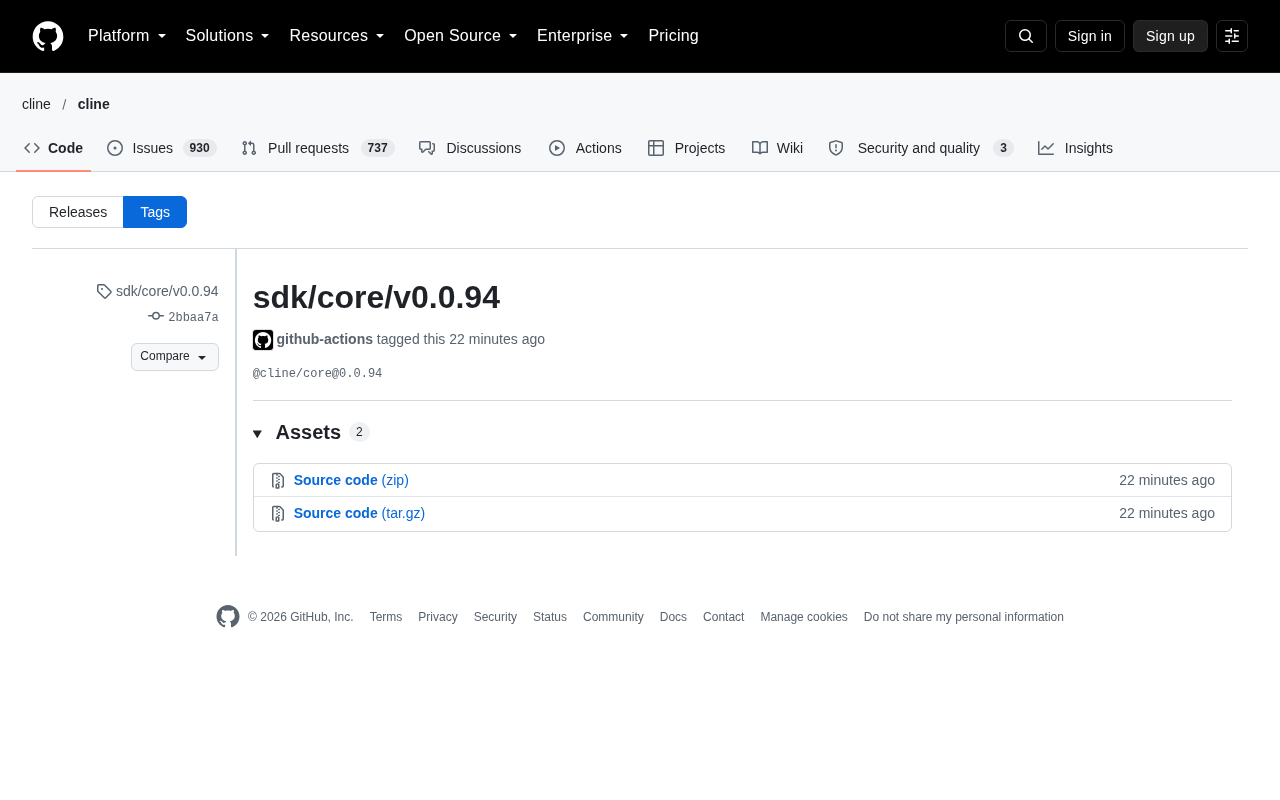
Cline Core SDK `@cline/core@0.0.94` was automatically built and tagged by GitHub Actions, associated with commit `2bbaa7a`. This update belongs to the SDK layer rather than the end-user-facing plugin version. The release page lacks detailed changelog, requiring commit diff to understand specific changes. The version number `0.0.94` indicates the SDK is still in an early rapid iteration phase with potentially unstable APIs. Plugin developers are advised to lock versions and directly track repository commit history to address compatibility risks.
The core SDK of AI coding assistant Cline has received a v0.0.94 update. This release, versioned as @cline/core@0.0.94, was automatically built and tagged by GitHub Actions, marking Cline's continued iteration on its toolchain infrastructure.
Release Overview
According to the release record, the sdk/core/v0.0.94 tag was automatically applied by the github-actions bot on the 16th, with the associated commit hash 2bbaa7a. The release page provides 2 asset files for download.
This update belongs to the core SDK layer of the Cline project, rather than the end-user-facing IDE plugin or CLI tool. For most Cline users, such SDK updates typically surface in subsequent plugin versions.
GitHub Actions automated tagging refers to the process of using GitHub's continuous integration/continuous delivery (CI/CD) services to automatically increment version numbers, create Git tags, and generate release pages when code merges or release workflows are triggered. In such workflows, operations are typically performed by bot accounts like github-actions[bot], which is why the author in the release record shows as a bot.
Commit hash (such as 2bbaa7a mentioned in this article) is a unique identifier generated by Git for each code commit, usually in abbreviated form of a 40-character hexadecimal string. Through this hash, developers can precisely locate a specific commit in the repository to view its diff (changes), commit message, and associated issues or pull requests. In the absence of release notes, the commit diff is the primary source for understanding the specific changes in a version.
Why Core SDK Updates Are Worth Watching
As an active open-source AI coding assistant, Cline's architecture is divided into multiple layers: the core SDK handles low-level capability encapsulation, while the upper layer consists of plugins that connect to editors like VS Code. Iterations of the core SDK often signify optimizations of underlying capabilities or the introduction of new interfaces.
Monitoring version changes of @cline/core has practical significance for the following scenarios:
- Plugin developers: If you need to build custom tools or integration solutions based on the Cline SDK, API changes directly affect compatibility
- Users tracking project evolution: The SDK release cadence reflects the project's development activity
- Enterprise users: When evaluating whether to adopt Cline into team toolchains, the stability of the underlying SDK is an important reference
SDK (Software Development Kit) is a set of developer-oriented tools, typically including API wrappers, helper functions, type definitions, and sample code, used to help developers build applications based on a platform or service more efficiently. In Cline's architecture, the core SDK abstracts the AI coding assistant's underlying capabilities (such as model invocation, conversation management, and tool execution) into reusable interfaces, while the upper-layer VS Code plugin is responsible for presenting these capabilities to end users. Therefore, SDK version changes propagate downstream to plugins and third-party integrations, making it a key node for evaluating ecosystem compatibility.
Information Limitations of This Release
It should be candidly noted that the release page for v0.0.94 does not include a detailed changelog or release notes. The release record only contains the version tag, associated commit, and build artifact information, without specifying which features were changed or which issues were fixed.
This situation is not uncommon in automated release workflows—when a project uses changesets or similar version management tools, patch releases sometimes do not generate detailed release notes. To understand the specific changes in v0.0.94, one needs to directly examine the diff record of the commit 2bbaa7a.
Changesets is a popular version management and changelog generation tool, commonly used in monorepo (single repository, multiple packages) projects. Developers can attach a changeset file when committing code, specifying the type of change (patch/minor/major) and description; during release, the tool automatically calculates version numbers, updates the CHANGELOG, and creates releases based on these files. For patch-level updates, if the changeset description is too brief or not included in the release process, the Release page may only show the version number and build artifacts, lacking user-facing detailed explanations.
Interpreting the Version Numbering Scheme
Judging from the 0.0.94 version number, Cline's core SDK is still in an early development stage. A 0.0.x version number typically means:
- The API is not yet stable and may have breaking changes
- The project is in a rapid iteration phase with high release frequency
- Production use requires careful evaluation
However, considering that the overall Cline project already has a substantial user base and feature accumulation, the early version number of the SDK layer reflects more its independent version management strategy rather than the project's maturity.
Semantic Versioning (SemVer) defines version numbers as MAJOR.MINOR.PATCH. A 0.y.z designation indicates the initial development phase, where any part may change at any time, and the public API is not considered stable. 0.0.x is even earlier, typically meaning that even minor version stable feature boundaries have not been planned, and patch number increments are mostly used for daily builds or small-scale fixes. Therefore, when seeing a version number like 0.0.94, it should be understood that the package is still evolving rapidly and interfaces may be adjusted at any time, rather than judging project maturity solely by the number's size.
Recommendations for Developers
If you are using or planning to integrate the Cline core SDK, it is recommended to:
- Lock versions: Use exact version numbers in package.json rather than
^or~ranges, to avoid unexpected compatibility issues from automatic upgrades - Follow commit records: Since release notes are incomplete, directly tracking the repository's commit history is more reliable than checking the Release page
- Regularly check for updates: The SDK iterates frequently during the
0.0.xphase; staying informed of changes helps you prepare in advance
Overall, v0.0.94 is a routine iterative release of the Cline core SDK. Currently, public information is limited, and it is recommended to follow the project repository for more detailed change information.
One-line Summary
Cline Core SDK releases v0.0.94, auto-built without changelog, an early iterative version.
Paragraph Summary
Cline Core SDK @cline/core@0.0.94 was automatically built and tagged by GitHub Actions, associated with commit 2bbaa7a. This update belongs to the SDK layer rather than the end-user-facing plugin version, and the release page does not include detailed release notes; the specific changes must be understood through the commit diff. The version number 0.0.94 indicates that the SDK is still in an early, rapid iteration phase with potentially unstable APIs. Plugin developers are advised to lock versions and directly track the repository's commit history to address compatibility risks.
Related articles

Chain of Thought Isn't Just for AI: How Humans Can Use CoT to Improve Thinking Quality
Chain of Thought isn't just a prompt trick for large models. Starting from a Hacker News discussion, this article analyzes why CoT works for human thinking too, breaks down actionable ways to transfer it, and highlights the key differences between human CoT and machine CoT.
Cloudflare Teams Up with OpenAI: Closi…
Cloudflare Teams Up with OpenAI: Closing the Loop from Vulnerability Discovery to Defense with AI
Cloudflare uses OpenAI Daybreak to investigate security vulnerabilities and generate reviewable remediation plans, while developers use Codex to boost coding efficiency and quality.

Orca Multi-Agent Orchestration in Practice: A Guide to Parallel Collaboration with Claude and Codex
Orca is Stable AI's free open-source agent workbench supporting 34 agents like Claude Code and Codex in parallel. Learn its Git worktree isolation, multi-model orchestration, and mobile management.