Cline Core SDK v0.0.95 Released: Version Update and Ecosystem Impact

Cline Core SDK releases v0.0.95, a routine iteration with no detailed official changelog yet.
The Cline team has released v0.0.95 of the `@cline/core` package, automatically tagged as `sdk/core/v0.0.95` via GitHub Actions, corresponding to commit hash `c718573`. Since no detailed changelog is officially provided, the small version increment suggests this is most likely a routine iteration that may include bug fixes, dependency upgrades, or minor optimizations. The article notes that the 0.0.x version number indicates the SDK is still in early development and the API may not yet be stable, so compatibility should be checked when upgrading. Automatic tagging reflects a standardized CI/CD process that helps ensure release consistency and traceability. The article recommends that developers review the commit history before upgrading, verify compatibility in a test environment, and keep following official announcements to plan upgrade strategies appropriately.
Release Overview
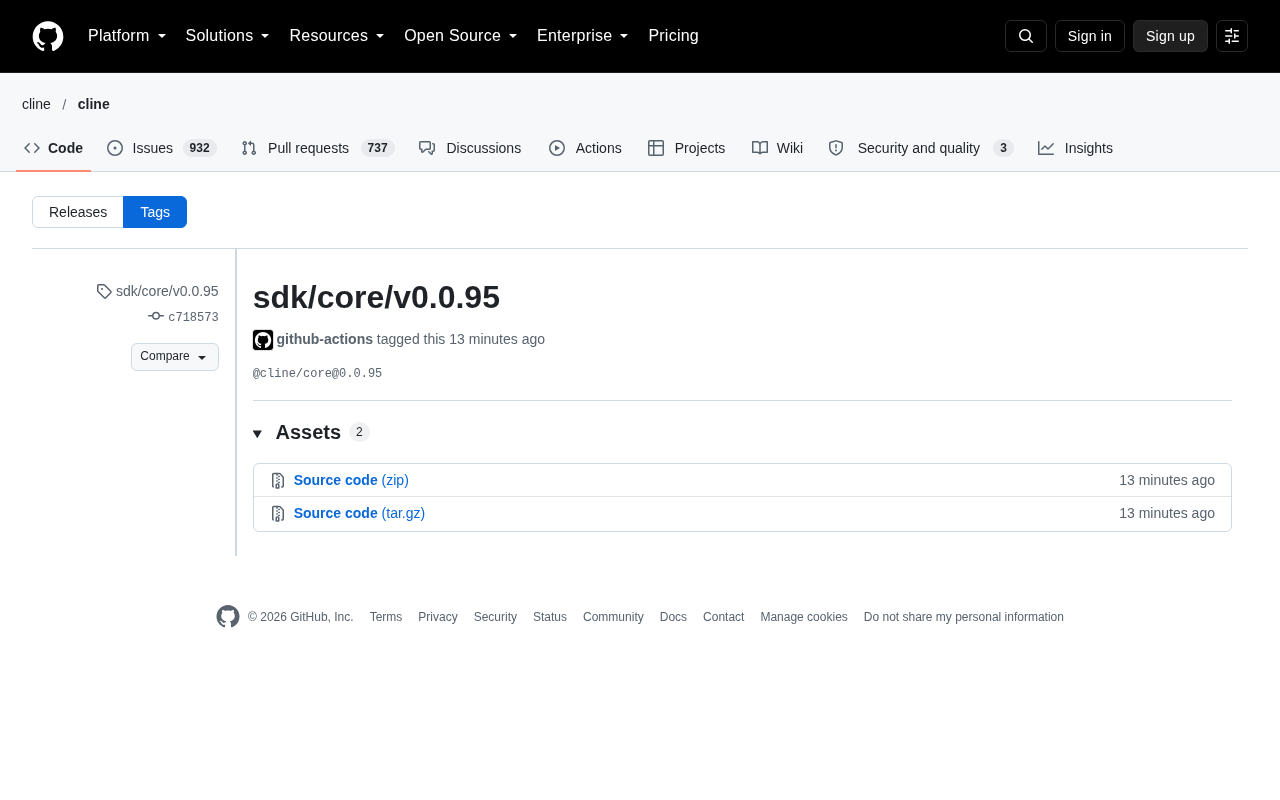
The Cline team has recently released version v0.0.95 of the @cline/core package. This version was automatically tagged as sdk/core/v0.0.95 via GitHub Actions, corresponding to commit hash c718573. Although no detailed changelog has been officially published yet, judging from the small increment in the version number, this is most likely a routine iterative update that may include bug fixes, dependency upgrades, or minor feature optimizations.
For developers, keeping the SDK version up to date is an important habit for ensuring project stability and security. It is recommended to follow subsequent announcements in the official repository to obtain the complete change description.
Semantic Versioning (SemVer) is the foundation for understanding the meaning of this version number. SemVer stipulates that version numbers take the form MAJOR.MINOR.PATCH: a major version change indicates incompatible API modifications, a minor version change indicates backward-compatible feature additions, and a patch version change indicates backward-compatible bug fixes. According to this specification, versions in the 0.y.z stage are defined as the "initial development stage," where anything may change at any time and the public API should not be considered stable. Therefore, the increment of @cline/core from v0.0.94 to v0.0.95, in the context of SemVer, only represents a patch-level change and does not promise backward compatibility; this also explains why the article emphasizes the need for compatibility testing before upgrading, rather than simply assuming it is purely a bug fix.
How to Understand This Update
Since this release does not come with detailed release notes, we can only infer its nature from the version number and the release process. v0.0.95 is still in the 0.0.x stage, indicating that the SDK may not yet have reached a stable version and the API may still change. Developers should pay attention to compatibility testing when upgrading, especially for projects involving core functionality.
Judging from the automatic generation of GitHub tags, the Cline team has adopted a standardized CI/CD process, which helps ensure consistency and traceability of releases. The commit hash c718573 can serve as a baseline for version comparison.
Git tags are immutable references in Git that point to specific commit objects, commonly used to mark release points. A lightweight tag is simply a commit pointer, while an annotated tag additionally stores the tag name, tagger, date, and message. The sdk/core/v0.0.95 mentioned in the article adopts a "package path + version number" naming convention, which is a common convention in Monorepo (single repository, multiple packages) scenarios: multiple independently publishable packages are hosted within one repository, and prefixed tags are used to distinguish the release history of different packages. Combined with the commit hash c718573, developers can use git show sdk/core/v0.0.95 to precisely reproduce the source code state of that version, and use git log c718573..HEAD to view all changes introduced since then—this is exactly the concrete method behind the article's suggestion to "check the commit history."
CI/CD and GitHub Actions: GitHub Actions is GitHub's built-in continuous integration and continuous delivery platform, which defines trigger conditions and execution steps through workflow files in the repository (located in the .github/workflows directory). A typical release pipeline automatically builds, runs tests, publishes the npm package, and creates the corresponding Git tag when a tag is pushed or a merge to the main branch occurs, thereby eliminating the risk of version inconsistency caused by manual operations. The "automatic tagging" mentioned in the article reflects exactly this mechanism: tags are generated by the pipeline rather than created manually, meaning the release is reproducible and auditable.
Recommendations for Developers
- Before upgrading, check the repository's commit history to understand the specific changes.
- Verify the new version in a test environment to ensure compatibility with existing code.
- Follow subsequent official announcements to obtain fix information in a timely manner.
Summary
Cline Core SDK v0.0.95 is a routine version release that reflects the team's ongoing maintenance cadence. Although information is limited, staying informed about version updates helps developers better plan their upgrade strategies.
Background Supplement
Changelogs and release notes are key artifacts in software release governance. A changelog is typically maintained in the repository as CHANGELOG.md, recording additions, fixes, and breaking changes by version, and the industry often follows the Keep a Changelog specification; release notes are the explanatory text on the release page, intended to explain the impact of the release to users. When both are missing, users can only rely on version numbers, commit history, and code diffs to make reverse inferences—for example, using git diff to compare the scope of changes between two tags, or checking PR titles and linked issues. This also explains why the article repeatedly reminds readers to follow subsequent official announcements.
Related articles

Chain of Thought Isn't Just for AI: How Humans Can Use CoT to Improve Thinking Quality
Chain of Thought isn't just a prompt trick for large models. Starting from a Hacker News discussion, this article analyzes why CoT works for human thinking too, breaks down actionable ways to transfer it, and highlights the key differences between human CoT and machine CoT.
Cloudflare Teams Up with OpenAI: Closi…
Cloudflare Teams Up with OpenAI: Closing the Loop from Vulnerability Discovery to Defense with AI
Cloudflare uses OpenAI Daybreak to investigate security vulnerabilities and generate reviewable remediation plans, while developers use Codex to boost coding efficiency and quality.

Orca Multi-Agent Orchestration in Practice: A Guide to Parallel Collaboration with Claude and Codex
Orca is Stable AI's free open-source agent workbench supporting 34 agents like Claude Code and Codex in parallel. Learn its Git worktree isolation, multi-model orchestration, and mobile management.