Cline Desktop v0.0.47 Update: Plugin Loading Fixed, Default Model Upgraded to Gemini 4 Argon

Cline Desktop v0.0.47 fixes plugin loading failure and refreshes the model catalog, with the default model changed to Gemini 4 Argon.
Cline Desktop v0.0.47 primarily resolves a blocking-level defect in v0.0.46 where Marketplace plugins failed to load because the packaged application lacked @cline/sdk, and removes the Cloud sessions toggle from Settings, enabling it by default in supported environments. On the stability side, when a provider error interrupts generation mid-stream, the client now automatically retries up to 3 times. The model catalog also sees major adjustments: Boundless and Standard Compute are added, SambaNova now fetches from the catalog with MiniMax M3 as default, Gemini 4 Argon is added to Cline's recommended list while Grok 4.7 is removed, the Cline provider's default model switches accordingly, and the free list replaces Step 5 Preview with Nemotron 3.5 Super VL. Additionally, dozens of providers including Cortecs, Nvidia, Requesty, and Aixy have their default models changed. The article recommends v0.0.46 users upgrade promptly and validate the new default model's performance in a small scope first.
Cline Desktop v0.0.47 Update Analysis: Plugin Loading Fix and Major Model Catalog Refresh
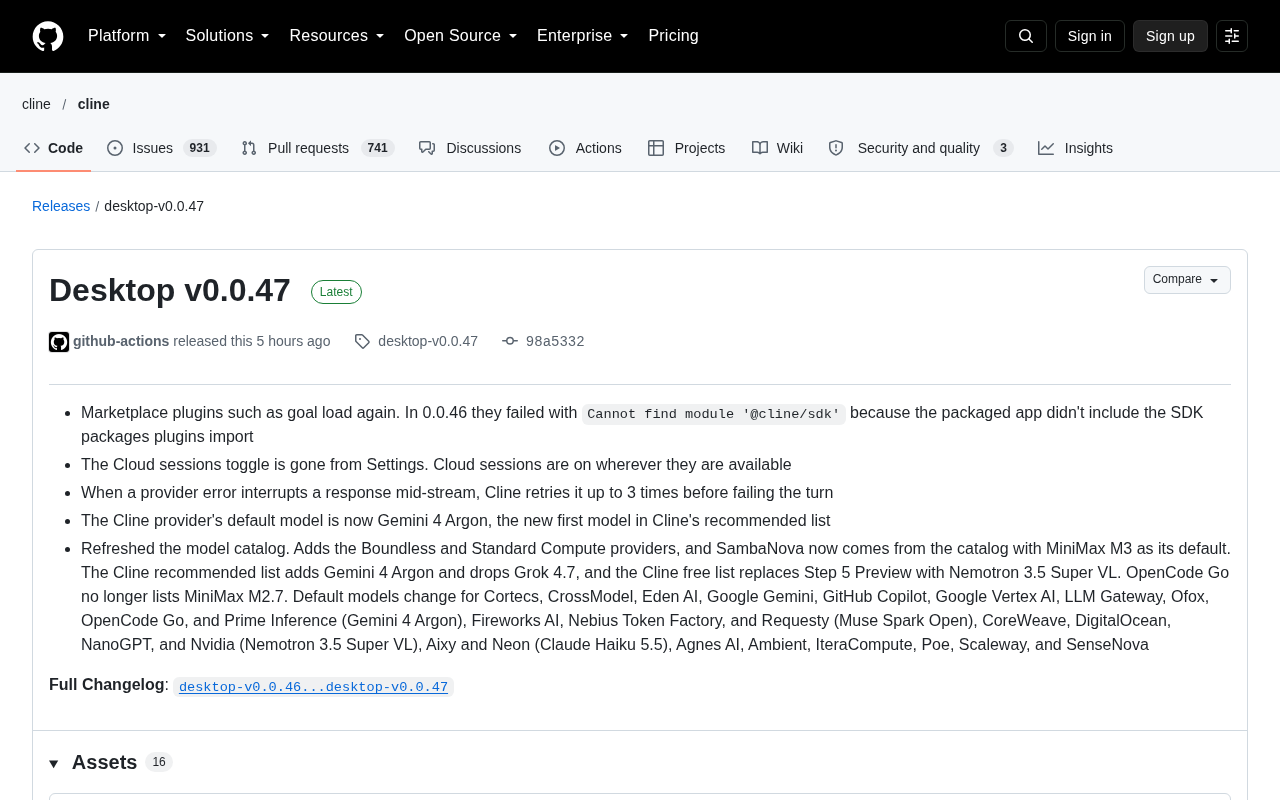
According to the GitHub Release page, Cline Desktop has released version v0.0.47. This update focuses on two areas: fixing the Marketplace plugin loading failure introduced in the previous version, and a large-scale refresh of the model catalog, involving default model adjustments across multiple providers.
Key Fix: Marketplace Plugins Restored
v0.0.46 had a defect that affected the proper loading of Marketplace plugins (such as goal), with the error message Cannot find module '@cline/sdk'. The root cause was that the packaged application did not include the SDK package referenced by the plugin. v0.0.47 resolves this issue, and plugins can now load again.
For users who rely on Marketplace extension workflows, this is a blocking-level fix. The missing SDK package is a packaging configuration oversight. It typically doesn't affect the development environment and only surfaces in distributed builds, which is why such issues often require user feedback before being discovered.
@cline/sdk and Packaging Dependency Resolution
@cline/sdk is a JavaScript SDK package that Cline provides for plugin developers to call core capabilities (such as file reading/writing, terminal execution, and session context). Plugins reference it via require or import, and the application runtime is responsible for resolving it. In Electron-based desktop apps, the development environment typically reads dependencies directly from node_modules, so the missing package doesn't surface. Distributed builds, however, go through packaging tools (such as electron-builder, webpack) that prune and inline the dependency tree, so only modules explicitly declared as production dependencies or whitelisted for packaging are included.
If @cline/sdk is mistakenly classified as a development dependency or omitted from the packaging entry point, users will encounter runtime errors like Cannot find module. The fix usually involves adjusting the dependency classification or external declarations in the packaging configuration, and adding the corresponding version lock. What makes this type of issue insidious is that CI builds won't fail; it's only triggered when the actual distributed artifact executes that code path on the end user's machine. This is why adding smoke test cases for plugin loading in regression testing is essential.
Settings Simplification: Cloud Sessions Toggle Removed
The new version removes the Cloud sessions toggle from Settings. The official explanation is that Cloud sessions are enabled by default in supported environments, and a manual toggle is no longer provided.
This change means the Cline team has delegated the availability determination of Cloud sessions to the system level rather than user manual control. For most users, the operational path is shorter, but it also means losing the option to explicitly disable it in certain scenarios.
How Cloud Sessions Work
Cloud sessions refer to hosting part of the session state data (such as context, task history, or parts of the execution environment) in the cloud rather than storing it entirely locally, enabling cross-device continuation, remote viewing, or team collaboration scenarios. Whether it's enabled typically depends on account type, network connectivity, enterprise policies, and regional compliance requirements.
When such capabilities shift from a "user manual toggle" to "automatic system determination based on environment," the actual control shifts from the UI to configuration delivery and backend policy layers. The benefit is avoiding feature unavailability caused by users accidentally disabling it, or state inconsistency across devices. The trade-off is that when users want to explicitly disable it due to data residency requirements, privacy audits, or debugging needs, there's no intuitive entry point — only indirect methods like enterprise policies or configuration files.
Stability Improvement: Automatic Retry on Streaming Response Interruption
When a provider error interrupts generation mid-stream, Cline now automatically retries up to 3 times before declaring the conversation round as failed.
Streaming response interruption is a common issue in products that integrate multiple model providers, caused by network jitter, provider rate limiting, or server-side exceptions. The automatic retry mechanism can significantly reduce how often users manually re-initiate requests, representing a substantial experience-level improvement.
Streaming Responses and Idempotency Risks
Streaming responses refer to the model returning tokens incrementally via Server-Sent Events or chunked transfer, with the client rendering as it receives. Compared to one-shot returns, it has lower time-to-first-token, but the connection lifecycle is longer, and any network jitter, provider rate limiting (such as 429), or server-side exception can cause the stream to break mid-way.
The benefits of automatic retry are clear, but idempotency issues need attention: if the interruption occurs after a tool call has been partially executed, a simple resend could cause side effects like duplicate file writes or duplicate command execution. A reasonable implementation would determine whether the current round has produced irreversible side effects before retrying, or resume from a breakpoint rather than resending the entire round. For users, "up to 3 times" should be understood as bounded fault tolerance — in cases of consecutive failures, you still need to check the specific error code rather than repeatedly waiting.
Model Catalog Refresh: New Providers and Default Model Adjustments
This update makes substantial adjustments to the model catalog.
New Providers: Boundless and Standard Compute have been added; SambaNova is now fetched from the catalog, with MiniMax M3 as its default model.
Cline Recommended List: Gemini 4 Argon has been added, and Grok 4.7 has been removed. The Cline provider's default model has been correspondingly changed to Gemini 4 Argon, the first model in the recommended list.
Cline Free List: Step 5 Preview has been replaced with Nemotron 3.5 Super VL.
OpenCode Go: MiniMax M2.7 is no longer listed.
Additionally, a batch of providers have had their default models changed, including Cortecs, CrossModel, Eden AI, Google Gemini, GitHub Copilot, Google Vertex AI, LLM Gateway, Ofox, OpenCode Go, Prime Inference, Fireworks AI, Nebius Token Factory, Requesty, CoreWeave, DigitalOcean, NanoGPT, Nvidia, Aixy, Neon, Agnes AI, Ambient, IteraCompute, Poe, Scaleway, SenseNova, and more. Among them, Prime Inference's default model is Gemini 4 Argon, Requesty's is Muse Spark Open, Nvidia's and Nebius Token Factory's is Nemotron 3.5 Super VL, and Aixy's and Neon's is Claude Haiku 5.5.
Analysis: What Default Model Adjustments Signal
The choice of default model often reflects a product team's comprehensive judgment on cost-effectiveness, capability, and stability. Setting Gemini 4 Argon as the Cline provider's default model and placing it first in the recommended list suggests the team has high confidence in its coding-scenario performance.
On the other hand, the free list replacing Step 5 Preview with Nemotron 3.5 Super VL, and multiple providers' default models migrating to Claude Haiku 5.5, Muse Spark Open, etc., show that the pace of updates on the model supply side remains rapid. For users, this means regularly checking whether the default model meets their needs and manually switching when necessary.
Model Catalog and Provider Routing
The model catalog is a structured list built into the product, describing which models each provider offers, context windows, pricing, capability tags, and the default selection. The client fetches this list on startup or at regular sync intervals, and the model dropdown in the user interface is generated from it.
The significance of decoupling default models from the catalog is that vendors can adjust recommended models, retire old models, or onboard new providers by updating the catalog without releasing a new client version. The "default model changes" mentioned in this article often correspond to upstream model version iterations or pricing changes. Users should note two things: first, the default model may have already changed without you releasing a version upgrade; second, if your workflow is sensitive to output stability, it's best to explicitly specify the model rather than relying on the default value.
Upgrade Recommendation
If you encountered Marketplace plugins failing to load in v0.0.46, v0.0.47 is a necessary upgrade. If you use the Cline provider and haven't manually specified a model, the default model will switch to Gemini 4 Argon after upgrading. It's recommended to validate the results in a small scope of tasks before full adoption.
Related articles

JobRunner MCP Server: AI Agents Can Now Fix Failed Java Jobs
JobRunner launches an open-source MCP server enabling AI agents to view cluster status, diagnose failures, and recover Java jobs—incident response from any cloud coding environment or existing agent.

MLAI Digital Launches 9 Security Agents: MCP Server Safeguards the Full Lifecycle of Agentic AI
MLAI Digital launches Security MCP Server with nine built-in specialized security agents covering vulnerability discovery, attack simulation, prompt injection detection, API and infrastructure assessment, and accelerated remediation—embedding security validation across the full Agentic AI lifecycle from development to production.

Running Isaac Lab on H100 GPUs: Exploring Better Approaches
Exploring optimization methods for running Isaac Lab on NVIDIA H100 GPUs, including MIG configuration, mixed precision, TensorRT acceleration, and community experience to improve robotics simulation and reinforcement learning efficiency.