Cline Desktop v0.0.49 Update: Terminal Panel and Local Model Management Go Live

Cline Desktop v0.0.49 strengthens change tracking, file tree, and terminal, and fixes several stability issues
Cline Desktop v0.0.49 focuses on interaction and reliability rather than model capability. A new Changes button in the session header lets users view modified files and diffs per turn, reducing review overhead in multi-turn conversations; the project file panel and integrated terminal (Ctrl+backtick) bring context visibility and result verifiability into the app, moving the product toward a "lightweight IDE + agent." The Local Models settings page manages Ollama and LM Studio and visualizes loaded model memory usage. Stability fixes cover Hub startup failures, duplicate running instances, oversized transcripts that couldn't be restored, git process explosions, and SSH ProxyJump connections, with retries reduced to 3. The model catalog adds two providers, the ClinePass default changes to Kimi K3.1 Pro, and Gemini's native search is disabled due to quota conflicts.
The desktop client for AI coding assistant Cline has released version v0.0.49, and this update makes significant moves on the interaction front: it adds an integrated terminal, a project file tree, and local model management, while also fixing a batch of long-standing stability issues. For a desktop app still in the 0.0.x stage, this changelog reveals a product direction worth paying attention to.
Finer-grained change tracking within sessions
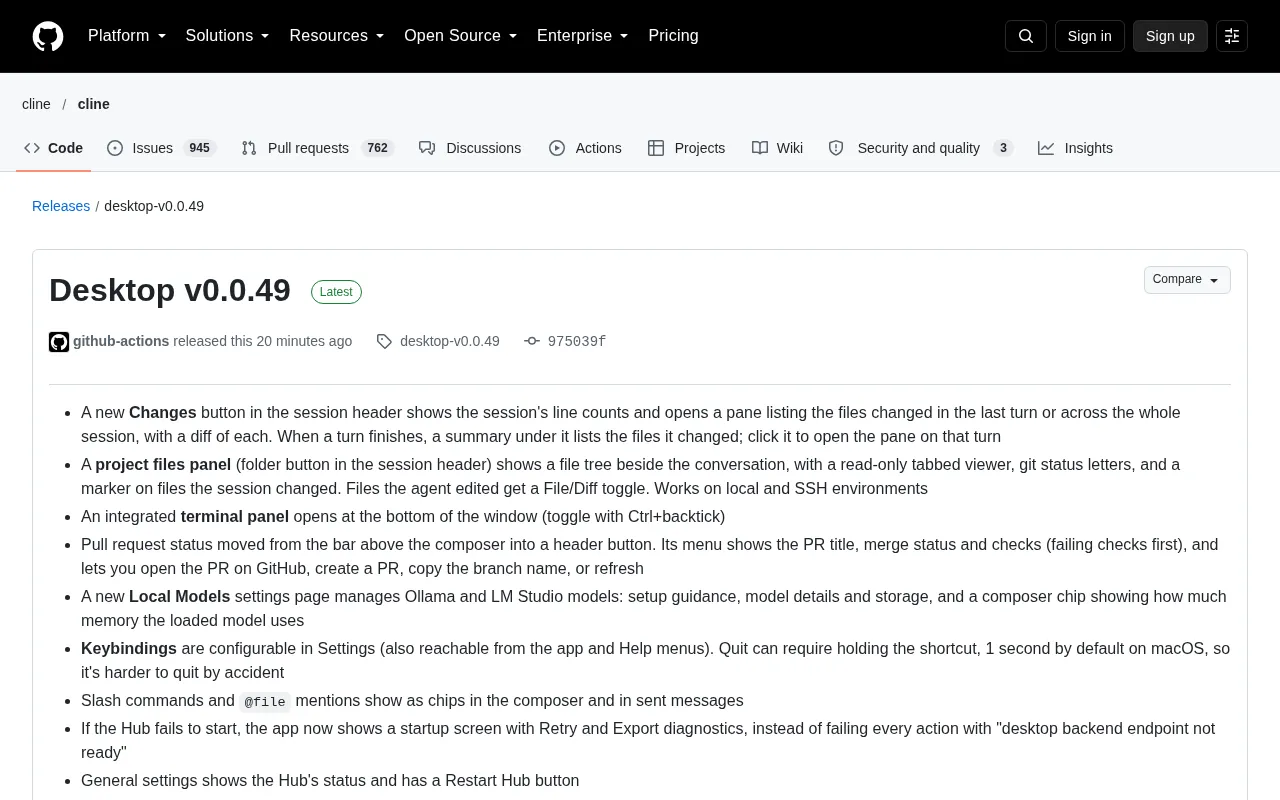
The new version adds a Changes button to the session header, showing the line count added/removed in the current session. Clicking it opens a panel listing the files modified in the most recent conversation turn or across the entire session, along with a diff for each file.
The real value of this feature is that it pulls "what the AI changed" out of the conversation flow. In multi-turn conversations, the model often modifies seven or eight files, and piecing together the full picture by scrolling through the chat log one entry at a time is difficult. Now a change summary is generated after each conversation turn, and clicking it takes you to the corresponding turn. For scenarios that require manual code review, this can significantly reduce the verification overhead.
File tree and terminal: bringing common IDE capabilities in
The project file panel opens via the folder button in the session header, displaying the file tree alongside the conversation. It supports a read-only tabbed viewer, shows git status letters, and marks files modified during the session. Files edited by the agent can be toggled between File/Diff views with one click. This capability works in both local and SSH environments.
An integrated terminal panel has also been added at the bottom of the window, summoned with Ctrl+backtick. Combined with the existing command execution capability, users no longer need to switch to an external terminal to verify the agent's operation results.
Looking at these two features together, Cline Desktop is moving from a "conversational code assistant" toward a "lightweight IDE + agent" form. The file tree solves context visibility, and the terminal solves the verifiability of execution results—both are among the most frequently complained-about aspects of agent programming.
Local model management becomes a first-class citizen
The new Local Models settings page is dedicated to managing Ollama and LM Studio models, providing configuration guidance, model details, and storage usage. There's also a chip in the composer showing the memory consumption of loaded models.
For local inference users, memory usage has always been a hidden cost. Knowing how much VRAM/memory a model consumes directly determines whether you can keep other tools open at the same time. Visualizing this is more closely aligned with actual usage than simply listing models.
Ollama and LM Studio are currently the two most commonly used local LLM runtime solutions on desktop: the former provides inference capability in the form of a command-line service plus REST API, with models stored locally as GGUF quantized files, pulled via ollama pull and served via ollama serve; the latter provides a graphical interface with built-in model downloads and conversation debugging, and exposes a local endpoint compatible with the OpenAI API. What both have in common is that inference runs entirely on the user's own GPU/CPU, incurs no API fees, and does not upload code to third parties. The cost is that VRAM and memory become hard constraints—a quantized 7B model typically uses several GB, while a 30B-class model may consume over 20 GB. Cline putting memory consumption directly on the composer chip is essentially making this hidden constraint explicit.
PR status and customizable keybindings
Pull Request status has moved from above the input box to a header button. The menu shows the PR title, merge status, and checks (failed checks listed first), and supports opening the GitHub PR, creating a PR, copying the branch name, and refreshing.
Keybindings can now be configured in settings, and can also be accessed from the application menu and help menu. The quit shortcut supports "long-press" confirmation—on macOS it defaults to holding for 1 second—reducing accidental quits.
A batch of stability fixes
Several fixes in the changelog are worth calling out separately:
- When the Hub fails to start, all operations no longer report "desktop backend endpoint not ready"; instead, a startup page with Retry and diagnostic export is shown. Hub status can also be viewed and restarted in general settings.
- When opening a task already running in another Cline app, it now attaches to the existing running instance instead of launching a second instance that cannot be stopped.
- Extra-long session records exceeding about 8 MB can now be restored. Previously the transcript was sent to the Hub twice, triggering the message size limit.
- Checking for changes in a workspace with many untracked files no longer spawns thousands of git processes.
- SSH environments using ProxyJump aliases can now connect properly.
- The model request retry count has been reduced from 5 to a maximum of 3.
The Hub mentioned in this article is the local backend service of the Cline desktop client, responsible for hosting session state, task execution, and model scheduling. The frontend interface communicates with it through a local endpoint. Therefore, when the Hub fails to start, all operations in the interface will error out because they cannot obtain the endpoint—a single point of failure gets amplified into global unavailability. This also explains why the new version exposes Hub status separately in general settings and provides a restart entry—for a local-service architecture, a visible health status and a recoverable startup flow affect availability more than any individual feature.
Model catalog adjustments
The model catalog has been refreshed: two new providers, Liquid Inference and Munito AI, have been added, while CrofAI, iFlow, and Llama have been removed. The Cline free list adds Reflection Beam, Nemotron 3.5 Lightning, and Laguna S 2.1, and removes Mimo V2.6 Flash and Muse Spark 1.3 Contributor. The ClinePass default model has changed to Kimi K3.1 Pro, with MiniMax M3.1 Flash and DeepSeekAd V4.1 Flash 1017 added. In addition, the default models for 56 providers have changed.
A fix for Gemini is also worth mentioning: the gemini provider no longer sends native Google Search, because free-tier keys hit 429 quota errors on every turn with Gemini 3+, and on Gemini 2.x all Cline tools were being dropped. This is a typical "upstream capability conflicts with downstream compatibility" problem, and simply disabling the feature is a pragmatic choice.
Gemini native Google Search refers to the grounding capability provided by the Gemini API: the model can directly invoke search during generation and return results with citations, with retrieval performed server-side by the upstream service, so the caller doesn't need to implement the tool itself. Its limitation is that it is an upstream feature constrained by quota and billing policies; free-tier keys and model generation differences can lead to inconsistent behavior—either direct 429 rate limiting, or conflicts with the caller's custom tool-calling mechanism that cause tools to be dropped. When an upstream feature cannot work reliably across all key types and model versions, proactively disabling it on the client side and handing things over to a unified tool-calling path is a common trade-off for keeping behavior predictable.
Summary
The focus of v0.0.49 is not model capability but interaction and reliability. Features like the file tree, terminal, and diff panel are nothing new individually, but combined in an agent programming tool, they address the core question of "how users can trust the agent's changes." As for the local model management page and the Hub status page, they show that Cline is taking self-hosting and offline scenarios seriously. For a 0.0.x version, this iteration direction is clear.
Related articles

Will GitHub Die? Open Source Maintainer Burnout and the Collaboration Crisis in the AI Era
Lex Fridman podcast discussion on open source maintainer burnout and GitHub's predicament: massive pull requests overwhelm core maintainers, and AI worsens code bloat. Using math journal peer review and Poincaré conjecture verification as analogies, the article analyzes why verification in knowledge production must be deliberately slow, and how open source communities can avoid the failure mode of maintainers exiting.
Stop Building Cookie-Cutter AI Websites: 3 Tools That Transform Your Coding Agent
Three tools that boost AI coding agents: FFmpeg skill for local video editing in Claude Code and Cursor, Hallmark's 50 design themes to fix cookie-cutter AI sites, and Jailbreaks' 25+ model prompts.

How America's Gerontocracy Squeezes the Younger Generation
Americans over 55 hold nearly three-quarters of national wealth, alongside an 80-year-old president and elderly congressional leaders. The Atlantic's Idrees Kahloon explains how gerontocracy drives up housing costs, squeezes opportunities for the young, and explores zoning reform and child poverty reduction as practical fixes.