Cline LLMs SDK v0.0.94 Released: AI Coding Toolchain Update

Cline's LLMs SDK releases v0.0.94, still in an early stage of rapid iteration.
The Cline project's LLMs SDK has released version v0.0.94, another iteration of its open-source AI coding assistance tool. This SDK manages connections to large language models as the foundation of Cline's AI capabilities, with its 0.0.x version indicating early evolution. Such low-level SDK updates typically involve model adaptation, API compatibility, and performance optimization. Cline publishes the LLMs SDK as an independent npm package, reflecting a modular ecosystem strategy.
The Cline project's LLMs SDK has released version v0.0.94, marking another iteration of this open-source tool focused on AI coding assistance.
Release Overview
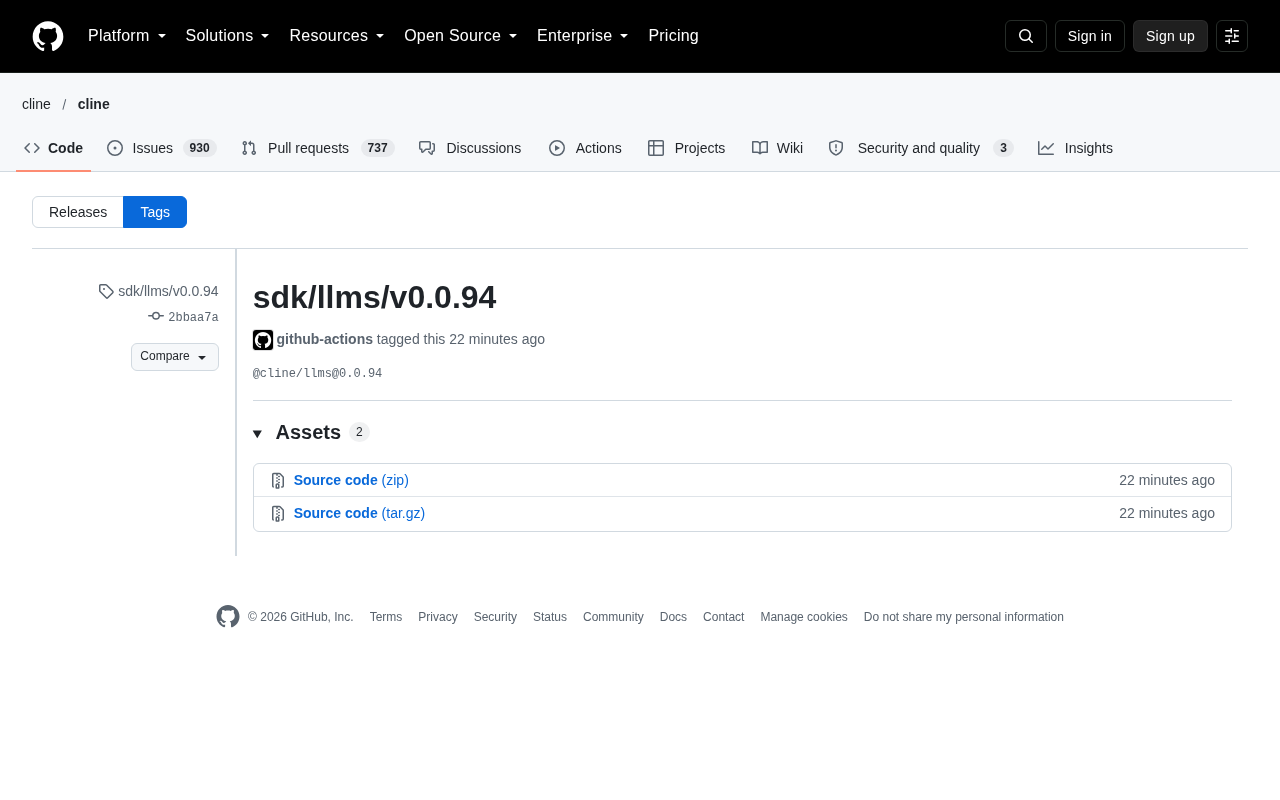
According to the release record on GitHub, @cline/llms@0.0.94 was tagged and released by the project's automation workflow github-actions. Judging by the version number, this is still in the early 0.0.x iteration stage, indicating that the SDK is evolving rapidly.
Cline is an AI coding assistant integrated into the editor, allowing developers to complete code writing, file operations, terminal command execution, and other tasks through natural language instructions. Its LLMs SDK module is responsible for managing connections to various large language models, serving as the foundational layer for the entire tool's AI capabilities.
Why the LLMs SDK Is Worth Watching
For developers using Cline for AI-assisted programming, updates to the LLMs SDK directly affect the stability and compatibility of model calls. Iterations of this kind of low-level SDK typically involve:
- Model adaptation: Supporting newly released language models or adjusting call parameters for existing models
- API compatibility: Adapting to interface changes from various AI vendors
- Performance optimization: Improving request processing efficiency and error recovery mechanisms
Although this release page does not show specific changelog details, the progressive rhythm of version numbers shows that the Cline team is continuously refining the reliability of the model integration layer.
About Semantic Versioning (SemVer): Under the SemVer specification, version numbers take the form major.minor.patch. 0.0.x indicates that the project is still in the initial development stage, and the API may undergo incompatible changes at any time, so caution is needed when using it in production. When the major version number is 0, increments to the minor version number may also introduce breaking changes, which differs from the convention after 1.x where "only major version changes represent incompatibility." For @cline/llms, 0.0.94 means it has accumulated nearly a hundred revisions, with a high iteration frequency, but interface stability has not yet been promised.
About the abstraction of the model invocation layer: APIs from different AI vendors differ greatly in request structure, authentication methods, streaming response formats, and error code systems. The role of middleware like the LLMs SDK is to unify these differences into a single internal interface, so that upper-layer business code only needs to face abstract operations such as "send message, receive response," without having to write separate adaptation logic for each model. When a vendor adjusts its interface or releases a new model, only one place in the SDK needs to be changed, and all callers benefit automatically. This is also the value of Cline separating the LLMs SDK into its own package.
Significance for the AI Coding Tool Ecosystem
Competition in the AI coding assistant track is becoming increasingly fierce, with tools from Cline to Cursor, Continue, and others all vying for entry into developers' daily workflows. As the middleware connecting AI capabilities with user interaction, the maturity of the LLMs SDK often determines the actual user experience of the tool.
Cline's choice to publish the LLMs SDK independently as an npm package means that other developers can also reuse this model invocation logic in their own projects. This modular strategy helps build a developer ecosystem around Cline.
About independent npm package publishing: npm (Node Package Manager) is the most mainstream package manager in the JavaScript/TypeScript ecosystem. Developers can bring public packages into their projects with npm install. Publishing an internal module to npm under a scoped package name like @cline/llms means it can be installed independently, upgraded independently, and depended upon by projects outside of Cline. The prerequisite for this approach is that the module has clear boundaries and does not depend on runtime environments specific to the Cline editor; otherwise, its reuse value is limited.
How to Obtain and Upgrade
Developers can install or upgrade to the latest version through npm:
npm install @cline/llms@0.0.94
Since this version is still in the 0.0.x stage, it is recommended to follow the GitHub Releases page for complete change notes and confirm compatibility with the current main Cline version before upgrading.
For developers who are not yet using Cline, they can learn about this AI coding assistant's features and installation methods through its official channels, and experience code writing and project management capabilities based on large language models.
One-line Summary
Cline's LLMs SDK releases v0.0.94, still in an early stage of rapid iteration.
Paragraph Summary
The Cline project's LLMs SDK has released version v0.0.94, another iteration of its open-source tool focused on AI coding assistance. This SDK manages connections to various large language models and is the foundational layer for Cline's AI capabilities, with its 0.0.x version number indicating that it is still evolving early on. The article notes that updates to this kind of low-level SDK typically involve model adaptation, API compatibility, and performance optimization. Although no specific changelog is shown, the progressive rhythm indicates that the team is refining the reliability of the model integration layer. Cline publishes the LLMs SDK independently as an npm package, enabling other developers to reuse its model invocation logic, reflecting a modular strategy and ecosystem intent. Developers can install and upgrade via npm, but should pay attention to compatibility with the main version.
Related articles

OpenAI Cracks Math Problems, Why Are Mathematicians Losing Sleep?
OpenAI claims to solve math problems — why are mathematicians anxious? Vergecast reveals the Eye of Sauron dilemma and the tension between AI answers and human understanding.

CSS Conditional Border-Radius Trick: Auto-Square Corners When Elements Touch the Edge
Pure CSS conditional border-radius: auto-square corners when elements touch the edge, rounded while floating. Use calc(100vw-100%) with clamp() to kill the transition band, and container query units cqi for non-fullscreen containers, plus a scrollbar offset workaround.

Google TimesFM 3.0 Hands-On: Is Zero-Shot Forecasting Good Enough?
Hands-on test of Google TimesFM 3.0: zero-shot error cut by ~25% with second-level results, but the two versions give opposite answers in business what-if planning. A deep dive into model internals, version differences, and four key production limitations.