Cline Releases @cline/shared 0.0.94: A Signal of Shared SDK Module Updates

Cline releases @cline/shared@0.0.94, reflecting its shared layer modularization and automated release cadence
A new release tag sdk/shared/v0.0.94 appeared in the Cline repository, corresponding to @cline/shared@0.0.94, automatically tagged by github-actions. The package handles common logic reuse across Cline components, and its independent versioning indicates Cline's architecture has moved from monolithic to modular. Analysis suggests splitting the shared layer ensures consistency in model call wrappers, prompt assembly, and tool protocol parsing, while lowering third-party integration costs. 0.0.94 is in SemVer's 0.x stage and may contain breaking changes; dependents should check the changelog and run tests before upgrading. Automated release pipelines bring faster iteration but require dependents to track version changes more proactively. Regular plugin users are unlikely to notice this update.
Cline's Shared Module Gets a New Version
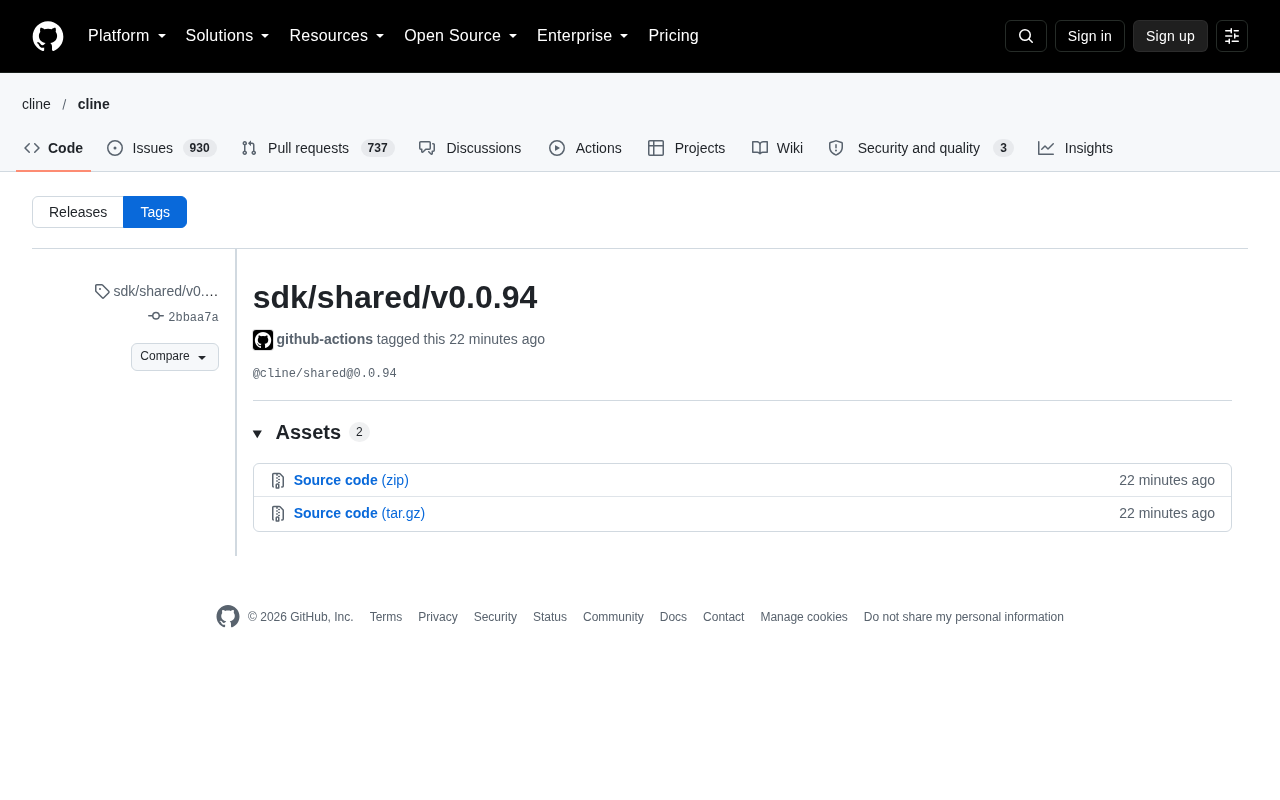
A new release tag has appeared in the code repository of open-source AI coding assistant Cline: sdk/shared/v0.0.94, corresponding to the package name @cline/shared@0.0.94, automatically tagged by github-actions. Version iterations of low-level shared packages like this are often not directly noticeable to regular users, but they frequently serve as the precursor to upstream feature evolution.
Judging by its name, @cline/shared is responsible for reusing common logic across Cline's various components. Splitting it into a separately versionable package means Cline's architecture has moved from monolithic to modular, where the main application, SDK, and various integrations can each be upgraded independently, while the shared layer ensures consistency in interfaces and behavior.
The Role of Shared Packages in AI Coding Tools
The complexity of products like AI coding assistants largely stems from needing to simultaneously interface with multiple models, multiple editor host environments, and multiple tool-calling protocols. Extracting cross-module common parts into a shared package is a common approach to controlling this complexity.
Why Split Out a Shared Layer
For a project like Cline that has both an IDE plugin form and an SDK form that can be externally invoked, content such as model call wrappers, prompt assembly, tool protocol parsing, and type definitions will be referenced in multiple places. If these logics were scattered across various sub-packages, any protocol change could cause inconsistency. After centralizing them into @cline/shared, bumping a single version number allows all dependents to align their behavior.
This split also lowers the integration cost for external parties. If third-party developers want to build their own tools based on Cline's capabilities, they only need to depend on the stable shared package rather than binding to the complete application implementation.
Version Number Semantics
A version number like 0.0.94 is in the 0.x stage. According to semantic versioning conventions, 0.x allows breaking changes without bumping the major version. For developers depending on this package, this means every minor version update is worth checking the changelog rather than assuming a painless upgrade.
Monorepo and Package Splitting: Projects like Cline that simultaneously maintain plugins, SDKs, and multiple integrations typically organize code using a monorepo (single repository, multiple packages), managed uniformly with tools like pnpm, npm workspaces, or Turborepo. Each subdirectory is an independently publishable npm package, referenced within the repository via the workspace protocol, then pushed to the registry separately upon release. The core value of this structure is that code is physically centralized for easy collaborative modification, while logical boundaries are clear and packages can be versioned independently. @cline/shared is precisely a product of this architecture—it's not an application, but the foundation that all other packages depend on. Understanding this makes it clear why its version number evolves independently of the main application, and why its changes affect multiple downstream packages simultaneously.
Semantic Versioning (SemVer) Quick Overview: SemVer defines version numbers as three segments: MAJOR.MINOR.PATCH. Ideally, an increment in MAJOR indicates breaking changes, MINOR indicates backward-compatible new features, and PATCH indicates backward-compatible fixes. However, there is a special provision in the specification: when the major version number is 0 (i.e., 0.y.z), the public API is considered unstable, and the MINOR position may also introduce breaking changes. 0.0.94 goes further, with both major and minor versions being 0, indicating that the project has made virtually no commitment to API stability, and any release could be breaking. This is why the community commonly uses ^0.0.x (accepting only exactly identical versions) or directly locks exact versions when depending on such packages, rather than using ^ or ~ range specifiers.
Evidence of an Automated Release Process
This tagging was performed by github-actions with a timestamp of 16 Oct 03:50. The release was entirely executed by a CI bot, indicating that the Cline team has incorporated version releases into an automated pipeline.
The Rhythm Change Brought by Automated Releases
When release actions are handled by a pipeline, the pace of version iteration is no longer constrained by manpower and process approvals. This typically corresponds to two possibilities: first, the team wants to push fixes downstream faster; second, the shared package's changes are frequent enough to require high-frequency releases to match the evolution speed of the main repository.
For users, the benefit of automated releases is that fixes arrive faster, at the cost of more versions requiring more proactive tracking of changes. This is especially true for the dense iterations of the 0.0.x series.
Practical Impact on Developers
If your project directly or indirectly depends on @cline/shared, the first thing worth doing with this update is to check the diff for that version. The tag page provides a Compare entry point where you can see the specific code differences from the previous version.
Upgrade Recommendations
During the 0.x stage, it's recommended that dependents with locked versions run their own test suite before upgrading, with particular focus on paths related to model calls and tool protocols. Since changes to the shared package typically have a broader impact surface than a single sub-package, the verification cost of upgrading is correspondingly higher.
For regular users who just use the Cline plugin, this update is unlikely to bring visible changes. Iterations of the shared layer typically need to be integrated by upper-layer packages before they appear as features or fixes in daily use.
Summary
@cline/shared@0.0.94 itself is not an end-user-facing release, but it reflects Cline's engineering structural choices: consolidating common capabilities into independently versionable shared modules and maintaining their iteration rhythm through automated pipelines. For developers interested in the architectural evolution of AI coding tools, such low-level releases are worth keeping on the watchlist.
Note: The original material is only metadata from the GitHub release tag page and does not include the specific change content, commit notes, or feature descriptions of this version. This article analyzes based on the package name, release process, and version number semantics. Judgments about the specific direction of changes are inferences; please refer to the official changelog.
Related articles

Workbuddy for Absolute Beginners: How a Desktop AI Agent Fits Into Real Workflows
A beginner's guide to the Workbuddy desktop AI agent: installation, claiming credits, file management, and building automated workflows—compared with CodeX for fit and cost, helping professionals shift from AI question-askers to AI managers.

OpenAI's New Agent Stack: Computer Use, Decisions API, and Ultra-Fast Workflows
OpenAI Dev Day unveiled a new agent stack: Computer Use outperforms humans, Decisions API delivers ultra-low-latency classification via Luna, Agents API opens the same Computer Use capabilities, and GPT-6.1 Sol costs only one-seventh of Astra. Core updates, benchmark data, and developer insights.

Liang Wenfeng Open-Sources DeepInfo Inference Framework, Takes On U.S. Ban
DeepSeek open-sources its DeepInfo inference framework after its models, featuring GPU/CPU cross-pipelining, small-model prediction with large-model verification, and full Huawei Ascend and NVIDIA chip support—facing the U.S. federal ban head-on. This article analyzes its significance for AI deployment and open-source strategy.