Cline SDK v0.0.91 Release Breakdown: Agent Completion Fix and Multi-Provider Adapter Improvements

Cline SDK v0.0.91 fixes Agent completion detection and raises MCP timeout for better stability and provider compatibility.
Cline SDK v0.0.91 is a stability and compatibility focused maintenance release. The most important change introduces an `unknown` finish reason state to prevent misinterpreting abnormal model endings as successful completions, with a "retry once" fallback to reduce unnecessary task failures. The Stdio MCP server initialization timeout is raised from 3 to 10 seconds, directly fixing the silent-drop issue with slow-starting npx/uvx on Windows. Provider adapters receive several refinements: Anthropic's refusal fallbacks now only go to the official endpoint to fix 400 errors on Azure AI Foundry, reasoning levels auto-align to model-supported tiers, and openai-compatible deprecation warnings are eliminated. The release also adds an `apiKeyOptional` capability declaration, consistent rule sorting, and optional Langfuse tracing support for BYOK providers.
Cline has released SDK v0.0.91. While this is a minor version update, it addresses several core issues affecting Agent stability and refines the adapter logic for multiple model providers. Developers building automated coding agents with Cline will want to take a close look at these changes.
Key Fix: Agent Completion Detection Logic
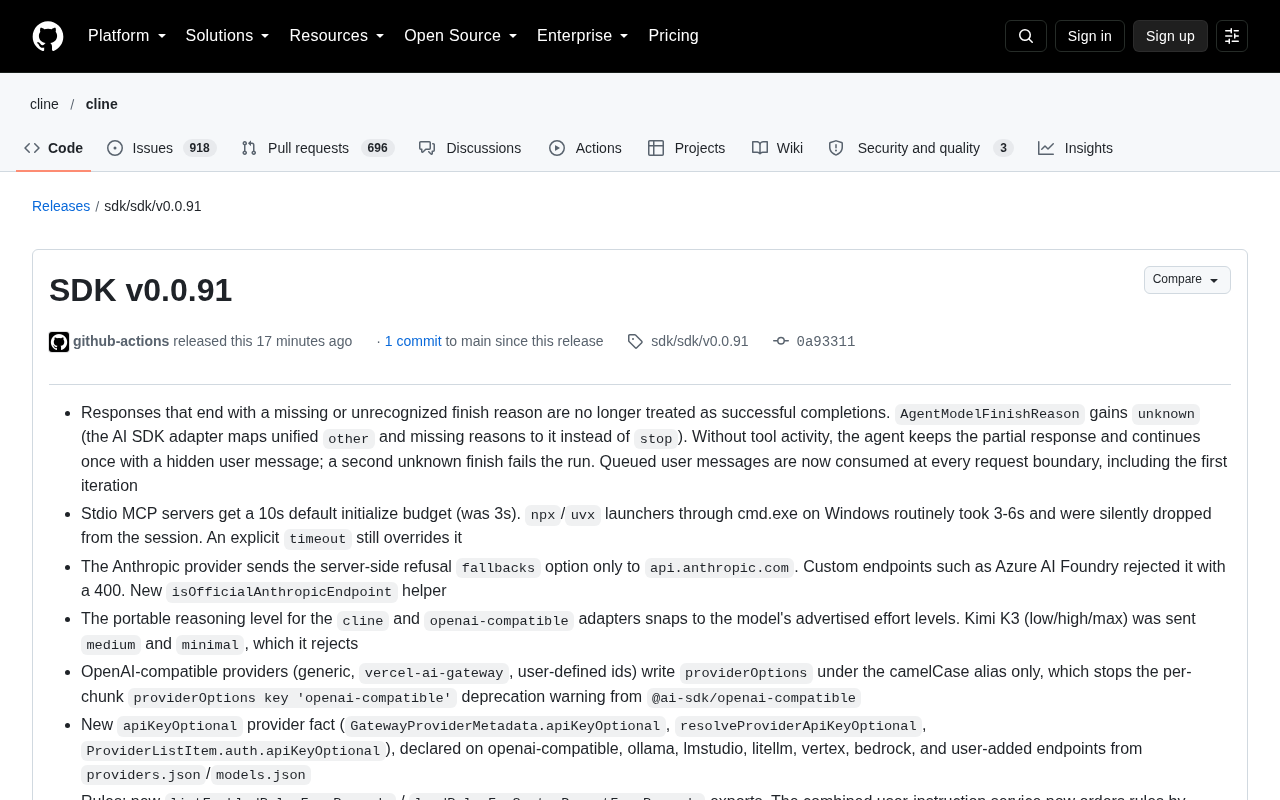
The most significant change in this update is how response finish reasons are handled. Previously, when a response ended with a missing or unrecognized finish reason, the system would incorrectly treat it as a successful completion. v0.0.91 no longer does this.
Specifically, AgentModelFinishReason now includes an unknown state. The AI SDK adapters map the unified other value and missing finish reasons to this new state, rather than defaulting to stop as before. This distinction may seem subtle, but it directly affects Agent behavior.
When no tool activity is present and the Agent encounters an unknown finish reason, it retains the partial response and continues execution once via a hidden user message. Only if the second attempt also returns unknown is the run marked as failed. This "give it one more chance" design avoids terminating an entire task flow just because the model produced an anomalous ending. Additionally, queued user messages are now consumed at each request boundary — including the first iteration — which resolves a consistency issue in message processing timing.
Background: The
finish reasonis a metadata field in LLM API responses that tells the caller why the current generation stopped. Common values includestop(natural completion),length(max token limit reached),tool_calls(model requested a tool), andcontent_filter(content blocked by safety policy). For Agent frameworks, this field is critical — it determines whether to keep waiting, invoke a tool, or mark the task as complete. The previous behavior of defaulting missing or unknown finish reasons tostopcaused Agents to falsely believe a task had completed successfully, skipping necessary follow-up steps or incorrectly terminating the entire workflow. Introducing theunknownstate with a "retry at most once" fallback is an engineering trade-off between robustness and avoiding infinite loops.
Windows Platform and MCP Server Timeout Improvements
For Stdio-type MCP (Model Context Protocol) servers, the default initialization timeout has been raised from 3 seconds to 10 seconds. This change is backed by concrete real-world scenarios.
On Windows, launching loaders like npx or uvx via cmd.exe often takes 3 to 6 seconds. Under the old 3-second budget, these servers would be silently dropped, causing tools to mysteriously disappear from sessions — and the root cause was extremely difficult to diagnose. Raising the default to 10 seconds significantly reduces the number of servers killed prematurely due to slow startup. Developers can still override this default by explicitly setting timeout if needed.
Background: MCP (Model Context Protocol) is an open protocol proposed by Anthropic to standardize how AI models interact with external tools and data sources. Stdio-type MCP servers are local services that communicate via standard input/output (stdin/stdout), which the Agent framework spawns as child processes and communicates with through pipes.
npxanduvxare tools for running packages on-demand in the Node.js and Python ecosystems respectively — the former belongs to npm, the latter to the uv package manager. On Windows, both tools must go through acmd.exeshell layer on first launch, plus potential package downloads or cache checks, making cold-start latency significantly higher than on macOS/Linux. The original 3-second timeout effectively created a systemic tool unavailability problem for Windows users — and because servers were silently dropped, this was extremely hard to debug.
Provider Adapter Updates
This release includes careful work on provider compatibility, resolving several issues that caused requests to be rejected.
Anthropic and Custom Endpoints
The Anthropic provider previously sent refusal fallback options to all endpoints, but custom endpoints like Azure AI Foundry don't accept this parameter and would return 400 errors. This option is now only sent to api.anthropic.com, and a new isOfficialAnthropicEndpoint helper function has been added to handle the check.
Reasoning Level Alignment
The portable reasoning levels for the cline and openai-compatible adapters now align with the effort levels actually supported by the model. For example, Kimi K3 supports low/high/max, but the system was previously sending medium and minimal — values the model would reject. Reasoning levels now automatically map to the levels the model actually supports.
Deprecation Warning Elimination
OpenAI-compatible providers (including the generic type, vercel-ai-gateway, and user-defined IDs) now write to providerOptions only under their camelCase alias. This eliminates the per-chunk deprecation warning providerOptions key 'openai-compatible' from @ai-sdk/openai-compatible.
New Provider Capability Declarations and Rule Management
This version introduces a new apiKeyOptional provider fact, encompassing GatewayProviderMetadata.apiKeyOptional, resolveProviderApiKeyOptional, and ProviderListItem.auth.apiKeyOptional. This declaration is now active for openai-compatible, ollama, lmstudio, litellm, vertex, bedrock, and user-defined endpoints added via providers.json / models.json, allowing the system to more accurately determine whether a given provider requires an API key.
On the rule management side, two new exports have been added: listEnabledRulesFromRecords and loadRulesForSystemPromptFromRecords. The merged user instruction service now sorts rules by name, consistent with single-workspace-path behavior, improving predictability in multi-rule scenarios.
For observability, this version adds optional Langfuse tracing support for BYOK (Bring Your Own Key) providers, enabled via CLINE_LANGFUSE_ALL_PROVIDERS, with support for configuring operation tags, metadata, and runtime environments through CLINE_LANGFUSE_TAGS, CLINE_LANGFUSE_METADATA, and LANGFUSE_TRACING_ENVIRONMENT environment variables. Hook discovery telemetry also fixes Windows path separator handling.
Background: Langfuse is an open-source LLM observability platform providing tracing, evaluation, and prompt management features — similar in concept to APM (Application Performance Monitoring) tools in traditional software. BYOK (Bring Your Own Key) mode means users access model providers directly using their own API keys rather than routing through a platform proxy. In this mode, request traffic bypasses intermediate services, and the platform typically cannot automatically collect call data. Adding optional Langfuse tracing support for BYOK providers means developers can now report call trace data to their own Langfuse instance via environment variables — even when connecting directly to a model — achieving unified observability coverage.
Model Catalog Updates
The model catalog has also been refreshed in this release. The Cline free model list adds Solar Mini 4 while removing DeepSeekAd V4.1 Flash and space-bunny-alpha. A new Engy provider has also been added.
Default models have changed for several providers, including AKI.IO, Blue Claw, CoralBricks, CrossModel (GPT-6.1 Sol), DevPass, LLM Gateway, Mistral, NanoGPT, Requesty (Mistral Large 4), Neon (Claude Opus 5.5), Subconscious, and The Grid AI. These changes reflect the rapid evolution of the backend model ecosystem — developers using these providers should be aware that default model switches may cause behavioral differences.
Summary
Overall, v0.0.91 is a maintenance release focused on stability and compatibility. The fix to Agent completion detection logic, the relaxed MCP server timeout, and the fine-grained adjustments to multi-provider adapter parameters all address pain points encountered in real-world usage. For teams relying on the Cline SDK in production, this release reduces task interruptions and request failures caused by edge cases — making the upgrade worthwhile.
Related articles

Chain of Thought Isn't Just for AI: How Humans Can Use CoT to Improve Thinking Quality
Chain of Thought isn't just a prompt trick for large models. Starting from a Hacker News discussion, this article analyzes why CoT works for human thinking too, breaks down actionable ways to transfer it, and highlights the key differences between human CoT and machine CoT.
Cloudflare Teams Up with OpenAI: Closi…
Cloudflare Teams Up with OpenAI: Closing the Loop from Vulnerability Discovery to Defense with AI
Cloudflare uses OpenAI Daybreak to investigate security vulnerabilities and generate reviewable remediation plans, while developers use Codex to boost coding efficiency and quality.

Orca Multi-Agent Orchestration in Practice: A Guide to Parallel Collaboration with Claude and Codex
Orca is Stable AI's free open-source agent workbench supporting 34 agents like Claude Code and Codex in parallel. Learn its Git worktree isolation, multi-model orchestration, and mobile management.