Cline UI SDK 0.2.1 Released: What a Low-Key Version Update Really Means

Cline's @cline/ui@0.2.1 is a CI-automated patch release with no release notes, requiring you to verify changes yourself.
The article examines Cline's @cline/ui@0.2.1 release, which left only the version number, tag, and commit identifier (0905e82), with the release page failing to load and no visible change notes. It interprets the release from three angles: 0.x semver means the API is unstable and patch releases are low-risk; the github-actions tag indicates CI-driven automated publishing with strong traceability; and the sdk/ui path reflects a split-package architecture with on-demand imports and independent evolution. It closes with steps for deciding whether to upgrade when release notes are missing.
An 'Information-Scarce' Release
Cline's sdk/ui package has released v0.2.1, with the tag @cline/ui@0.2.1 automatically applied by GitHub Actions. Judging from the public release record, this update left behind almost nothing but the version number itself: the repository page shows the tag, a commit comparison entry point, and an Assets section, but error messages appeared multiple times during page loading, and no specific change descriptions, commit lists, or release notes were rendered.
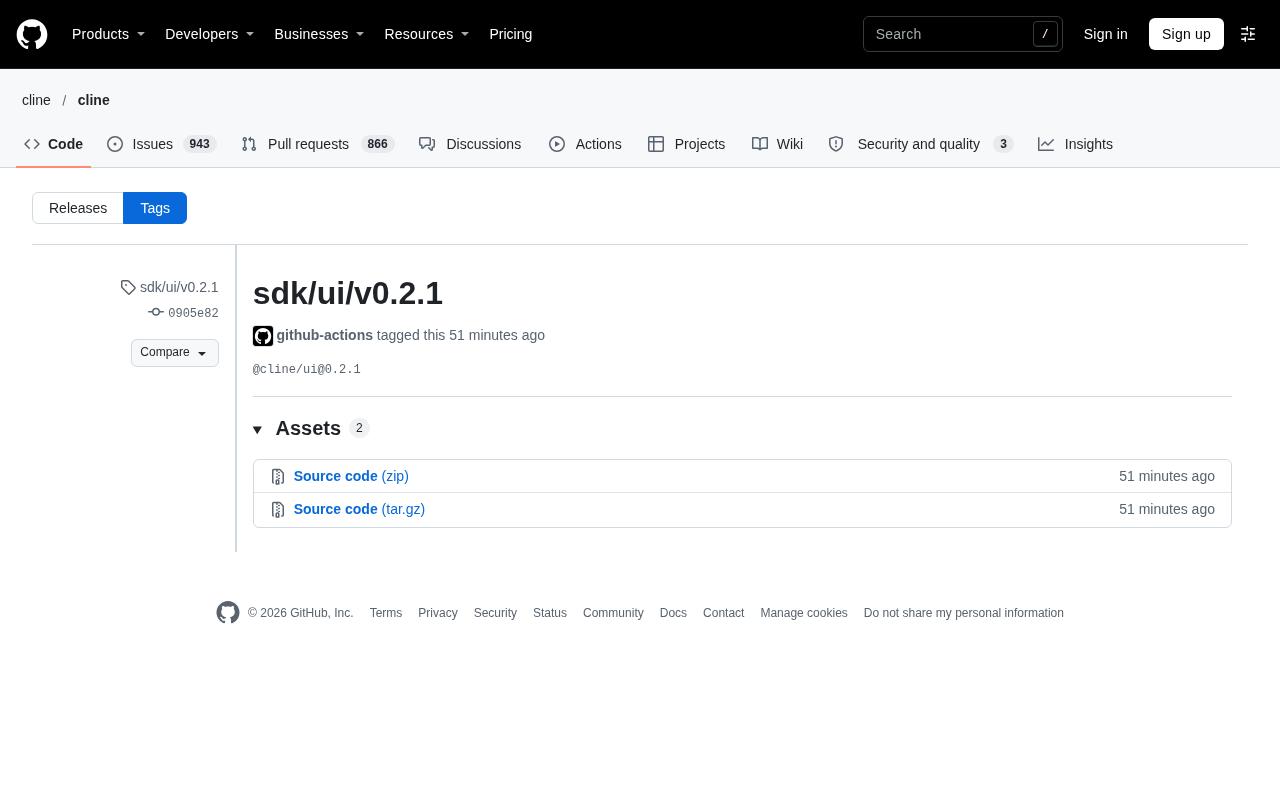
Frankly, this piece of material carries very little information. But 'little information' is itself a signal, and it's worth interpreting from both an engineering and a product perspective.
Structured Information Revealed by the Version Number
Judging the release cadence from 0.2.1
In semantic versioning, 0.x.y means the API is not yet committed to stability. 0.2.1 is a patch version, and by convention, patch versions usually contain only bug fixes, dependency upgrades, documentation corrections, or minor compatibility adjustments—not breaking changes or major features.
This judgment has two practical implications:
- For consumers: upgrading from
0.2.0to0.2.1is usually low-risk, but you should still be aware that at the0.xstage, any version can carry behavioral adjustments. - For maintainers: frequent patch releases often mean the project is in an active iteration phase with fast issue response.
Semantic Versioning (SemVer) is defined by semver.org, with the format MAJOR.MINOR.PATCH. MAJOR increments on incompatible API changes, MINOR on backward-compatible feature additions, and PATCH on backward-compatible bug fixes. The specification specifically notes that the 0.y.z stage is the 'initial development phase,' where anything may change at any time and the public API should not be considered stable. So the 2 in 0.2.1 does not mean 'two feature versions'—it means the project has not yet entered the 1.0.0 stability line; maintainers can introduce behavioral adjustments or even breaking changes between 0.x releases at their own pace without bumping MAJOR. This is also why, when making upgrade decisions for 0.x packages, you cannot infer compatibility from the version number alone the way you would for 1.x and above—you still need to look back at the specific changes.
Automated release pipeline
The release record clearly shows the github-actions account performing the tag operation, along with the unified naming @cline/ui@0.2.1. This indicates the package uses a CI-driven automated release process rather than manual builds. For developers, this is a positive signal: automated releases usually mean version consistency is guaranteed, and the published package corresponds one-to-one with the tag in the repository, providing stronger traceability.
GitHub Actions is the CI/CD platform provided by GitHub, where trigger conditions and execution steps are defined through workflow YAML files in the repository. In the npm package publishing scenario, a common approach is to configure a workflow that triggers on tag push or merge to the main branch, which executes npm publish and authenticates using GITHUB_TOKEN—hence the github-actions bot account appearing in the release record. Combined with npm's provenance mechanism, the published package can also be cryptographically bound to a specific commit and build process for downstream verification. The value of such pipelines lies in eliminating the risk of 'local manual npm publish causing package contents to diverge from the repository,' forming a traceable chain of tag → commit → artifact.
Insights from the SDK/UI Layered Architecture
From the package name @cline/ui and the path sdk/ui, it's clear that Cline distributes UI capabilities as an independent sub-package under the SDK system. This kind of split has several clear benefits in real projects:
- On-demand imports: Higher-level applications can depend on just the UI layer without pulling in the full SDK.
- Independent evolution: The UI package can iterate faster than the core SDK, with decoupled version numbers.
- Clear boundaries: The
sdk/uidirectory structure suggests other parallel sub-modules exist internally, with UI being just one facet.
For integrators, the direct benefit of this kind of package-splitting strategy is dependency size and upgrade flexibility; the cost is needing to track the version compatibility matrix across multiple sub-packages.
Monorepos and sub-package splitting is the underlying pattern of this architecture. Cline keeps its code in a single repository, managing multiple sub-packages like sdk/ui through workspaces (such as npm/pnpm workspaces), where each sub-package independently has its own package.json, version number, and release pipeline, ultimately published to npm under scoped package names like @cline/ui. In this model, sub-packages reference each other through protocols like workspace:*, linking directly to source code during local development and resolving to specific version numbers at publish time. It solves the pain point of 'multi-package version synchronization' but also introduces the management cost of peer dependencies and version compatibility matrices—integrators need to ensure that @cline/ui doesn't conflict with the version range of the core SDK it depends on.
The 'Noise' on the Release Page Is Also a Real State
The release page showed loading failures and 'No results found' messages multiple times. This isn't unique to Cline—GitHub's tag comparison and release asset sections often render abnormally in certain network environments.
From an engineering perspective, this reminds us of two things: first, beyond the automated release pipeline, the readability of release content is equally important—tag-only releases are not conducive to external users understanding changes; second, relying on the release page as the sole source of changes is not reliable—the actual differences still need to be confirmed through commit comparisons or the CHANGELOG.
How to Decide Whether Such Updates Are Worth Upgrading
In the absence of release notes, it's recommended to make decisions in the following order:
- Open the comparison view for commit
0905e82to see the actual scope of changed files. - Check whether dependency versions are involved, especially UI-related foundational libraries.
- If your project has pinned
0.2.0, verify in a small-scale environment before a full upgrade. - Watch for whether formal release notes are added later.
Summary
@cline/ui@0.2.1 is a typical patch release completed automatically by CI. It provides no visible change descriptions, so no functional judgments can be made; what can be confirmed is only the version number, commit identifier, and release method. For such updates, the rational approach is to treat it as a minor version that requires your own verification, rather than a meaningless release that can be skipped.
One-line Summary
Cline's @cline/ui@0.2.1 is a CI-automated patch release with no release notes, requiring you to verify changes yourself.
Paragraph Summary
The article focuses on Cline's @cline/ui@0.2.1 release, noting that this update left behind almost nothing but the version number, tag, and commit identifier (0905e82), with the release page failing to load multiple times and no visible change descriptions. The author interprets it from three angles: semantic versioning indicates that the API is not yet stable at the 0.x stage, and patch versions usually contain only fixes and dependency adjustments, so upgrade risk is low; the github-actions account applying the tag indicates a CI-driven automated release with guaranteed version consistency and traceability; the sdk/ui path reflects an architecture where UI capabilities are split into an independent sub-package, bringing the benefits of on-demand imports and independent evolution, at the cost of managing a multi-package compatibility matrix. The article concludes with upgrade decision steps when release notes are missing: check the commit comparison, check dependency changes, verify in a small scope, and watch for follow-up notes.
Related articles

Prompt Engineering for Beginners: From Writing Prompts to Engineering Thinking
Starting from the essence and four functions of prompts, this article systematically explains the six-step process, four success criteria, learning value, and practical limitations of prompt engineering to help you build a complete understanding.

Anthropic Launches Nasdaq IPO: AI Giant's Listing and Risk Disclosures
Anthropic officially launches its Nasdaq IPO under ticker ANT, with market valuation expected to potentially exceed SpaceX's record. The prospectus devotes nearly 100 pages to AI risks, while first-half revenue grew over 14x but net losses widened sharply, reigniting the AI bubble debate.

Rust cURL Clone Uses 4,832 unsafe Blocks—Is the Memory Safety Myth Broken?
A Rust cURL clone uses 4,832 unsafe keywords, challenging Rust's memory safety narrative. We analyze what unsafe really means, compare Fil-C, and examine rewrite motives.