Clippo: Orchestrate Your AI Coding Agent Team on a Visual Canvas

Clippo uses an infinite visual canvas to orchestrate multiple AI coding agents locally with zero cloud or login required.
Clippo is a Windows-native AI agent orchestration tool built around an infinite canvas where developers can place and connect nodes for Claude Code, Codex, OpenCode, and other AI coding tools, letting multiple agents work in parallel through a visual graph structure. It emphasizes a local-first approach — on-device memory to compress token usage, native Windows performance, and zero cloud/zero login for code privacy. The core value proposition is elevating developers from typing individual commands to acting as the tech lead of an AI engineering team. With 72 Product Hunt upvotes, the product shows promise, though key technical details around orchestration granularity and cross-agent context handling still need real-world validation, and its Windows-only support limits its audience.
When Terminal Tabs Become a Developer's Nightmare
Every developer who's worked with AI coding tools has probably been there: a screen full of terminal windows — one running Claude Code, another running Codex, plus several CLI tools you're constantly switching between — and things spiral into chaos fast. Managing the collaborative work of multiple AI agents often ends up being more exhausting than writing code itself.
Clippe, which recently appeared on Product Hunt, targets exactly this pain point. Its positioning is straightforward: turn software development into a "visual command center" where you act as a tech lead overseeing your AI engineering team, rather than frantically juggling a pile of terminal tabs. The product has earned 72 upvotes and ranked #17 on Product Hunt, categorized under Windows, Developer Tools, and Artificial Intelligence.
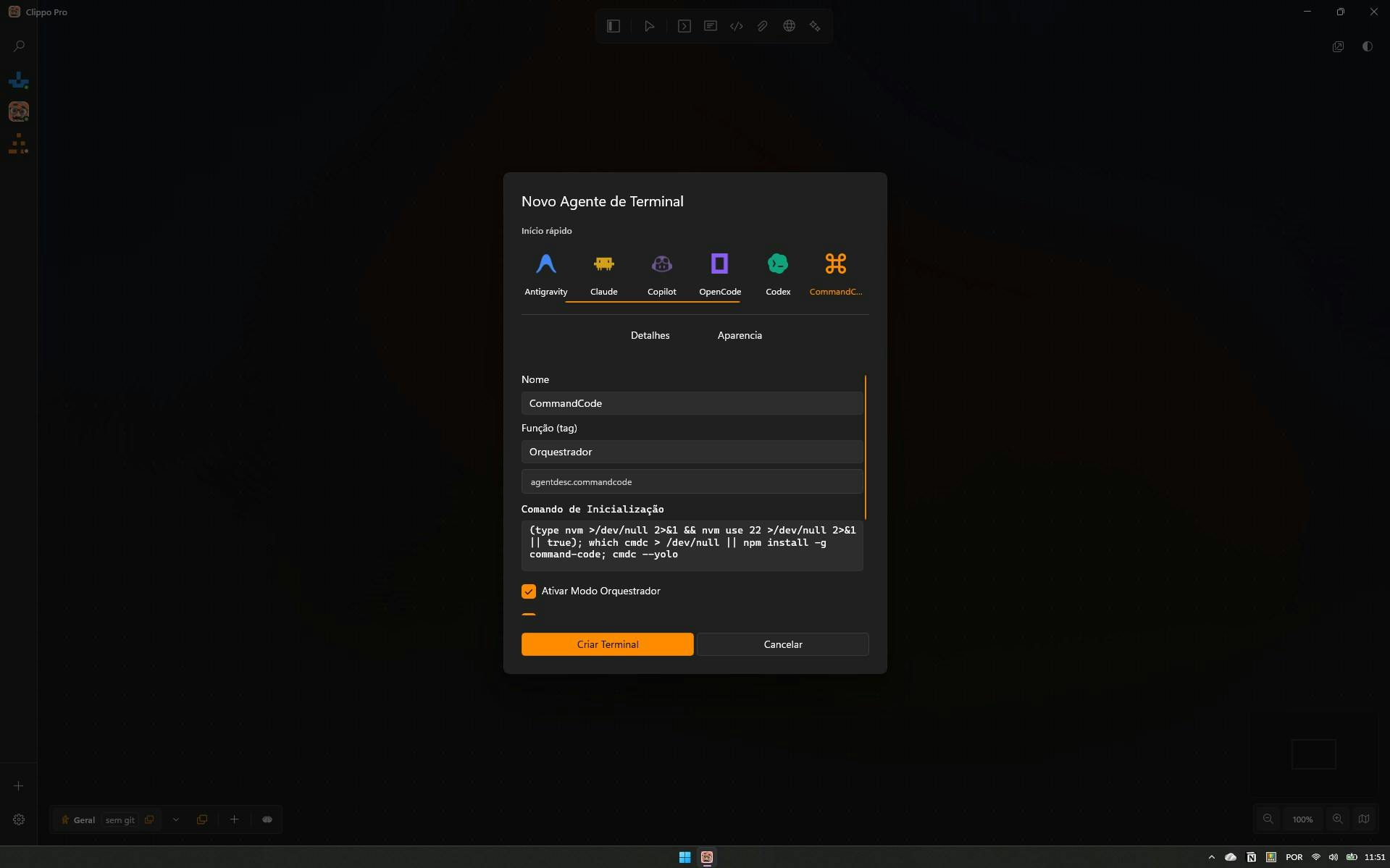
Agent Orchestration on an Infinite Canvas
Clippe's core interaction is an "infinite canvas." Developers can place and connect various AI coding agent nodes on the canvas — officially supported tools include Claude Code, OpenCode, Codex, CommandCode, Antigravity CLI, Kiro, and other mainstream tools.
The elegance of this design lies in how it uses linking nodes to let multiple agents work in parallel, allowing users to visually watch each one writing code. Compared to calling agents one by one from the command line, this node-based visual orchestration turns the abstract concept of "agent collaboration" into a visible, manipulable graph structure. For complex projects that need multiple models handling different modules, this kind of bird's-eye view offers real practical value.
In essence, Clippo elevates the developer's role from "typing every command manually" to "orchestrating and directing" — which is precisely the selling point it keeps emphasizing: become the tech lead of your own AI engineering team.
The infinite canvas as an interaction paradigm was popularized by collaborative tools like Miro and FigJam, with the core advantage of breaking fixed screen boundaries and letting users freely lay out nodes and relationships. Bringing this paradigm into AI agent orchestration is essentially a visualization of "workflow orchestration" — tools like n8n and LangGraph already use node graphs to describe LLM call chains. Clippo's distinction is that it targets terminal CLI tools rather than the API call layer. The key challenge in node-based orchestration typically lies in the semantics of "edges": a connection between two nodes isn't just a visual link — it needs to define how data flows and how one agent's output becomes another's input. This is also where such products most commonly hit bottlenecks in real-world complex projects.
Local-First: Saving Tokens, Native Speed, and Privacy
Another noteworthy aspect of Clippo is its local-first strategy. The product highlights three key features:
- On-device memory: Context memory is stored locally to reduce token consumption. For developers who frequently call large model APIs, token costs are a real expense, and local memory can help mitigate this to some degree.
- Native speed: Runs as a native Windows application, not cloud-based or browser-based.
- Complete privacy: Zero cloud, zero login. Everything happens locally with no account registration required — appealing to both enterprise developers and indie developers who care about keeping their code confidential.
In a landscape where most AI tools rely on cloud services and account systems, Clippo's purely local "no cloud, no login" positioning is a meaningful differentiator. It trades away the convenience of cloud collaboration in exchange for privacy and data sovereignty — ideal for users who don't want their code or context leaving their own machine.
The logic behind "on-device memory saving tokens" is worth unpacking. Large language model APIs typically charge based on the total number of input and output tokens. In multi-turn conversations or long-running projects, each API call requires stuffing the entire historical context back into the prompt, causing token consumption to balloon rapidly as sessions grow. The common approach to local memory is building a vector database or structured summaries, retrieving only the most relevant snippets at call time rather than the full context, thereby compressing the input length of each request. However, this compression inevitably carries a risk of information loss — the actual savings depend heavily on retrieval precision and summary quality. For agents like Claude Code or Codex that have their own context management mechanisms, how an external local memory layer coordinates with these tools' built-in state management is also a technical detail that remains to be validated.
Who It's For — and What Questions Remain
Based on the information available, Clippo targets developers who heavily use multiple AI coding agents and are running on Windows. The problem it aims to solve — chaotic management of multiple agents — is a genuinely growing pain point as AI-assisted coding becomes more widespread.
That said, it's worth noting objectively that the Product Hunt page is still leaning heavily toward marketing language. Several key questions remain to be verified: How granular is the visual canvas's orchestration in real projects? How are context passing and dependency relationships between different agents handled? What are the actual results and technical details behind "on-device memory saving tokens"? These all require hands-on testing to assess. Additionally, the product currently only supports Windows, which will lock out a significant portion of macOS and Linux developers.
Conclusion
Clippe represents an interesting evolutionary direction for AI coding tools. As single AI agents become insufficient and developers start orchestrating multiple agents simultaneously, the question of how to efficiently "orchestrate" rather than just "stack" these tools is becoming a new product opportunity. The combination of visual canvas + local-first + multi-agent parallelism gives it a recognizable identity among similar tools. Whether it can truly transform developers into "tech leads of their own AI engineering team" will ultimately depend on whether the real-world experience and ecosystem support can catch up to that ambition.
Related articles

Chain of Thought Isn't Just for AI: How Humans Can Use CoT to Improve Thinking Quality
Chain of Thought isn't just a prompt trick for large models. Starting from a Hacker News discussion, this article analyzes why CoT works for human thinking too, breaks down actionable ways to transfer it, and highlights the key differences between human CoT and machine CoT.
Cloudflare Teams Up with OpenAI: Closi…
Cloudflare Teams Up with OpenAI: Closing the Loop from Vulnerability Discovery to Defense with AI
Cloudflare uses OpenAI Daybreak to investigate security vulnerabilities and generate reviewable remediation plans, while developers use Codex to boost coding efficiency and quality.

Orca Multi-Agent Orchestration in Practice: A Guide to Parallel Collaboration with Claude and Codex
Orca is Stable AI's free open-source agent workbench supporting 34 agents like Claude Code and Codex in parallel. Learn its Git worktree isolation, multi-model orchestration, and mobile management.