CLM-8B: How a Contrastive Language Model Achieves Up to 9x Speedup

CLM replaces autoregressive generation with dual-encoder similarity search, delivering up to 9x faster decision-making.
CLM (Contrastive Language Model), developed jointly by Stanford and NVIDIA, achieves up to 9x faster inference than same-scale generative models using 8 billion parameters. Inspired by CLIP, it uses dual encoders to map context and candidate actions into a shared embedding space — the best decision is simply the highest-similarity action. The key accelerator is caching: candidate actions are encoded once and reused, so each step only requires a single context embedding and a dot product. In tests with 1,000 candidates, CLM takes 44ms versus 579ms for generative baselines. The trade-off is that independently encoded options can't be directly compared against each other, which may affect quality on tasks requiring fine-grained cross-candidate reasoning.
A New Decision-Making Paradigm
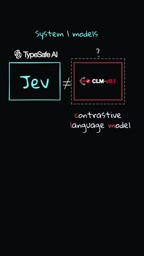
While the industry continues to debate generative (JEPA/Jev-style) models, a new model from Stanford and NVIDIA's research teams breaks with conventional thinking. It's called CLM (Contrastive Language Model), with 8 billion parameters — comparable to most mainstream model variants — but its underlying mechanism is entirely different. The researchers claim CLM can perform inference up to 9x faster than traditional generative models.
The question is: why can a model with the same 8B parameters be nearly an order of magnitude faster? The answer isn't a larger model or more compute — it simply doesn't "generate" answers the old way.
The Performance Bottleneck of Generative Models
To understand CLM's advantage, we first need to identify where the overhead in traditional generative decision models comes from. In a generative (Jev-style) model, every inference call requires feeding both the "current context" and "all available options" into the model together.
This means the more options there are, the more content the model must read and process at each step. As the decision space grows, compute scales linearly — or even faster. In scenarios requiring a choice from thousands of candidate actions, this "full ingestion" approach quickly becomes a latency bottleneck.
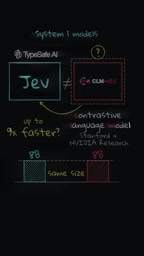
The "generative decision model" here specifically refers to architectures that output action descriptions or action tokens in an autoregressive manner, distinct from other generative paradigms like diffusion models. Jev (Joint Encoder-Value) style models are common in research combining reinforcement learning with LLMs. Their defining characteristic is concatenating all candidate action texts into the context and performing a single forward pass over the entire sequence to extract scores. This causes input length to grow linearly with the number of candidates, and since Transformer self-attention complexity is quadratic with respect to sequence length, doubling the number of candidates can more than double the computational cost. This is why, in scenarios like tool calling or API routing — where selection must be made from hundreds or thousands of candidates — generative inference latency is often unacceptable.
CLM's Core Mechanism: Decision-Making Like CLIP
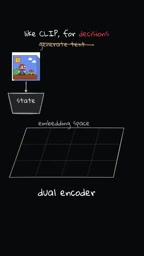
The most intuitive analogy for CLM is CLIP — except CLIP is used for image-text matching, while CLM is used for decision matching. The key insight is: CLM never generates an answer.
Instead, it uses a dual-encoder architecture: one encoder reads the "current context," and another encoder reads each "possible action" independently. The final decision is simply the action whose embedding is closest to the context in the embedding space. In other words, decision-making is transformed into a vector similarity retrieval problem, not a token-by-token text generation task.
Speedup Through Cache Reuse
What truly creates the performance gap is the caching mechanism. In many decision-making scenarios, the set of available actions typically doesn't change frequently from one step to the next. CLM exploits this: it encodes these actions only once and caches the results.
So at each new step, the model only needs to compute an embedding for the current context and perform a dot product against the cached action vectors — an extremely lightweight operation.
In tests with 1,000 candidate options, CLM takes approximately 44 milliseconds, while generative models require 579 milliseconds — the source of that ~9x difference.
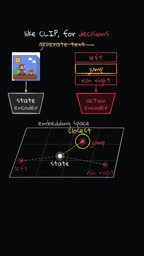
CLIP (Contrastive Language-Image Pre-Training), released by OpenAI in 2021, uses two independent encoders to map images and text into a shared embedding space, training by maximizing cosine similarity for matched pairs and minimizing it for unmatched ones. The essence of this contrastive learning paradigm is "discrimination" rather than "generation" — the model learns to distinguish and rank, not to synthesize outputs step by step. CLM transfers this paradigm to the decision-making domain: context plays the role of the image, candidate actions play the role of text, and the "optimal decision" is the action vector with the highest cosine similarity or dot product score. The underlying assumption is that a good decision can be measured by "how close the context and action are in semantic space," without requiring the model to "reason through" an entire chain of thought.
The Cost Beyond Speed
Every architectural choice involves trade-offs, and CLM is no exception. Because each option is encoded independently, CLM never places multiple options side by side for direct comparison during processing.
This stands in sharp contrast to generative models, which can see global information about all options in a single forward pass — enabling cross-referencing and trade-off analysis. CLM's "encode separately" approach delivers cache efficiency and fast retrieval, but at the cost of direct interaction between options. For tasks requiring fine-grained comparison and mutual constraint among candidates to arrive at the optimal judgment, this limitation could affect decision quality.
Implications for Engineering Practice
CLM's approach reflects a broader engineering trend: when decision-making can be reframed as a "nearest-neighbor retrieval" problem, replacing step-by-step generation with contrastive learning plus vector caching can often yield order-of-magnitude latency improvements. This architecture is especially attractive for applications with large action spaces, relatively stable candidate sets, and high real-time requirements — such as agent routing, tool call routing, and recommendation-based decision systems.
That said, whether to adopt a CLM-style solution depends on how much the task relies on cross-option interaction. If decision quality depends heavily on comparing candidates against each other, the generative path may remain irreplaceable. If the decision is primarily about "matching context to action," CLM's speed gains are substantial.
Note: The above content is based on a single YouTube source. The specific performance figures (44ms vs. 579ms, 9x speedup) are values claimed by the researchers in the video. It is recommended to refer to the official paper and benchmark results for verification.
This architecture aligns closely with the rise of the vector database ecosystem (e.g., Faiss, Pinecone, Weaviate). Once action embeddings are pre-computed and stored in a vector index, the "context → nearest-neighbor action" retrieval during inference can be further accelerated with approximate nearest neighbor (ANN) algorithms, maintaining millisecond-level response times even as the candidate set scales to millions. This means CLM-style solutions are naturally positioned to integrate with existing retrieval infrastructure — engineering teams can reuse established vector search toolchains without maintaining a separate generative inference service for the decision module. For scenarios where the action space slowly expands at runtime (e.g., adding new tools or APIs), only the new entries need to be incrementally encoded and inserted into the index, with no need to reprocess the full candidate set — further reducing maintenance overhead.
Related articles

DeepCell: One-Click AI Generation of Documents, Spreadsheets, and Slides
DeepCell tops Product Hunt with one-click generation of documents, spreadsheets, and slides, using the .deepcell format for linked updates, designed for System 2 tasks like modeling and sales reviews.

Doneas: 15-Minute Daily Accountability Calls That Keep Indie Developers From Procrastinating
Doneas is a daily accountability tool for indie developers: plan tasks on Monday, join a 15-minute call with five builders each day, and log deliveries on a public progress page. This article analyzes its core mechanics, effectiveness, and potential issues around retention and matching.

Fastlane 2.0: Fully Automated AI Ad Campaigns, From Creative to Optimization
Fastlane 2.0 is an AI ad automation tool: enter your website and it learns your brand, generates video and image ads, and runs and optimizes them on Meta, TikTok, Instagram, and YouTube.