Clocknext: Billing and Pricing Infrastructure Built for AI Agents

Clocknext provides billing infrastructure for AI apps and Agents with usage tracking, billable metrics, and flexible pricing.
Clocknext launched on Product Hunt, positioned as billing and monetization infrastructure for AI-native applications and Agents. The article notes that traditional SaaS subscription models can't reflect AI cost structures based on tokens, calls, or tasks, and teams can lose money while usage appears to grow. Clocknext covers real-time usage tracking, billable metric conversion, flexible pricing, and cost/margin monitoring for AI founders, revenue teams, and engineering teams. It also cautions that current information is mainly from official self-description, and metering accuracy, integration depth, and handling of pricing changes for existing bills still need real-world validation.
AI application commercialization is hitting a real-world problem: traditional subscription billing models can't accommodate AI usage patterns based on tokens, calls, or task completion. Clocknext launched on Product Hunt with exactly this positioning—providing billing and monetization infrastructure for AI-native applications and Agents.
Why AI billing needs dedicated infrastructure
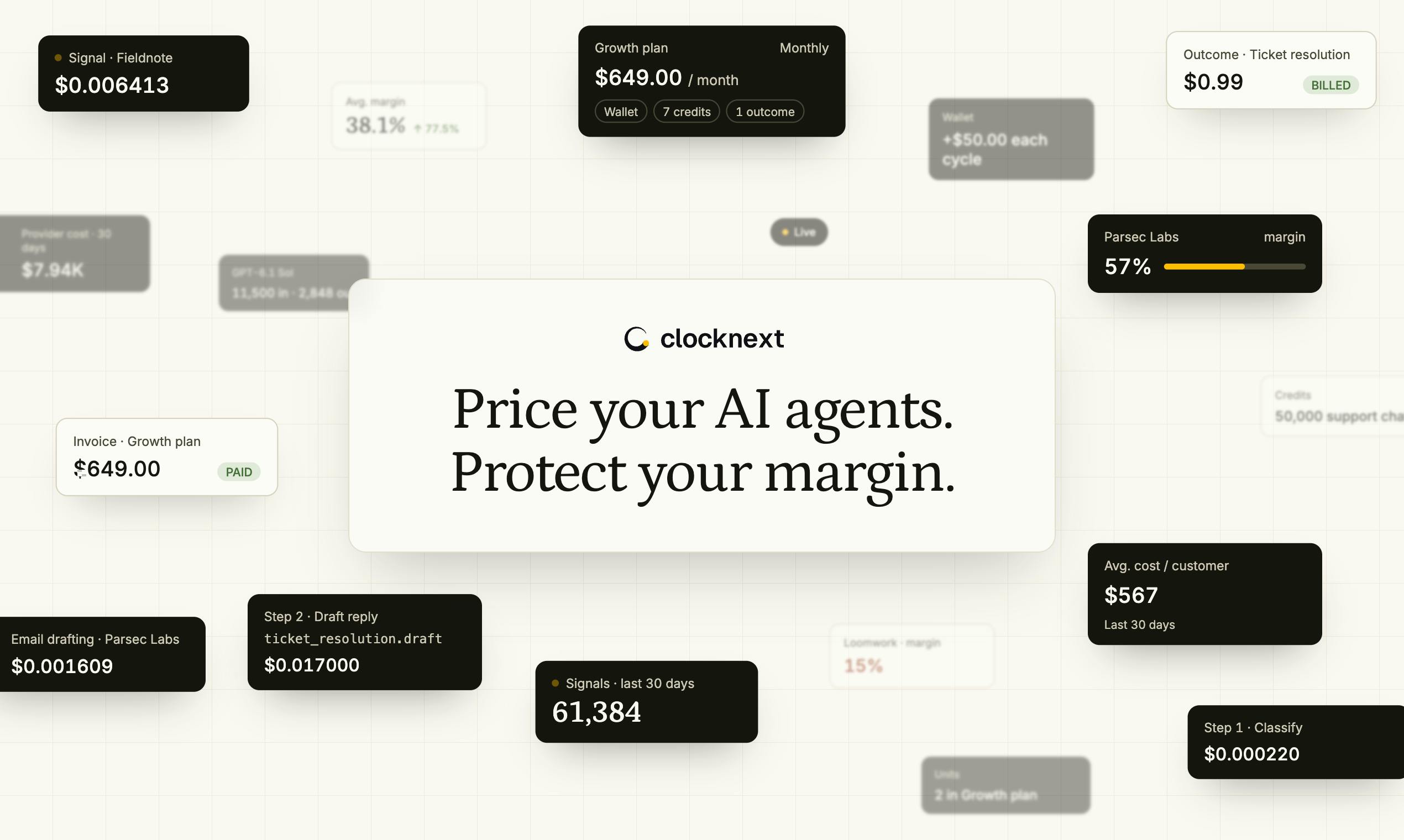
Traditional SaaS billing logic is relatively simple: monthly subscriptions, per-seat charges, with limited usage fluctuation. But AI products have a completely different cost structure. A single Agent task may trigger multiple model calls, tool calls, and external API requests, with each call's cost varying by model, context length, and reasoning depth. If product pricing doesn't reflect these differences, teams can easily keep losing money under the appearance of "usage growth."
Clocknext's entry point is to track AI usage in real time, convert it into billable metrics, and then sell it externally through flexible pricing plans. This pipeline covers the complete path from the engineering side (usage collection) to the business side (pricing and billing), rather than just being a bill generator.
Unit Economics refers to calculating the relationship between revenue and variable costs on a per-customer, per-task, or per-billing-unit basis, with common metrics including unit gross margin and the ratio of customer lifetime value to acquisition cost. The variable costs of AI products are highly dependent on model selection, context length, and reasoning depth—the actual cost of the same feature can differ several-fold across different customers. Embedding unit economics into the billing system means every unit of usage can be mapped to both cost and revenue sides, enabling data-backed decisions on customer segmentation, pricing tiers, and quota design, rather than relying on end-of-quarter financial summaries.
Product positioning: For AI founders and revenue engineering teams
According to the Product Hunt page description, Clocknext's target users are AI founders, revenue teams, and engineering teams. This positioning shows it's neither a pure developer tool nor a pure finance tool, but a middle layer spanning both ends.
For AI startups, this position is quite critical. Early-stage teams often launch with simple per-use billing first, only to discover after user scale grows that gross margins were overestimated and certain customer segments are actually losing money. Clocknext claims to monitor costs, margins, and profitability at every level, which is equivalent to embedding "unit economics" calculations into the billing system, making it part of ongoing operations rather than a spreadsheet calculated temporarily during fundraising.
Core capabilities breakdown
Based on the official description, Clocknext's capabilities can be summarized into three stages:
Real-time usage tracking—collecting AI usage data from the product as the source of truth for billing. In AI scenarios, usage data sources are scattered—model calls, Agent steps, and tool executions may be distributed across different services, and unified collection itself is an engineering challenge.
Billable metric conversion—transforming raw usage into externally sellable billing units. This determines whether the product can use pricing methods closer to customer value such as "per task" or "per outcome," rather than being limited to per-token pricing.
Flexible pricing plans—supporting combinations of different price structures. AI product pricing often requires hybrid models, such as base subscription plus overage usage, or tiered pricing based on the number of tasks completed by Agents.
On this foundation, cost and profit monitoring provides a feedback layer: whether pricing plans actually make money can be seen directly in the system's data, rather than relying on after-the-fact reviews.
Metering vs. Billing separation is key to understanding this type of system architecture. Metering is responsible for recording every usage event with high precision and auditability, typically requiring event collection, deduplication, aggregation, and persistent storage; billing maps aggregated usage into amounts according to pricing rules and generates invoices. The benefit of separation is that pricing strategies can be adjusted repeatedly without affecting raw usage data, and usage data can also be used independently for cost analysis, customer reports, and dispute verification. If metering logic is hard-coded into the billing process, any pricing change may require re-running or retroactively processing historical data—a high-risk proposition.
Competitive landscape and observations
The AI billing space has seen multiple players emerge over the past two years, each with different focuses: some start from usage metering, some extend from subscription billing management, and others lean more toward enterprise-level revenue operations. Clocknext's distinguishing feature is putting "pricing design" and "cost monitoring" in the same product, emphasizing a closed loop from usage to profit.
Worth noting: the Product Hunt page information mainly comes from the official self-description. The 83 votes and 26 comments reflect early attention, but the product's metering accuracy under real high-concurrency, multi-tenant scenarios, the depth of integration with mainstream model service providers, and the ability to handle pricing changes for existing customer bills all require real integration validation. Once a billing system makes errors, it directly affects customer trust and revenue recognition—the reliability threshold for this type of infrastructure is far higher than for general-purpose tools.
For AI teams transitioning from "free trial" to "formal charging," Clocknext represents a category of solutions worth evaluating: rather than building a billing and usage tracking system in-house, it may be better to introduce dedicated infrastructure early to lower the cost of pricing experiments. Whether it fits depends on the complexity of the product's own usage structure and the team's requirements for billing transparency.
Multi-tenancy refers to a single system instance serving multiple isolated customer organizations. For billing infrastructure, multi-tenancy challenges concentrate in three areas: usage data must be strictly isolated by tenant to prevent cross-account contamination and unauthorized queries; quotas, rate limiting, and overage policies need to be independently configured per tenant and take effect in real time; billing cycles, currencies, and tax rules may vary by tenant. Under high concurrency, out-of-order events, duplicate reports, and delayed arrivals also test the metering pipeline's idempotency design and reconciliation capabilities—these are typically the areas most worth stress-testing when evaluating such products.
Frequently asked questions
What stage of teams is Clocknext suitable for? The official positioning targets AI founders and revenue and engineering teams—based on the description, it's more suitable for AI-native applications that have already started charging or are preparing to charge, rather than completely free experimental projects.
How is it different from ordinary subscription billing tools? The core difference lies in real-time tracking of AI usage and conversion into billable metrics, as well as the ability to monitor costs and margins at every level—capabilities that traditional subscription billing tools typically lack.
Can it replace a self-built billing system? It depends on the complexity of the product's usage structure. For AI products that need frequent pricing adjustments and have scattered usage sources, introducing dedicated infrastructure can reduce development and maintenance costs; specific integration results require actual testing.
One-line Summary
Clocknext provides billing infrastructure for AI applications and Agents with usage tracking, billable metric conversion, and flexible pricing.
Paragraph Summary
Clocknext launched on Product Hunt, positioned as billing and monetization infrastructure for AI-native applications and Agents. The article points out that traditional SaaS models of monthly subscriptions and per-seat charges cannot reflect the cost structure of AI products billed by token, by call, or by task, and teams can easily keep losing money under the appearance of usage growth. Clocknext's pipeline covers real-time usage tracking, billable metric conversion, flexible pricing plans, and cost and profit monitoring, with target users spanning AI founders, revenue teams, and engineering teams. The article also notes that current information mainly comes from official self-description, and the 83 votes and 26 comments only reflect early attention—metering accuracy, integration depth with model service providers, and the ability to handle pricing changes for existing bills still require actual integration validation.
Related articles
 Tech Frontiers
Sherlock: An Open-Source Tool for Tracking Usernames Across Social Networks
Sherlock is an open-source Python tool that tracks social accounts across networks by username. This article covers its core features, why developers love it, typical use cases, and privacy compliance considerations.
 Tech Frontiers
GitHub Daily·Nov 07: Agent-Ready and Context Compression
GitHub Trending Nov 07: meta's agent-ready design system astryx, billion-context's 5x context compression, sherlock nearing 100k stars, plus local-first localthings and bare-metal GPU orchestration nvke.
 Tech Frontiers
Buoyant Open-Sources Kinference: An Inference Control Plane for vLLM on K8s
Buoyant open-sources Kinference, an inference control plane for vLLM on Kubernetes, with declarative routing, KV-cache-aware load balancing, and per-tenant metrics—claiming 95% lower median TTFT in official benchmarks.