Closed-Loop Stimulation Control of LLMs: H∞ Controllers Improve Out-of-Distribution Robustness

Researchers reframe LLM steering as closed-loop feedback control, using an H∞ controller for out-of-distribution robustness.
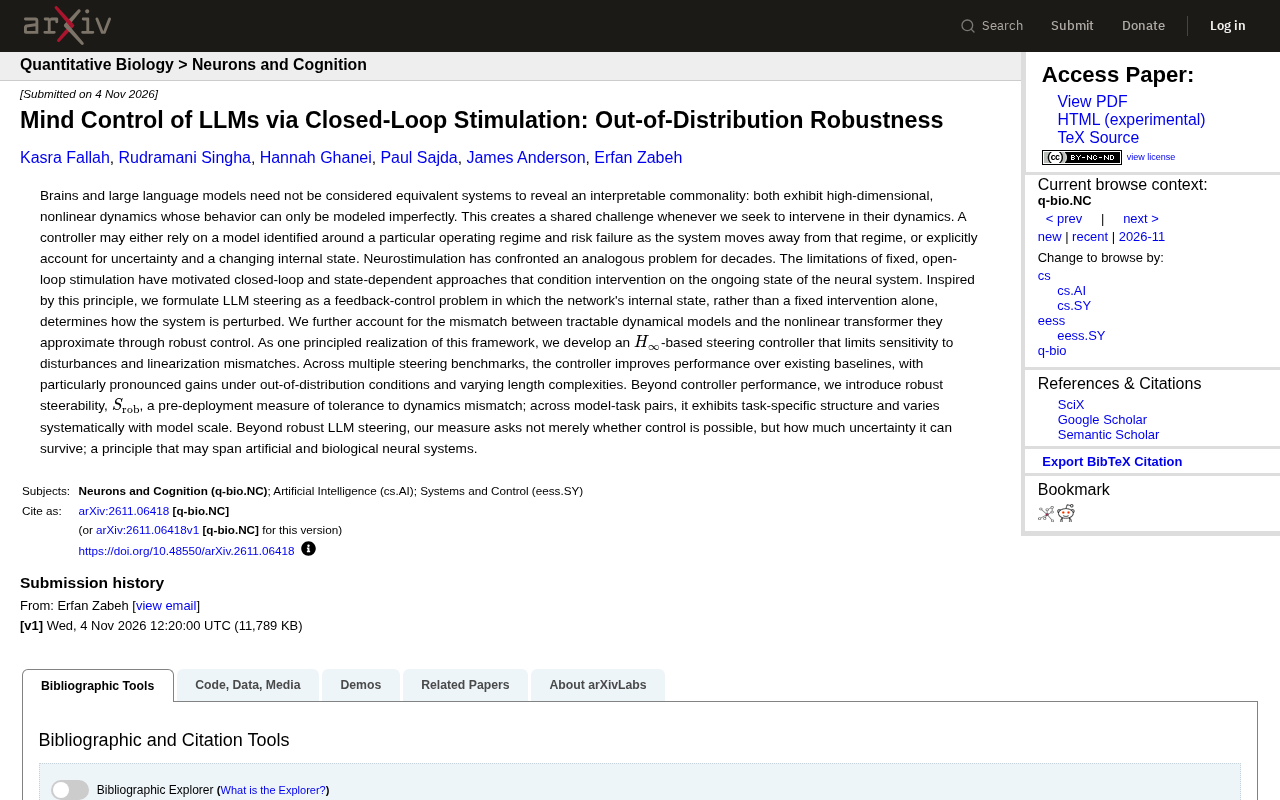
This article presents a study that transfers the closed-loop intervention approach from neural stimulation to large language model control. Since fixed open-loop steering is limited by constantly changing internal model states, the researchers formalize LLM steering as a feedback control problem in which the model's internal state determines perturbations in real time. To handle the structural mismatch between tractable models and the true Transformer, the team adopts a robust control framework and implements an H∞-based steering controller aimed at limiting sensitivity to perturbations and linearization errors. Across steering benchmarks, the controller outperforms existing baselines, especially under out-of-distribution conditions and length complexity changes. The study also proposes the robust steerability metric S_rob for pre-deployment assessment of tolerance to dynamics mismatch, finding that it varies systematically with model scale.
Title
Closed-Loop Stimulation Control of LLMs: H∞ Controllers Improve Out-of-Distribution Robustness
Meta Description
This research brings the closed-loop control approach from neural stimulation to LLM steering, proposing an H∞-based feedback controller that significantly outperforms existing baselines under out-of-distribution conditions. It also introduces a robust steerability metric, S_rob, for pre-deployment evaluation of a model's tolerance to dynamics mismatch.
Article Content
For decades, the field of neural stimulation has grappled with a thorny problem: fixed open-loop stimulation has limited effectiveness because the internal state of the nervous system is constantly changing, and one-size-fits-all interventions struggle to remain effective over time. Now, a study has transferred this idea to the control of large language models—rather than relying on a fixed intervention vector, the model's internal state determines in real time how to perturb the system.
Why Fixed Interventions Fail
Brains and large language models are not equivalent systems, but they share a key characteristic: high-dimensional, nonlinear dynamical behavior that can only be imperfectly modeled. This poses a common challenge for any control approach that attempts to intervene in their behavior.
Specifically, if a controller relies on a model identified within a particular operating regime, its control performance may degrade sharply when the system deviates from that regime. The alternative is to explicitly account for uncertainty and changes in internal state, but this requires the controller to be capable of handling model mismatch.
Historical experience in the field of neural stimulation shows that closed-loop and state-dependent intervention strategies are precisely designed for this—modulating stimulation according to the real-time state of the nervous system, rather than executing a pre-programmed fixed schedule.
Reframing LLM Steering as a Feedback Control Problem
The researchers formalized LLM steering as a feedback control problem: the network's internal state itself, rather than a fixed intervention vector, determines how the system is perturbed. The core of this reframing is the recognition that a structural mismatch exists between any tractable dynamical model and the true nonlinear Transformer.
To address this mismatch, the study introduces a robust control framework. As a principled implementation of this framework, the team developed an H∞-based steering controller designed to limit the system's sensitivity to perturbations and linearization errors. In other words, the controller does not aim to be optimal under an ideal model, but rather to remain reliable when the model is imperfect.
This design orientation stands in sharp contrast to open-loop interventions: the latter may perform reasonably well within the training distribution, but once the input distribution shifts, performance can deteriorate rapidly.
H∞ control (H-infinity control) is a classic framework in robust control theory, where the ∞ in its name refers to the H∞ norm of the system's transfer function in the frequency domain. The design goal is to minimize the energy gain from disturbance to output in the worst case, rather than performing optimal optimization for some nominal model. This property makes it naturally suited to handling model mismatch: when the actual system (here, the nonlinear Transformer) deviates from its linearized approximation, the H∞ controller can still guarantee certain stability and performance bounds. In the LLM steering setting, the researchers treat interventions in activation space as control inputs and shifts in the model's output distribution or internal state as the controlled variables, thereby applying this framework to solve for controller parameters. Compared with schemes such as LQR that rely on precise models, the H∞ approach has greater deployment value under model uncertainty.
Linearization error and structural mismatch: The attention mechanism and feedforward networks of a Transformer constitute a highly nonlinear dynamical system, and any tractable model used for controller design (such as local linearization or low-order approximation) can capture only part of the true dynamics. This mismatch is not random noise but structural—it is systematically amplified as the system deviates from its operating point. Feedback control theory distinguishes between "parametric uncertainty" and "unmodeled dynamics," and the latter is precisely the main challenge faced by LLM steering. The core idea of robust control is not to seek to eliminate mismatch but to design a controller with bounded sensitivity to mismatch, so that the closed-loop system remains stable within the range of mismatch. Understanding this is essential to understanding why the researchers emphasize "limiting sensitivity to perturbations and linearization errors" rather than "improving model accuracy."
Performance Advantages Under Out-of-Distribution Conditions
Across multiple steering benchmarks, the H∞ controller achieved better performance than existing baseline methods. The study particularly notes that the improvements are especially pronounced under out-of-distribution conditions and when length complexity varies.
The significance of this result lies in validating the practical value of the closed-loop feedback approach in LLM control—the controller can dynamically adjust interventions according to the model's current state, rather than rigidly executing a preset strategy. For developers who need to deploy model steering in real-world scenarios, out-of-distribution robustness often determines whether a system is usable more than in-distribution accuracy does.
Out-of-distribution (OOD) conditions in the LLM context generally refer to inputs whose length, complexity, domain, or task type fall outside the distribution covered during controller training. For open-loop intervention methods, the intervention vector is optimized within the training distribution; once input features shift, the fixed perturbation may no longer act on the correct activation subspace and may even produce counterproductive effects. A closed-loop controller, by contrast, adjusts intervention strength and direction in real time according to the current internal state, and thus can maintain a certain level of steering effectiveness even when the input distribution shifts. Changes in length complexity are especially challenging for controllers: the longer the sequence, the more complex the dynamics of the activation space and the greater the accumulated error of fixed interventions, whereas state-dependent strategies can correct position by position. This result is the core empirical evidence that the closed-loop approach outperforms open-loop schemes in real deployment scenarios.
Robust Steerability: A Pre-Deployment Predictive Metric
In addition to the controller's own performance, the study also proposes a new metric—robust steerability (S_rob)—for measuring, before deployment, a system's tolerance to dynamics mismatch.
This metric exhibits task-specific structure across different model-task combinations and varies systematically with model scale. This means that S_rob is not only an evaluation tool but may also reveal a deeper relationship between model scale and controllability.
More broadly, the question raised by this metric goes beyond "whether control is possible": it also asks "how much uncertainty control can withstand." The researchers believe this principle may apply to both artificial and biological nervous systems, providing a new point of entry for cross-disciplinary dialogue between the two fields.
The proposal of robust steerability (S_rob) responds to a practical pain point: before deploying a steering controller, how can one judge whether a given model-task combination is "worth controlling"? Traditional steerability metrics mostly measure intervention effectiveness under nominal conditions and cannot reflect performance degradation under model mismatch. By quantifying a system's tolerance to dynamics mismatch, S_rob evaluates controller robustness upfront as a model property. The finding that it varies systematically with model scale suggests that larger models may have smoother activation manifolds or lower degrees of local nonlinearity, and thus be more tolerant of mismatch. This provides a quantifiable analytical tool for the question of "whether scale improves controllability," as well as a pre-deployment basis for decision-making in cross-model comparison and controller selection.
Takeaways Worth Noting
By combining the closed-loop stimulation concept from neuroscience with robust control theory, this work offers a path for LLM steering that differs from prompt engineering and fixed activation interventions. It reminds us that, given that model dynamics can only be approximately modeled, a controller that acknowledges its own uncertainty is often more practical than one that assumes a perfect model.
For researchers and engineers concerned with AI controllability and interpretability, the robust steerability metric provides a quantitative pre-deployment perspective that deserves further validation and extension in future work.
One-line Summary
Researchers reframe LLM steering as a closed-loop feedback control problem, using an H∞ controller to improve out-of-distribution robustness and proposing a steerability metric.
Related articles

AI Coding Enters the Team Collaboration Era: Interpreting Three Major Moves from Meta, GitHub, and Mistral
Meta acquires Conductor, GitHub Copilot Fusion becomes available, Mistral opens Large 4 weights—three moves show AI coding shifting from code generation to organizing development workflows. This article explains task orchestration, model collaboration, and cost control for developers.

Building a RAG Assistant with Dify: A Practical Guide to Knowledge Bases, Workflows, and Agent Nodes
How should knowledge bases, workflows, and Agent nodes connect in a Dify RAG assistant? We break down the division of labor and wiring logic for a shippable app.
 Tech Frontiers
The AI Industry Doesn't Lack Marketing—It Lacks Good Products
AI faces market selloffs and public skepticism—is marketing really the problem? This analysis of market signals and product experience argues the core困境 is incomplete products and a gap between promises and experience; the only way to change perceptions is to ship better products.