Cloudflare Launches Clef Decision Models: Open Source, Cost-Effective, and Low-Latency

Cloudflare launches Clef decision models with low latency, low pricing, Apache-2.0 licensing, and RL fine-tuning support.
Cloudflare has launched the Clef decision model series on Workers AI, featuring the 27B flagship Clef ($0.24/M input tokens) and the 9B lightweight Clef-flash ($0.09/M, 38.8ms median latency). Both models use Apache-2.0 licensing and are Jev-compatible to minimize migration costs. Leveraging Cloudflare's global edge network, they target latency-sensitive use cases like API routing, real-time risk assessment, and content moderation. A bundled RL fine-tuning service allows enterprises to customize models on their own business data, marking a broader industry shift toward vertical-scenario cost-efficiency in AI deployment.
Cloudflare has recently launched a series of decision-focused large language models called Clef on its Workers AI platform, emphasizing open-source licensing, highly competitive pricing, and millisecond-level decision latency. This move signals that Cloudflare is extending its edge computing network advantages into AI inference — particularly for decision-making scenarios that demand rapid response.
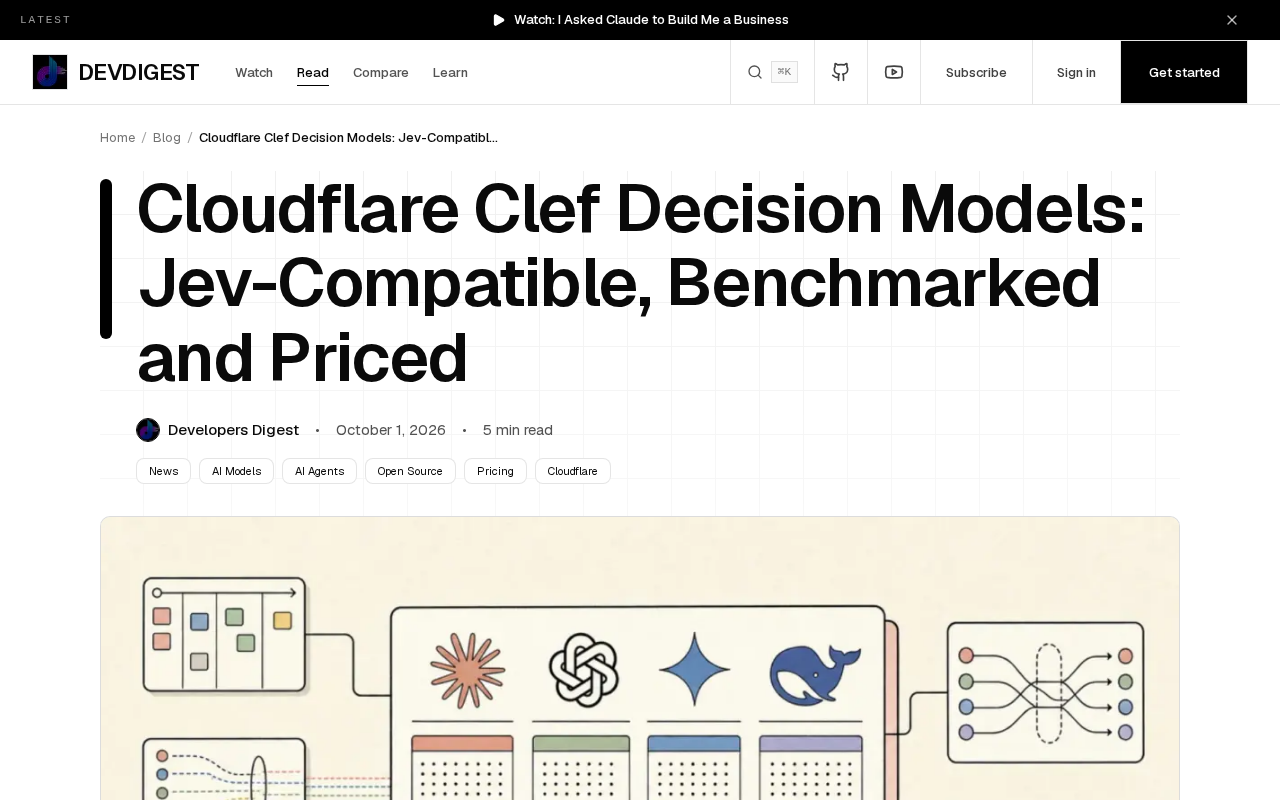
Core Specifications of the Clef Model Family
The Clef series currently includes two models, designed to address different performance and cost requirements.
The flagship Clef is a 27B-parameter decision model released under the Apache-2.0 open-source license, meaning developers can use it relatively freely in commercial projects without worrying about licensing restrictions. Its pricing on Workers AI is $0.24 per million input tokens — quite affordable for its parameter scale.
The lightweight Clef-flash is a 9B-parameter model priced even lower at $0.09 per million input tokens. More importantly, its median decision latency is just 38.8 milliseconds — a figure that makes it highly attractive for latency-sensitive applications such as real-time decision-making, request routing, and content moderation.
Why the Apache-2.0 License Matters
The choice of Apache-2.0 licensing is worth noting. Compared to open-source licenses that impose usage restrictions or require additional approvals, Apache-2.0 grants enterprises greater freedom — including the ability to fine-tune, deploy, and even redistribute the model. This lowers the compliance barrier for integrating Clef into production environments and leaves room to build toolchains around it.
Jev Compatibility and Ecosystem Integration
Both models are claimed to be Jev-compatible. This compatibility means that applications already developed against this interface standard can switch to Clef models at low migration cost, without needing to rewrite their calling logic from scratch.
This compatibility strategy benefits Cloudflare's goal of growing model adoption — rather than requiring developers to adapt to an entirely new interface, existing workflows can be onboarded smoothly. For teams that already have experience with decision models, this reduces friction when evaluating or replacing their current solution.
Jev (JSON Execution Vocabulary — though some suggest its full name has not been fully standardized publicly) is an interface specification designed for AI model invocation, aiming to unify request formats, parameter structures, and response body definitions across different model services. Similar to how the OpenAI Chat Completions API has become a de facto standard in conversational model deployment, Jev seeks to play the same role in decision model invocation. Developers write their calling logic once in the Jev interface format and can switch between multiple compatible models without maintaining separate adapter layers for each one. For enterprise applications, this interoperability reduces vendor lock-in risk and simplifies A/B testing across different models. It's worth noting that Jev is still a relatively nascent ecosystem standard, and its actual community coverage and toolchain maturity should be evaluated against your specific tech stack.
The Real Value of Low-Latency Decision-Making
Clef-flash's 38.8ms median latency is one of its biggest differentiators. In decision-making tasks, latency is often more critical than raw generation quality.
Consider a few typical scenarios: request routing at API gateways, real-time traffic risk assessment, and policy selection in content delivery. These scenarios typically sit on the critical path — every millisecond of added latency compounds directly into end-user experience. Cloudflare's globally distributed edge network is a natural fit for latency-sensitive inference tasks, and Clef-flash is purpose-built to leverage that advantage.
A Two-Tier Value Design
Cloudflare has built a clear tiered architecture with Clef and Clef-flash: tasks requiring higher decision accuracy can call the 27B Clef, while high-frequency tasks prioritizing speed and cost efficiency go to the 9B Clef-flash. The price difference between $0.24 and $0.09 also lets enterprises allocate costs based on task criticality.
Bundled RL Fine-Tuning Service
Beyond the out-of-the-box models, Cloudflare has also bundled a Reinforcement Learning (RL) fine-tuning service with the Clef series. This means enterprises can not only call the pre-trained model directly, but also optimize it on their own decision data.
RL fine-tuning is especially valuable for decision-making tasks because decisions typically come with clear reward signals — such as click-through rates, conversion rates, or interception accuracy. Using RL to align a model with business objectives over time delivers better long-term outcomes than prompt engineering alone. This service elevates Clef from a general-purpose model to a customizable decision engine.
Reinforcement Learning (RL) fine-tuning is fundamentally different from the more common Supervised Fine-Tuning (SFT) approach. SFT relies on human-annotated "correct answer" examples, whereas RL fine-tuning defines a reward function that allows the model to learn through interaction with an environment — discovering which outputs earn higher scores. In decision-making scenarios, reward signals typically come from real business metric feedback: uplift in recommendation click-through rates, fraud interception accuracy in risk models, or reduced false positive rates in content moderation. These signals are often difficult to convert into static labeled datasets, yet they are a natural fit for RL frameworks. Popular RL fine-tuning methods for large models include PPO (Proximal Policy Optimization) and GRPO, among others. Cloudflare has not disclosed specific algorithm details for Clef, but given the nature of decision tasks, the RL approach does offer a higher performance ceiling than prompt engineering in the long run.
Market Observations
The launch of Clef reflects a broader shift in AI model competition — away from raw parameter scale and generative capability, and toward vertical-scenario cost-efficiency and deployment convenience. Rather than chasing the largest general-purpose models, Cloudflare has focused on the niche of decision-making, assembling a compelling proposition through open-source licensing, low pricing, and low latency.
For developers already using Cloudflare Workers, Clef is a natural addition — edge deployment and model invocation can be handled within the same platform, reducing cross-service integration complexity. For the broader industry, high-value decision-focused models like these may accelerate the transition of real-time AI applications from experimentation to production.
It's worth noting that publicly available information is currently concentrated on specifications and pricing. Clef's performance on specific benchmarks and detailed comparisons with competing decision models still require more real-world test data to validate. Teams considering adoption are advised to run small-scale pilots against their own use cases before committing to large-scale deployment.
Related articles

Chain of Thought Isn't Just for AI: How Humans Can Use CoT to Improve Thinking Quality
Chain of Thought isn't just a prompt trick for large models. Starting from a Hacker News discussion, this article analyzes why CoT works for human thinking too, breaks down actionable ways to transfer it, and highlights the key differences between human CoT and machine CoT.
Cloudflare Teams Up with OpenAI: Closi…
Cloudflare Teams Up with OpenAI: Closing the Loop from Vulnerability Discovery to Defense with AI
Cloudflare uses OpenAI Daybreak to investigate security vulnerabilities and generate reviewable remediation plans, while developers use Codex to boost coding efficiency and quality.

Orca Multi-Agent Orchestration in Practice: A Guide to Parallel Collaboration with Claude and Codex
Orca is Stable AI's free open-source agent workbench supporting 34 agents like Claude Code and Codex in parallel. Learn its Git worktree isolation, multi-model orchestration, and mobile management.