Cloudflare Python Workers Goes GA: Running Python via WebAssembly Becomes Mainstream

Cloudflare Python Workers goes GA, running CPython via Pyodide + WebAssembly on the V8-based workerd edge runtime.
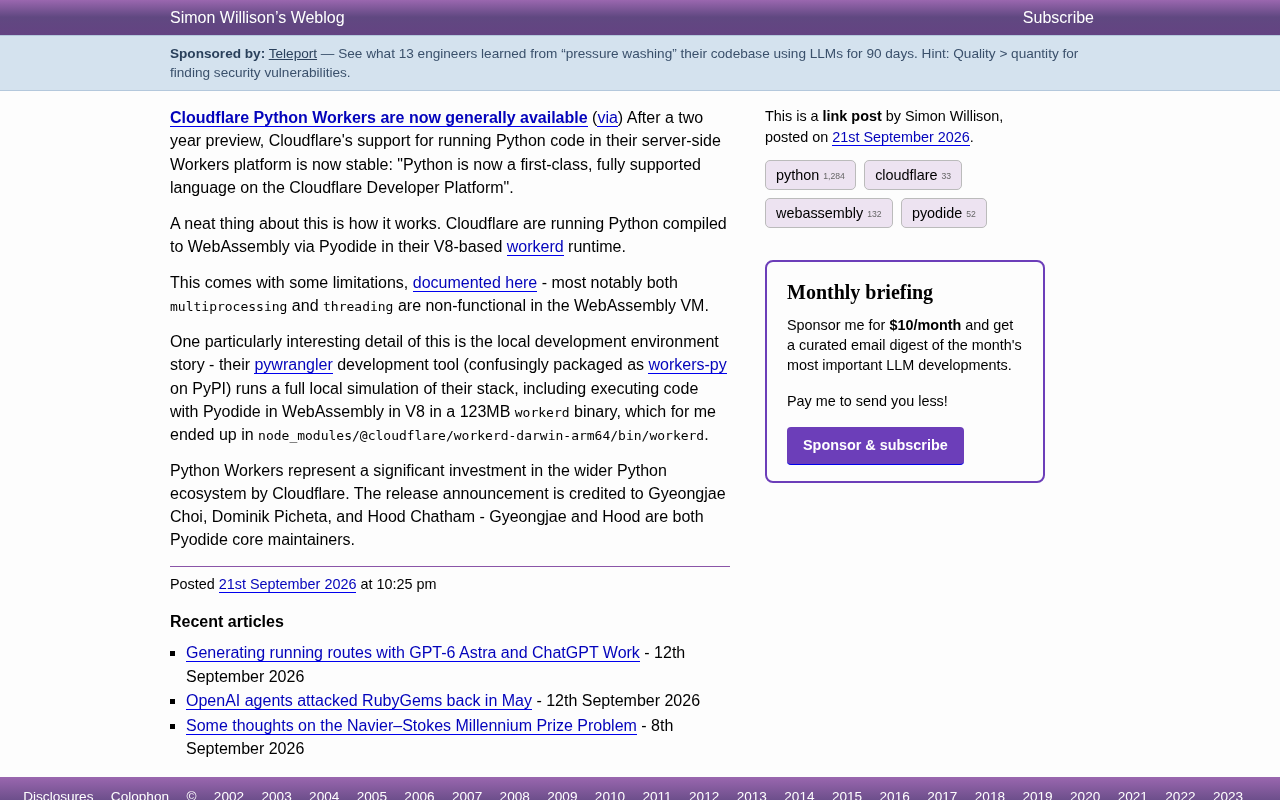
Cloudflare has announced Python Workers is now generally available after two years in preview, making Python a first-class citizen on its developer platform. The implementation compiles CPython to WebAssembly via Pyodide and runs it inside the V8-based workerd runtime, reusing existing isolation infrastructure rather than maintaining a separate interpreter. While `multiprocessing` and `threading` are unsupported due to Wasm sandbox constraints, `asyncio` works fine for typical edge scenarios. The local dev tool pywrangler ships a full 123MB workerd binary for true local-production parity. Notably, the release team includes core Pyodide maintainers, signaling Cloudflare's genuine upstream investment in the Python ecosystem.
After two years in preview, Cloudflare has officially announced that Python support on its Workers platform has reached General Availability (GA). The company made its position clear: "Python is now a first-class citizen on the Cloudflare developer platform with full support." This means developers can run Python server-side code on Cloudflare's edge computing network in a stable, production-ready way.
The Technical Path Behind First-Class Status
What's most noteworthy about this release isn't Python itself — it's how Python runs. Rather than embedding a traditional CPython interpreter, Cloudflare compiles Python to WebAssembly via Pyodide, then runs it inside workerd, its open-source V8-based runtime.
This technical approach is quite clever. Pyodide was originally designed as a Python port for browser environments, and Cloudflare has brought it into a server-side edge runtime — effectively reusing the entire WebAssembly ecosystem's isolation and portability guarantees. V8 is already the core engine of the Workers platform, so slotting Python into the same sandbox via Wasm both ensures security isolation and allows Python to share the underlying infrastructure with existing JavaScript Workers.
From a product architecture standpoint, this is a smart "don't reinvent the wheel" move — rather than maintaining a separate runtime for Python, it folds Python into the existing V8 + Wasm stack.
Pyodide was originally launched by Mozilla in 2018 with the goal of enabling Python's data science ecosystem (NumPy, Pandas, etc.) to run directly in the browser. Its core function is compiling the CPython interpreter itself — along with commonly used C extension libraries — into WebAssembly binaries via the Emscripten toolchain, which can then be loaded and executed by a browser or any Wasm-compatible runtime. This means developers get a "real" CPython, not a reimplemented subset — most pure Python code runs without modification.
workerd is the JavaScript/Wasm runtime that Cloudflare open-sourced in 2022. It's the same engine powering Cloudflare Workers in production. Unlike Node.js, workerd is designed from the ground up for multi-tenant isolation: each request executes in its own V8 Isolate with no shared global state, and cold start times are measured in milliseconds. By embedding Pyodide's Wasm output into this system, Python code naturally inherits Isolate-level security boundaries — no additional container or VM isolation layer required.
An Unavoidable Limitation: Multiprocessing and Threading Don't Work
The sandboxing benefits of WebAssembly come with real constraints. According to Cloudflare's official documentation, both the multiprocessing and threading standard library modules are non-functional within the WebAssembly VM.
This limitation requires an adjustment for Python developers accustomed to concurrent programming. However, for the typical use cases of edge Workers — short-lived, request-driven, stateless computation — the absence of multithreading and multiprocessing is relatively manageable. Edge computing inherently relies on horizontal scaling and request isolation rather than intra-instance concurrency. Developers migrating existing Python code will need to pay close attention to any logic that depends on these two modules.
The root cause of this limitation lies in WebAssembly's execution model: the standard Wasm spec was originally designed as single-threaded. multiprocessing depends on OS primitives like fork()/spawn(), which the Wasm sandbox completely blocks; threading relies on POSIX or Windows threads, and while there is nascent threading support in Wasm via SharedArrayBuffer and Atomics (the wasm-threads proposal), Pyodide has not yet enabled this feature in the Workers environment.
It's worth noting that Python's asyncio and async/await syntax are unaffected — asynchronous I/O is fundamentally a single-threaded event loop with cooperative scheduling, completely independent of OS threads. It works fine in Workers, which is more than sufficient for typical edge computing scenarios like handling network requests and calling external APIs.
Local Development Experience: A Complete Simulated Stack in 123MB
One particularly interesting detail of Python Workers is the design of the local development environment. Cloudflare provides a development tool called pywrangler — though its PyPI package name is workers-py, an inconsistency that can genuinely cause confusion.
More intriguing is how it works under the hood: pywrangler runs a complete local simulation of the full stack, including executing WebAssembly code via Pyodide inside V8 — all powered by a workerd binary that weighs in at roughly 123MB. On macOS, for example, it ends up at a path like node_modules/@cloudflare/workerd-darwin-arm64/bin/workerd.
In other words, the local development environment isn't a simplified emulator — it's a full replica of the production runtime. This "local equals production" consistency effectively reduces "works locally, breaks in production" issues, which is a genuine win for developer experience. The trade-off is a sizeable binary dependency.
A Real Commitment to the Python Ecosystem
This release also reflects Cloudflare's investment in the broader Python ecosystem. The authors listed on the release announcement include Gyeongjae Choi, Dominik Picheta, and Hood Chatham — and both Gyeongjae and Hood are core maintainers of the Pyodide project.
A cloud infrastructure company directly employing and supporting core maintainers of an open-source project is itself a substantial contribution to the upstream ecosystem. Cloudflare's push on Python Workers isn't just about adding another language to its platform — it's also driving the maturation of Pyodide as a critical middleware layer, and Pyodide's progress benefits every project that depends on it, including browser-based Python applications.
This model of "hiring upstream maintainers" is known in the open-source ecosystem as an "upstream-first" strategy, in contrast to maintaining private forks. Cloudflare's approach means that bugs they fix and features they add in Pyodide get merged directly into the mainline rather than sitting in an internal patch set, benefiting the entire community. Similar patterns — Vercel employing the Next.js core team, Shopify supporting Ruby on Rails core maintainers — are increasingly becoming a common path for leading cloud vendors to build technical moats while giving back to the open-source community.
Summary
Cloudflare Python Workers moving from preview to GA marks the maturation of "running Python via WebAssembly" as a production-grade approach. For developers, it means being able to deploy stable Python services across a global edge network — but it also requires a clear understanding of the limitations imposed by the Wasm sandbox, particularly the absence of concurrency-related standard library modules. For the broader Python community, sustained investment from infrastructure vendors is helping Python establish a firm foothold in new environments like browser-side and edge computing.
Related articles

Felix Rieseberg Personal Homepage
Felix Rieseberg's personal homepage sparks attention on Hacker News. This article covers the Slack engineer's technical background, the rise and fall of nativefier, and the value of a developer homepage as a tech calling card.

@ai-sdk/vue 3.0.306 Patch Release Syncs with [email protected] Update
@ai-sdk/vue 3.0.306 released, synced with [email protected]. A routine patch release for the Vercel AI SDK ecosystem with no public API changes; the Vue adapter layer stays version-aligned with the core package.

Gemini 4 Argon API Launches: The Era of Million-Token Output Begins
Google launches Gemini 4 Argon with sparse MoE architecture, up to 1M output tokens, and a 68.90% Vals Index score, available across API, AI Studio, and the Gemini app.