Cloudroom Core: A Self-Hosted Coding Agent Platform That Could Replace Your Devin Pro Subscription

Self-hosted infrastructure for running Claude Code, Codex, and Cursor on your own Linux server continuously.
Cloudroom Core is a self-hosted platform that runs coding agents like Claude Code, Codex, and Cursor on a user-owned Ubuntu 24.04 server, preserving full conversation history. Built around a lightweight single Rust service per machine, it isolates each agent as an unprivileged Linux user using OS-native permissions. Priced to compete with Devin Pro at $20/month, it hosts agents you already own rather than providing AI capabilities itself — model API costs are still billed to the user. Currently limited to Ubuntu 24.04 servers and Apple Silicon Mac clients, it targets developers who value data ownership and persistent agent execution.
What Is Cloudroom Core
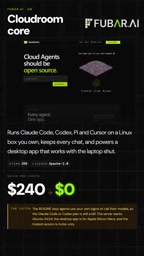
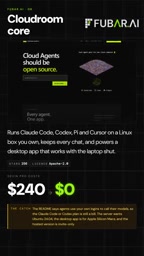
Cloudroom Core is a self-hosted coding agent platform built for developers. It runs Claude Code, Codex, Pi, and Cursor on your own Linux server while preserving the full conversation history of every session. What makes it particularly interesting is that it powers a desktop app that keeps running even when you close your laptop — meaning your agent tasks won't be interrupted just because you shut your machine.
Architecturally, Cloudroom Core is built around a single Rust service per machine. Whether you're running it on a VPS, a home server, or a spare laptop, as long as it has Ubuntu 24.04 installed, you're good to go — no Cloudroom account required. This design philosophy follows the recent self-hosting trend of prioritizing data sovereignty and avoiding forced cloud lock-in.
The concept of "self-hosted coding agents" has gained rapid traction over the past couple of years as LLM capabilities have matured. Traditional code completion tools like GitHub Copilot are synchronous and single-turn: you type, it responds, and the task ends. Coding agents introduce an "autonomous loop" — they can plan steps, invoke tools, execute code, read feedback, and iterate, with the entire process potentially running for minutes or even hours. This long-running nature creates new infrastructure requirements: tasks can't depend on a local process staying alive, they need persistent context storage, and they require resource isolation when running in parallel. Cloudroom Core targets exactly this scenario by moving the agent's execution environment off the developer's local machine and onto a continuously available server.
Security Isolation Design
When multiple agents run in parallel, security isolation becomes a critical concern. Cloudroom Core addresses this by running each agent as an independent Linux user without admin privileges. This means different agents are effectively walled off from one another — a misbehaving agent can't easily affect other agents or the host system.
Conversation history is encrypted in transit via TLS and persisted to disk. This OS-native user permission isolation is lighter weight than a container-based approach and better aligned with the "you control everything on your own machine" philosophy. For developers worried about the risks of agents executing arbitrary commands, this is a design detail worth paying attention to.
Linux multi-user isolation is a classic security mechanism that's been part of Unix-like operating systems for decades: each user has a unique UID, filesystem permissions are enforced by the kernel, and processes belonging to different users can't read or write each other's data by default. Cloudroom Core maps this mechanism directly onto agent runtimes — each new agent launch creates a restricted system user, leveraging the OS's own access controls to define boundaries. Compared to Docker container isolation, this approach requires no additional container runtime daemon and has lower memory and CPU overhead. The trade-off is that isolation isn't as airtight as containers — sharing the same kernel means kernel-level vulnerabilities could theoretically pierce the isolation. For most developers' everyday workflows, user-level isolation is more than sufficient to prevent agents from accidentally "stepping out of bounds," but in high-risk production environments, this trade-off warrants careful evaluation.
The Pricing Logic: Competing with Devin Pro
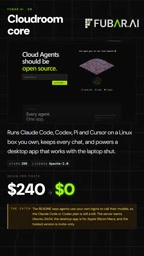
Cloudroom Core positions its value directly against Devin's Pro plan — $20/month, or $240/year. That said, this is a loose comparison at best; the two products operate on fundamentally different logic.
What Devin sells you is a ready-to-use agent. What Cloudroom Core does is host agents you already have. The former provides intelligence; the latter provides the infrastructure to run and manage it. Strictly speaking, Cloudroom Core replaces the hosting and continuous-execution costs of Devin Pro — not the agent's AI capabilities themselves. For developers already using Claude Code, Codex, or similar tools, the "bring your own agent" model actually fits more naturally into existing workflows.
Devin is an autonomous coding agent from Cognition Labs, positioned as an "AI software engineer" capable of independently completing end-to-end software engineering tasks. Its Pro plan targets individual developers with limited concurrent tasks and compute quotas. By comparison, Claude Code is Anthropic's command-line coding assistant, Codex is OpenAI's code-focused model/tool brand, and Cursor is an AI-assisted editor built on VS Code. What these tools share is that they provide AI capabilities but run ephemerally — either locally or in their own clouds — without infrastructure for long-running, asynchronous, persistent execution. That's the gap Cloudroom Core is trying to fill: serving as the execution substrate for these tools, not competing with them.
Costs and Limitations to Be Aware Of
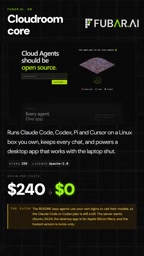
The "free" and "replaces a $20/month subscription" framing deserves a reality check. According to the project's README, when an agent calls a model, it uses your own login credentials — meaning your Claude Code or Codex subscription bills still apply. What Cloudroom Core saves you is the hosting and infrastructure layer cost, not the model inference cost itself.
Environmental requirements are also fairly specific: the server side requires Ubuntu 24.04, the desktop app currently supports only Apple Silicon Macs, and the official hosted version is also based on Ubuntu 24.04. These constraints mean the current release is best suited for developers on specific tech stacks — Intel Mac or Windows desktop users may need to wait for future support.
Who Is It For
Cloudroom Core's target user profile is pretty clear: developers who already subscribe to coding agent tools like Claude Code, Codex, or Cursor; who have a spare server or Linux machine available; and who want full control over their agent's execution environment, isolation, and conversation history.
If you want a complete, out-of-the-box agent experience without the setup work, something like Devin is probably less friction. But if you prioritize data ownership, cost predictability, and the ability to keep tasks running even with your laptop closed, this self-hosted approach offers a compelling path worth exploring. It represents one direction in the broader trend toward self-hosted infrastructure for coding agent toolchains.
Related articles

Chain of Thought Isn't Just for AI: How Humans Can Use CoT to Improve Thinking Quality
Chain of Thought isn't just a prompt trick for large models. Starting from a Hacker News discussion, this article analyzes why CoT works for human thinking too, breaks down actionable ways to transfer it, and highlights the key differences between human CoT and machine CoT.
Cloudflare Teams Up with OpenAI: Closi…
Cloudflare Teams Up with OpenAI: Closing the Loop from Vulnerability Discovery to Defense with AI
Cloudflare uses OpenAI Daybreak to investigate security vulnerabilities and generate reviewable remediation plans, while developers use Codex to boost coding efficiency and quality.

Orca Multi-Agent Orchestration in Practice: A Guide to Parallel Collaboration with Claude and Codex
Orca is Stable AI's free open-source agent workbench supporting 34 agents like Claude Code and Codex in parallel. Learn its Git worktree isolation, multi-model orchestration, and mobile management.