Cluing Hosted Agents: Turning AI Agents into Shareable Team Collaboration Assets

Cluing Hosted Agents transforms AI agents from personal tools into cloud-hosted, shareable team assets.
Cluing's Hosted Agents moves AI agents from local devices to the cloud, enabling cross-device continuity, evolving skills that learn from team insights, collaborative task assignment, and open connectivity via API and MCP protocol. This approach upgrades agents from isolated scripts to shared organizational infrastructure, mirroring the SaaS evolution of productivity tools.
From Personal Laptops to Collaborative Workspaces
Most AI agents today are trapped on a single user's device — they run on your laptop, and the moment you close the lid, tasks are interrupted and accumulated context can't be shared. AI agents, by definition, are artificial intelligence programs capable of autonomously perceiving their environment, formulating plans, and executing actions. Unlike traditional chatbots, agents don't just answer questions — they can break down complex tasks, call external tools, and iterate in loops until objectives are met. Since 2024, as the reasoning capabilities of large language models like GPT-4 and Claude have taken a leap forward, agents have rapidly moved from academic concepts to real products, with offerings like AutoGPT, OpenAI Assistants API, and Microsoft Copilot Studio emerging in succession. However, the vast majority of agent solutions still rely on local runtime environments, suffering from fundamental limitations such as context loss and the inability to collaborate across multiple users.
Cluing's newly launched Hosted Agents takes direct aim at this pain point, seeking to upgrade AI agents from "one person's tool" to "the entire team's asset."
According to its Product Hunt listing, the core philosophy of Hosted Agents is to "free agents from personal laptops and place them in collaborative workspaces." Users can start a task on their computer, continue working on it from their phone, and hand it off to team members — all without losing context. This cross-device, cross-user continuity is precisely what traditional locally-run agent solutions struggle to achieve. From an architectural perspective, local agents run on a user's personal device, with their lifecycle tied to the device's on/off state. Context is stored in local memory or the file system, and once the device is shut down or switched, tasks are interrupted and state is difficult to recover. Cloud-hosted agents, on the other hand, deploy the runtime environment on cloud servers, with task state persistently stored in databases. Multiple clients (PCs, phones, tablets) interact with the same agent instance via API or WebSocket. This architecture essentially upgrades agents from "processes" to "services," gaining cloud-native advantages such as high availability, elastic scaling, and multi-device synchronization — while also introducing trade-offs around data sovereignty, latency sensitivity, and operational costs.
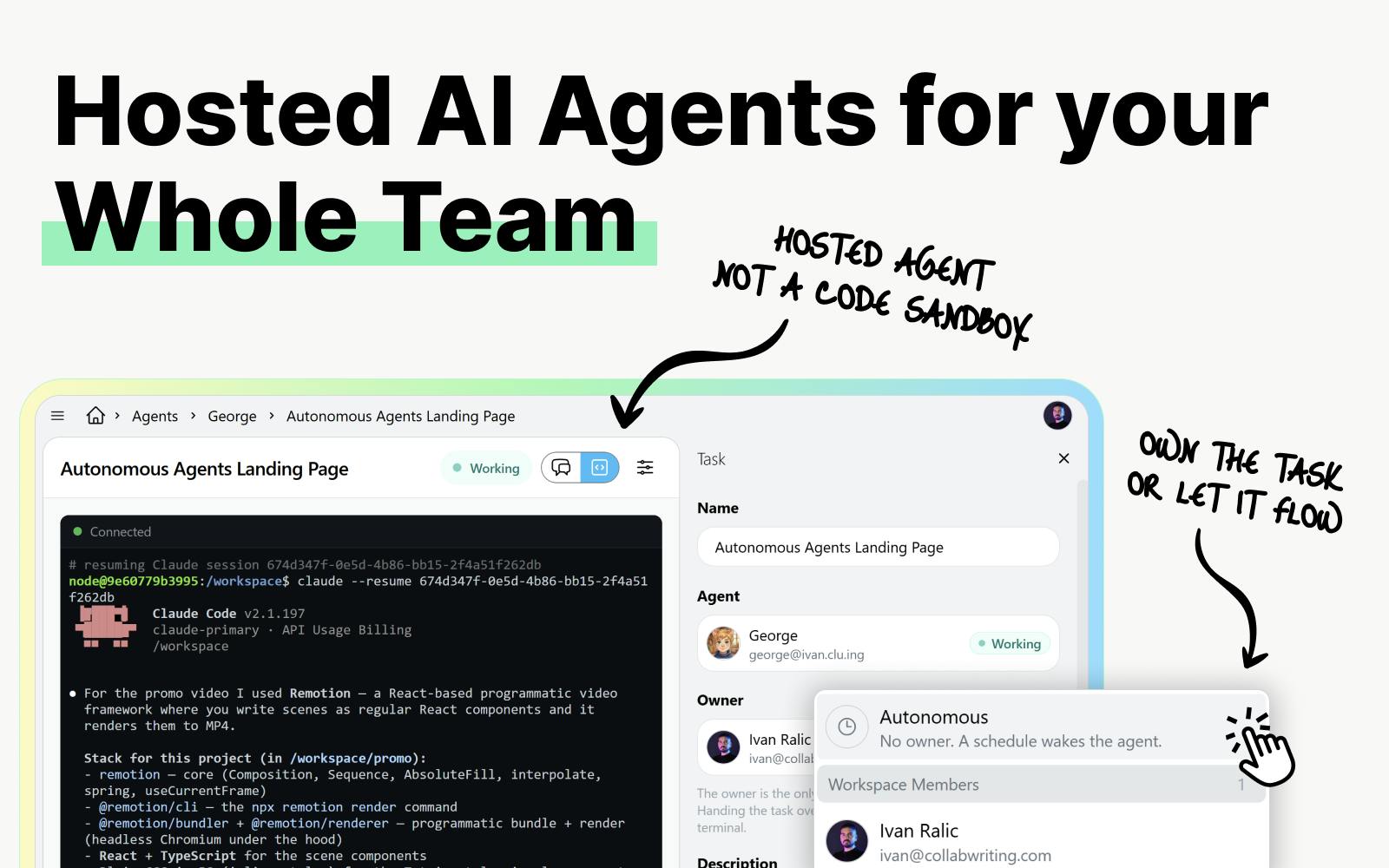
The product received 104 upvotes and 7 comments on Product Hunt, ranking 5th for the day, and was categorized under Android, Productivity, and Artificial Intelligence.
Core Features of Hosted Agents: Evolving Skills and Team Sharing Mechanisms
Skills That Evolve with New Insights
One of the most noteworthy design elements of Hosted Agents is "Evolving skills." According to the official description, as you collect new insights, the agent's skills continuously update — in other words, the agent isn't a static, one-time tool but an asset that keeps learning and growing through use.
From a technical implementation standpoint, evolving skills typically rely on paradigms such as Continual Learning and Retrieval-Augmented Generation (RAG). In traditional approaches, once an AI model finishes training, its capabilities are fixed and can only be updated through re-fine-tuning. Evolving skills, however, write the feedback, preferences, and new knowledge generated through user interactions into a retrievable external memory store, enabling agents to continuously improve performance without retraining the underlying model. This approach is more lightweight from an engineering perspective and better suited for team scenarios — insights contributed by different members can converge into a shared knowledge base, forming organization-level intelligence accumulation.
Behind this concept lies an important shift: whereas we used to view AI capabilities as fixed model outputs, Cluing is trying to let an agent's "experience" accumulate into reusable, transferable team knowledge. When one team member trains a smarter agent, the entire team benefits.
Unified Task Assignment and Publishing
On the collaboration front, Cluing allows any team member to assign tasks and publish work results. This means agents are no longer the exclusive toys of technical staff but general-purpose tools that non-technical members can directly invoke. This "accessible to everyone" positioning significantly lowers the barrier for deploying AI agents within teams.
Open Connectivity: Dual Support for API and MCP Protocol
Another major highlight of Hosted Agents is its open connectivity. Through Cluing's custom connectors, agents can interface with any external tool that has an API or supports MCP (Model Context Protocol).
MCP (Model Context Protocol) is an open-source standard protocol released by Anthropic in late 2024, designed to unify communication between large language models and external tools and data sources. Before MCP, each AI application needing to integrate with different SaaS tools (such as Slack, Notion, GitHub) required writing independent integration code, creating a massive "M×N" adaptation problem — M models connecting to N tools required M×N integration solutions. MCP defines a standardized request-response format that lets any model supporting the protocol plug-and-play with any compatible tool, similar to what USB-C does for hardware device standardization. Currently, major players including Google and OpenAI have also announced MCP support, and it is rapidly becoming the de facto industry standard.
Cluing's proactive embrace of MCP signals its desire to integrate into the broader AI ecosystem rather than build a closed system. For teams already using multiple SaaS tools, this openness means lower integration costs and greater automation potential.
"Close your laptop, and the work keeps going" — this vivid tagline from the official team neatly captures the essential difference between hosted agents and local agents: tasks continue running in the cloud, independent of any single device's power state.
Industry Trend: AI Agents Moving from Standalone to Organizational Collaboration
From a broader perspective, Cluing Hosted Agents represents a clear evolutionary direction in the AI agent space — from standalone to collaborative, from personal tools to organizational infrastructure.
This trend closely mirrors the historical evolution path of enterprise SaaS. Looking back, spreadsheets evolved from Lotus 1-2-3 on personal PCs to Google Sheets-style multi-user collaboration tools; document processing evolved from local Word to cloud collaboration platforms like Notion. AI agents are replicating this trajectory: Salesforce's Agentforce, ServiceNow's AI Agent, and Microsoft Copilot Studio are all attempting to embed agents into enterprise workflows. Gartner predicts that by 2028, 33% of enterprise software will have embedded agent capabilities. In this context, "who can be the first to solve the experience and security challenges of multi-user shared agents" will become a key competitive moat.
Over the past year, discussions around AI agents have largely focused on the reasoning and execution capabilities of individual agents. But as the technology matures, how to share, reuse, and continuously optimize agents within teams is becoming the new competitive frontier. Cluing's approach essentially transforms agents into a "cloud-hosted service," giving them the persistence, collaboration capabilities, and scalability of SaaS products.
Of course, products like this also face real-world challenges: How do you ensure context consistency across devices and team members? Could evolving skills create conflicts due to differing individual preferences? How should permissions and data security for team-level agents be managed? These questions all need further validation through actual use.
Summary
Cluing Hosted Agents, through its four core features — cross-device continuity, evolving skills, task collaboration, and open connectivity — attempts to redefine the role of AI agents within teams. It's no longer an isolated running script but a team member capable of learning, sharing, and working continuously.
For small and medium-sized teams exploring AI adoption, this type of "hosted collaborative agent" may offer a more pragmatic path — enabling the entire organization to share the productivity dividends of AI without requiring every individual to become a prompt engineering expert. Whether it can truly deliver on its promise of "close your laptop and the work keeps going" is well worth watching.
Related articles

Chain of Thought Isn't Just for AI: How Humans Can Use CoT to Improve Thinking Quality
Chain of Thought isn't just a prompt trick for large models. Starting from a Hacker News discussion, this article analyzes why CoT works for human thinking too, breaks down actionable ways to transfer it, and highlights the key differences between human CoT and machine CoT.
Cloudflare Teams Up with OpenAI: Closi…
Cloudflare Teams Up with OpenAI: Closing the Loop from Vulnerability Discovery to Defense with AI
Cloudflare uses OpenAI Daybreak to investigate security vulnerabilities and generate reviewable remediation plans, while developers use Codex to boost coding efficiency and quality.

Orca Multi-Agent Orchestration in Practice: A Guide to Parallel Collaboration with Claude and Codex
Orca is Stable AI's free open-source agent workbench supporting 34 agents like Claude Code and Codex in parallel. Learn its Git worktree isolation, multi-model orchestration, and mobile management.