CMP 170HX Voltage Glitch Successful: 80GB VRAM + 126 SM Unlocked

A Reddit user used a Raspberry Pi Pico to voltage-glitch the CMP 170HX, unlocking 80GB of VRAM and 126 SMs.
The article reports that a Reddit user successfully carried out a voltage glitch attack on the NVIDIA CMP 170HX mining-specific card, bypassing firmware restrictions to unlock the originally locked 8GB VRAM and 56 SMs to 80GB VRAM and 126 SMs, with specifications approaching the A100 80GB PCIe. The crack used a Raspberry Pi Pico for the hardware-layer glitch along with a script to bypass restricted write permissions, taking nearly 15 hours. The article analyzes the technical principles and barriers of voltage glitching, pointing out that after unlocking the card has theoretical usability for AI inference and scientific computing, but cooling design, driver compatibility, and long-term stability remain to be verified. Finally, it discusses the gray area of reusing mining cards, including warranty voidance, hidden hardware damage, and vendor terms risks, emphasizing that its technical inspiration outweighs its value for direct emulation.
From Mining Card to Compute Beast: The Hard-Mod Potential of the CMP 170HX
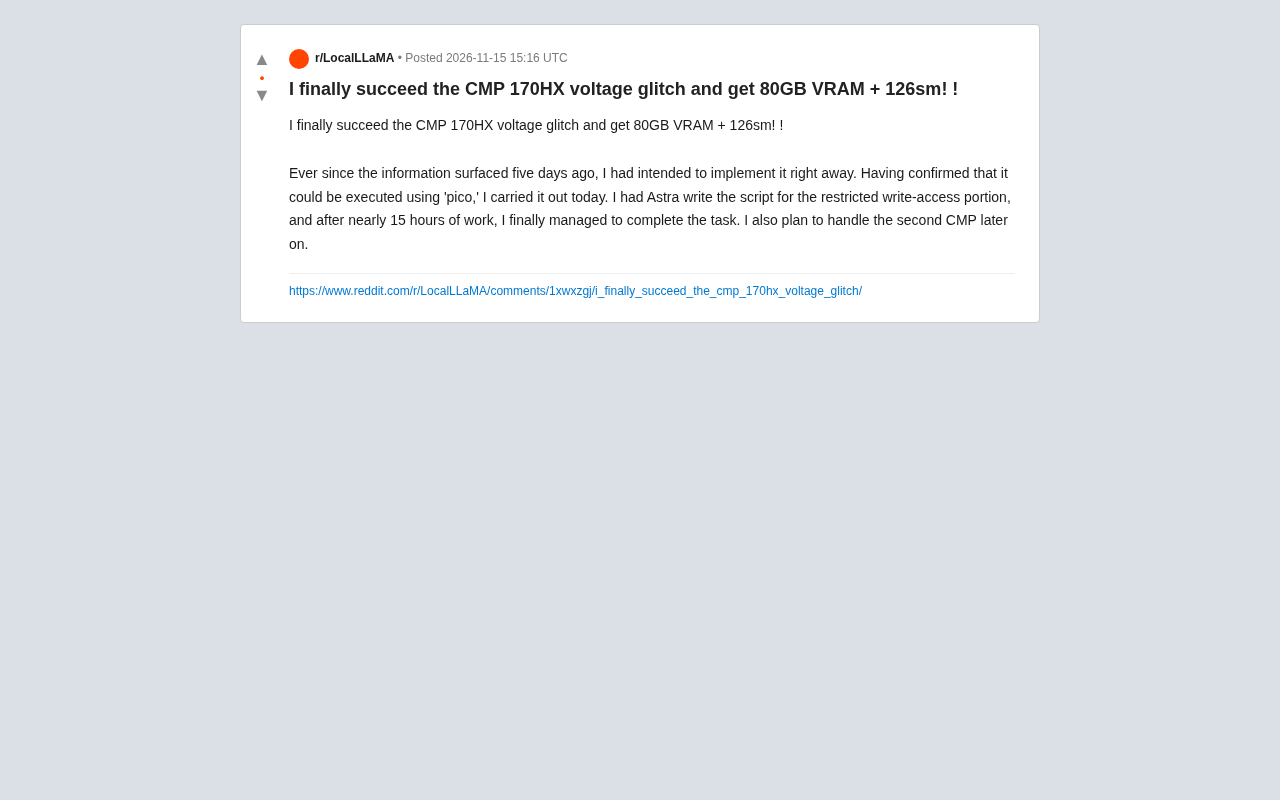
Recently, a user in the Reddit community announced a successful voltage glitch attack on the NVIDIA CMP 170HX, unlocking a mining-specific card that was originally locked to 8GB of VRAM and 56 SMs to 80GB of VRAM and 126 SMs. This operation came only five days after the relevant information was made public, and the user completed the hardware-level breakthrough with the help of a Raspberry Pi Pico.
The CMP 170HX is based on the GA100 core and was originally designed as a dedicated accelerator card for cryptocurrency mining. NVIDIA strictly limited its VRAM capacity and number of compute units at the firmware level, making it unusable for general-purpose compute tasks. The significance of this crack is that it bypasses these firmware restrictions, giving the card theoretical usability in scenarios such as AI inference and scientific computing.
The Cracking Process: Pico and a 15-Hour Script Battle
According to the user's description, the entire cracking process involved two key stages: a voltage glitch attack at the hardware layer, and bypassing restricted write permissions at the software layer. He used a Raspberry Pi Pico as the tool to execute the voltage glitch, and had Astra help write the script for the restricted write permission portion.
Looking at the timeline, five days after the information surfaced, the user set to work, and after actually starting the operation it took nearly 15 hours to finally complete. This reflects that voltage glitching is not a simple "one-click unlock"—it requires precise timing control, repeated attempts and debugging, and real-time monitoring of the hardware state. The user also said he plans to tackle a second CMP card later, indicating that although the process is time-consuming, it has already achieved a certain degree of reproducibility.
The Technical Barrier of Voltage Glitching
Voltage glitching is a technique that induces erroneous behavior at a specific moment by momentarily pulling down or up the chip's supply voltage. Performing a glitch attack during the firmware verification process can skip security checks and thereby write to locked configuration areas. This type of operation demands extremely high timing precision; the slightest deviation can cause the chip to reset or be permanently damaged. The fact that the user was able to complete this process with a Pico means he has considerable hardware debugging experience.
SM (Streaming Multiprocessor) is the basic compute unit in NVIDIA's GPU architecture. Each SM contains dozens of CUDA cores, tensor cores, shared memory, and schedulers, and is responsible for executing thread-block-level parallel computing tasks. A GPU's total compute throughput is approximately proportional to the product of the number of SMs and the frequency, so the SM count is one of the core metrics for measuring a compute card's performance. The GA100 core is fully configured with 128 SMs; the CMP 170HX was masked by firmware down to 56, and after unlocking it was restored to 126, equivalent to releasing the vast majority of its compute potential. This kind of "soft masking" is common in vendors' product tiering strategies: the same physical chip is divided into different SKUs through fuses or firmware restrictions to cover different price segments, and voltage glitching is precisely a physical attack method targeting such firmware locks.
The Raspberry Pi Pico is a small development board based on the RP2040 dual-core microcontroller, featuring programmable I/O (PIO) peripherals that can control GPIO pin levels with nanosecond precision. This characteristic makes it very suitable for executing the precise timing pulses required for voltage glitching: users can write state machines via PIO to inject an extremely short low-voltage or high-voltage pulse into the power line at a specific moment when the target chip powers on or performs firmware verification, thereby inducing a transient fault. Compared with dedicated glitch attack equipment, the Pico is low-cost and has abundant community documentation, and in recent years it has gradually become a common tool for hardware security researchers—an important prerequisite for this case's rapid reproduction.
The Performance Leap After Unlocking: What 80GB and 126 SMs Mean
The combination of 80GB of VRAM and 126 SMs is, in terms of specifications, already close to the level of the NVIDIA A100 80GB PCIe version. For AI inference workloads, large VRAM means larger models or longer contexts can be accommodated; more SMs directly increase parallel compute throughput. The CMP 170HX, originally limited to 8GB of VRAM, after unlocking has its scope of application expanded from pure hash computation to broader fields such as deep learning and data analysis.
However, the practical value of this crack still needs to be viewed rationally. The CMP 170HX's cooling design, PCB layout, and driver support are all optimized for mining scenarios, and stability under prolonged high-load operation has not yet been verified. In addition, NVIDIA's official drivers may impose additional restrictions on the CMP series, and the compatibility of the cracked card with mainstream deep learning frameworks still needs further community testing.
Community Reaction and Future Outlook
The post attracted the attention of hardware modding enthusiasts on Reddit. In the comments, many users showed interest in the specific implementation details of the voltage glitch, while others worried about the risks of warranty voidance and hardware damage that such cracks may bring. The user said he will tackle a second CMP card, and if a reproducible complete solution can be developed afterward, it may open up new ideas for reusing second-hand mining cards.
The A100 80GB PCIe is NVIDIA's flagship data center accelerator card based on the GA100 core, featuring 108 SMs, 6912 CUDA cores, 80GB of HBM2e memory and approximately 2TB/s of memory bandwidth, supporting NVLink and PCIe 4.0, and is widely used for large-model training and inference. The CMP 170HX is also based on GA100, but the original card is equipped with only 8GB of HBM2e and has a large number of SMs masked, positioned for hash computation. The unlocked CMP 170HX is close to the A100 in VRAM capacity and SM count, but the two still differ in memory bandwidth, interconnect capabilities, ECC support, and official software stack optimization, so "close to A100" is more of a specification-level analogy than an equivalence in measured performance.
The Gray Area of Reusing Mining Cards
As a product line NVIDIA launched specifically for mining, the CMP series' second-hand prices are usually far lower than compute cards with the same core. If such cracks can be reliably reproduced, it means the possibility of obtaining large-VRAM compute resources at a lower cost. But this also comes with a gray area at the legal and warranty levels—cracking firmware usually violates the vendor's terms of use, and the hardware may have hidden damage after a glitch attack.
For ordinary developers, the value of this case lies more in technical inspiration: it shows that firmware restrictions are not insurmountable, and that hardware security boundaries can potentially be bypassed in the face of physical attacks. As for whether it is worth emulating, that depends on a comprehensive trade-off among cost, risk, and stability.
Related articles

Abnormal Error Rate Spike in Claude Mythos 5.2 and Fable 5.2
Claude Mythos 5.2 and Claude Fable 5.2 show an abnormal spike in request error rates, marked as investigating on the official status page. This article covers the incident overview, practical impact on developers, and recommended responses.

ReAct Runtime Context Trimming: Why Claude Code Acts at 70%
A deep dive into ReAct runtime context trimming: why Claude Code compresses at ~70% usage, why tool calls dominate, why messages must be dropped in pairs, and why codebases don't need RAG.

AI Agent vs LLM: How Cursor and Claude Code Actually Work
An in-depth analysis of the essential difference between AI Agents and LLMs: LLMs generate code suggestions, while Agents modify files and run tests via tool calls. Using a Spring Boot bug fix as an example, it breaks down the workflows, permission control, and verification mechanisms of Cursor and Claude Code.