Coarena: An Evaluation Platform Where AI Agents Compete on Real-World Work

Coarena lets AI agents compete head-to-head on real-world tasks instead of synthetic benchmarks.
Coarena, built by the Coasty team, is a new evaluation platform that pits AI agents against each other on real computer tasks spanning browsers, desktop apps, and enterprise software. Using a crowdsourced voting mechanism similar to Chatbot Arena, it lets users compare agents on speed, accuracy, and reliability — addressing the growing gap between synthetic benchmark scores and actual performance in production environments.
When Benchmarks Lose Credibility, How Should We Evaluate AI Agents?
As AI agent capabilities rapidly evolve, a core question becomes increasingly pressing: how do we actually determine which agent performs best in real-world work? Over the past few years, the industry has relied on synthetic benchmarks to measure model capabilities, but there's often a massive gap between these standardized tests and real-world work scenarios.
Synthetic benchmarks are standardized test sets artificially constructed by researchers — MMLU (Massive Multitask Language Understanding) covers multiple-choice questions across 57 subjects, GSM8K contains 8,000 elementary math word problems, and HumanEval evaluates code generation ability. The advantage of these test sets is reproducibility and easy quantification, but their core flaw lies in Goodhart's Law — when a metric becomes a target, it ceases to be a good metric. Model providers boost scores through data contamination (test questions leaking into training sets), targeted fine-tuning, and even overfitting to specific question formats, causing benchmark scores to severely decouple from real-world application performance. Multiple studies in 2024 showed that some models excelling on benchmarks actually performed worse than lower-scoring competitors on open-ended practical tasks.
Recently launched on Product Hunt, Coarena (built by the Coasty team) targets precisely this pain point. Its tagline is straightforward and powerful — "The arena where agents battle on real-world work." After launch, it received 87 upvotes and 37 comments, ranking 14th that day, gaining notable attention in the Analytics, Tech, and Data categories.
Coarena's Core Features and Design Philosophy
Real Tasks Drive Evaluation, Goodbye to Synthetic Tests
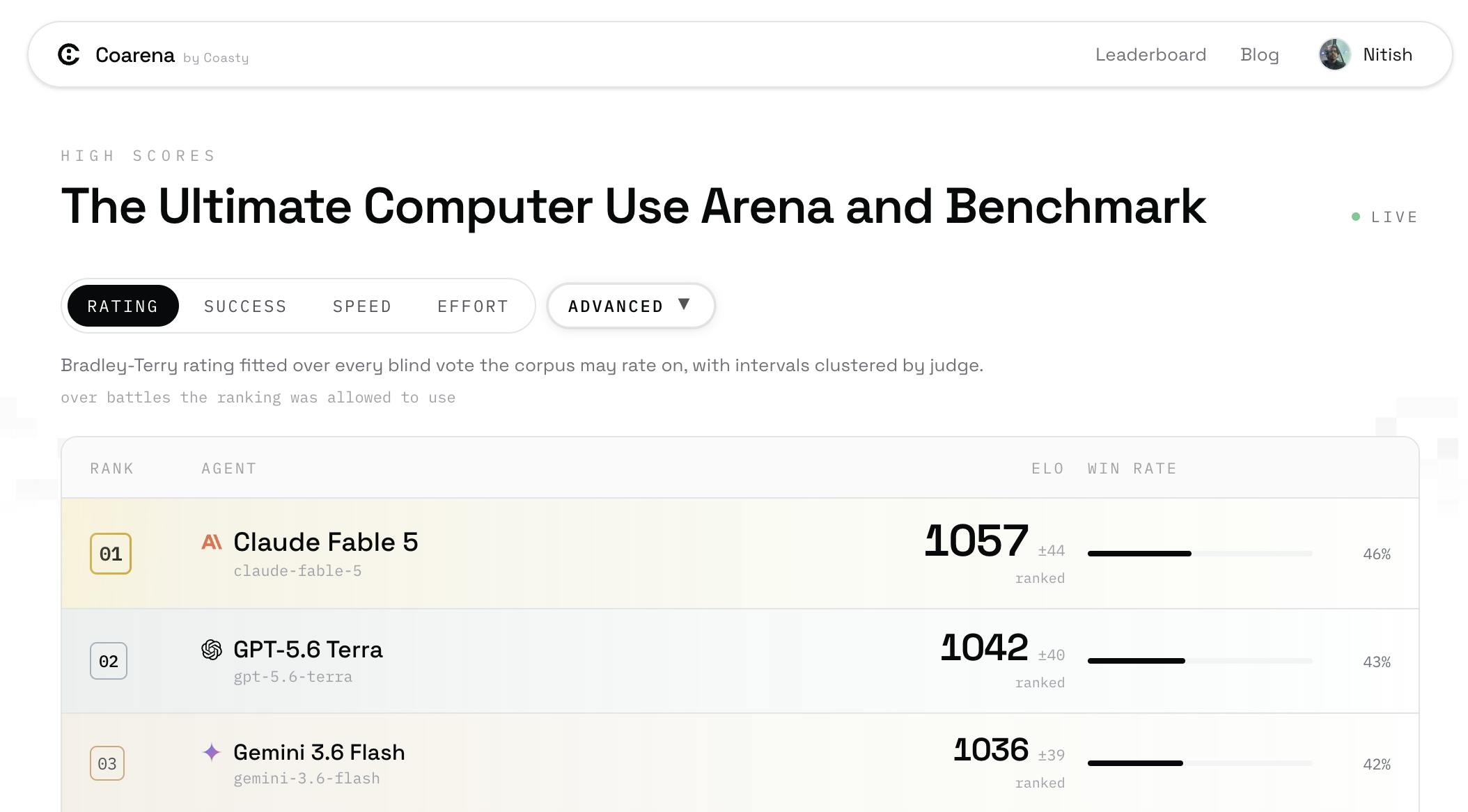
Coarena's core approach is to have multiple AI agents compete on real computer tasks side by side, rather than running synthetic benchmarks that are carefully designed and easy to game. Users can observe multiple models completing the same workflow in parallel, intuitively comparing their performance across three dimensions — speed, accuracy, and reliability — then vote for the winner.
This shift in design philosophy is significant. A fatal flaw of traditional benchmarks is that model providers can optimize for specific test sets, leading to "high scores, low ability" phenomena. The unpredictability and diversity of real tasks better reflect an agent's true capabilities in production environments.
Coverage: Browsers, Applications, and Enterprise Software
According to official descriptions, Coarena's test scenarios span browser operations, desktop applications, and enterprise-grade software. This means it's not just testing a model's conversational or reasoning abilities — it's examining an agent's comprehensive execution capability as a "digital worker" — whether it can actually open web pages, fill forms, operate software interfaces, and complete an entire business workflow.
From a technical architecture perspective, a complete computer-use agent typically includes several key modules: a visual perception module (understanding screen content through screenshots), a DOM/API interaction layer (directly manipulating web elements or application interfaces), a task planner (decomposing high-level goals into executable steps), and memory and state management (tracking context across multi-step operations). How well these modules work together determines whether an agent can smoothly complete complex cross-application workflows.
This type of cross-application operational task is currently the most imaginative yet hardest-to-crack domain for AI agents. From OpenAI's Operator (a browser-operating agent based on GPT-4o) to Anthropic's Computer Use (Claude directly controlling desktop environments), to Google DeepMind's Project Mariner and open-source solutions like WebArena and OSWorld, major players are fiercely competing on this track. The common challenges these systems face include error accumulation in long-sequence operations, real-time understanding of dynamic pages, and cross-application state synchronization — but there's been no unified, fair, and realistic evaluation platform for horizontal comparison of their actual performance.
A Crowdsourced Evaluation Mechanism à la Chatbot Arena
How Voting and Ranking Work
Coarena's "vote to select the winner" mechanism naturally recalls LMSYS's Chatbot Arena. The latter was launched in 2023 by the LMSYS (Large Model Systems Organization) team at UC Berkeley. It has users blindly test responses from two models and vote, using an Elo rating system to establish a widely recognized LLM leaderboard.
The Elo system originated from chess rankings. Its basic principle: after two players compete, the winner's points gained are inversely proportional to the skill gap — beating a stronger opponent earns more points, beating a weaker one earns fewer. The statistical foundation of this methodology is the Bradley-Terry model, which infers global rankings from large numbers of pairwise comparisons. By the end of 2024, Chatbot Arena had accumulated over 1 million human votes, and its rankings are widely regarded as a more valuable indicator of model capability than any single benchmark.
Coarena essentially migrates this crowdsourced evaluation logic from "text conversations" to "practical operational tasks."
The advantages of this approach include:
- Aligned with real needs: Real users vote based on their own use cases, making evaluation results more reflective of actual value
- Hard to manipulate: The diversity of real tasks significantly increases the cost of targeted optimization
- Dynamically updated: As new models and tasks are added, the leaderboard can continuously evolve
From "Can Talk" to "Can Do" — A Leap in Evaluation
If Chatbot Arena addresses "which model speaks better," then Coarena attempts to answer "which agent performs better." This leap in evaluation dimensions corresponds precisely to the AI industry's broader shift from "Generative AI" to "Agentic AI."
The core distinction in this paradigm shift is: Generative AI's capability boundary is content production — text, images, code — but outputs still require human review and manual execution. Agentic AI emphasizes end-to-end task completion — understanding goals, making plans, operating tools, and verifying results, all autonomously. This poses fundamental challenges to evaluation methodology: text quality can be simply judged through human preference, but evaluating operational tasks requires considering step correctness, execution efficiency, error recovery capability, and handling of edge cases across multiple dimensions. Gartner predicts that by 2028, 33% of enterprise software will incorporate Agentic AI capabilities, making reliable agent evaluation an industry imperative.
For enterprise users, such an evaluation platform is particularly valuable. When companies consider using AI agents to replace or augment daily work, they never care about a model's MMLU or GSM8K scores — what matters is whether it can stably and accurately complete "the actual work we have here."
Coarena's Value and Challenges Ahead
Potential Value to the Industry
If Coarena can establish a trustworthy agent evaluation ecosystem, it could have far-reaching impact across the industry. Developers can clearly identify their agents' weaknesses on real tasks; enterprise buyers gain third-party references independent of vendor marketing; and end users can make more rational tool choices.
Real-World Challenges to Overcome
Of course, the road ahead isn't smooth. Real-task evaluation faces several inherent challenges:
- Task standardization: Real tasks vary enormously. Designing test sets that are both representative and reproducible is a massive engineering challenge. The technical complexity of building a real-task evaluation platform far exceeds that of text benchmarks — each agent needs to run in an independent sandbox environment that simulates realistic software conditions (including network latency, dynamic page loading, etc.) while preventing interference between agents and unintended operations on external systems. Moreover, the same task may have multiple correct paths, requiring complex verification logic to determine task "completion."
- High evaluation costs: Having multiple agents complete real operational tasks in parallel consumes far more compute and time than text benchmarks. Some tasks may require waiting for external system responses (such as email delivery confirmations), making real-time comparison even more difficult.
- Voting bias: While crowdsourced voting is closer to reality, it may also be influenced by user subjective preferences, sample distribution, and other factors.
- Security and privacy: Real work involves browser and enterprise software operations, making data protection during testing a legitimate concern.
Academic benchmarks like OSWorld and WebArena have been exploring solutions in similar directions, but their scale and diversity still fall far short of covering enterprise application complexity, leaving opportunity space for productized platforms like Coarena.
Conclusion: A New Direction for AI Agent Evaluation
Coarena represents a noteworthy direction in AI evaluation — using real-world work to test agents' real capabilities. As synthetic benchmarks increasingly lose reference value, this kind of "real-world arena" may fill an industry gap and become the "authoritative leaderboard" for the agentic era.
However, as a newly launched product, whether Coarena can truly solve core challenges around evaluation standardization, cost control, and fairness still requires time and practice to verify. But at the very least, it raises the right question: rather than arguing over whose model scores are higher, why not let them compete head-to-head on real work?
Related articles

JobRunner MCP Server: AI Agents Can Now Fix Failed Java Jobs
JobRunner launches an open-source MCP server enabling AI agents to view cluster status, diagnose failures, and recover Java jobs—incident response from any cloud coding environment or existing agent.

MLAI Digital Launches 9 Security Agents: MCP Server Safeguards the Full Lifecycle of Agentic AI
MLAI Digital launches Security MCP Server with nine built-in specialized security agents covering vulnerability discovery, attack simulation, prompt injection detection, API and infrastructure assessment, and accelerated remediation—embedding security validation across the full Agentic AI lifecycle from development to production.

Running Isaac Lab on H100 GPUs: Exploring Better Approaches
Exploring optimization methods for running Isaac Lab on NVIDIA H100 GPUs, including MIG configuration, mixed precision, TensorRT acceleration, and community experience to improve robotics simulation and reinforcement learning efficiency.