CocoonBench: Can Multilingual Search Agents Break Out of the Language Information Cocoon?
CocoonBench is the first to systematically evaluate whether multilingual search agents can escape the language information cocoon; the strongest model still falls short of 70%.
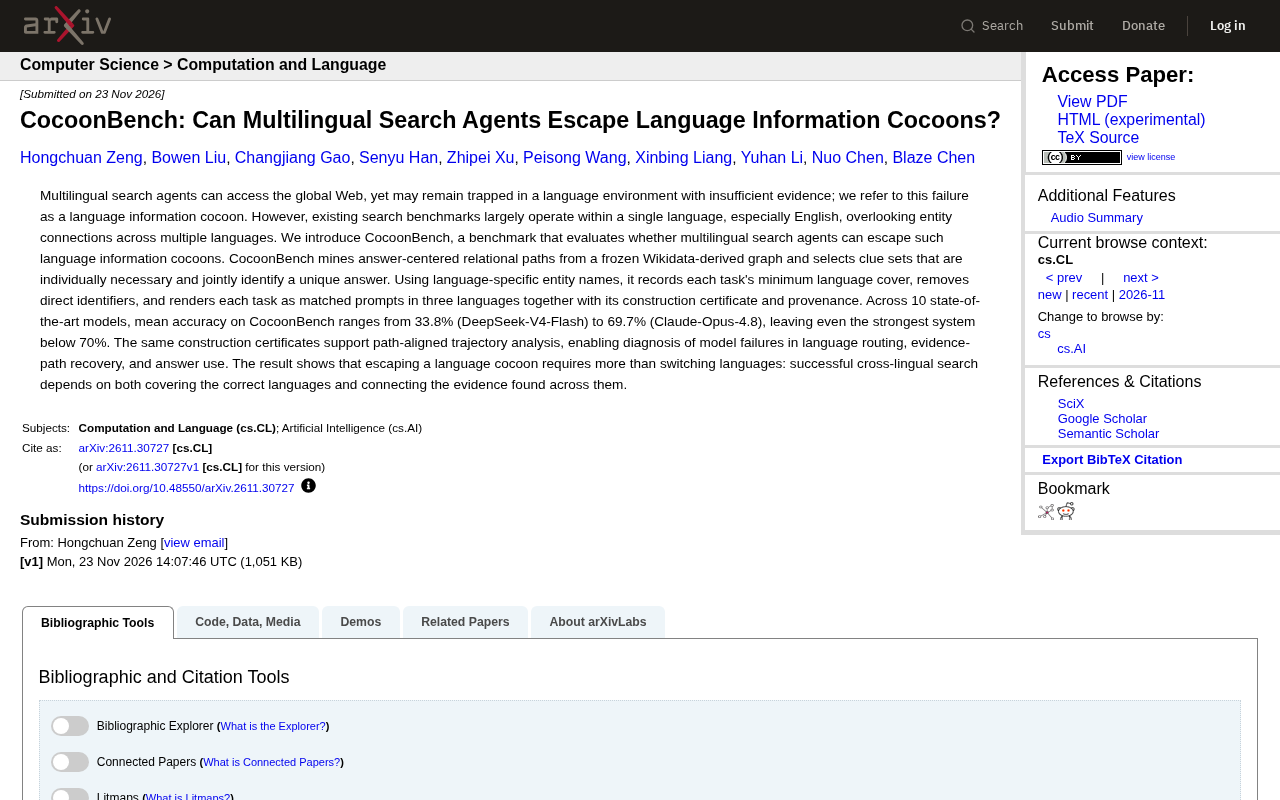
The article introduces a new problem facing multilingual search agents—the language information cocoon: agents can access the global web yet often get trapped in a single language environment, leading to insufficient evidence. Researchers propose the CocoonBench benchmark, which mines answer-centric relational paths from a frozen Wikidata-derived graph, selects clue sets that are each necessary and jointly uniquely determine the answer, removes direct identifiers, and renders prompts in three languages. Tests on 10 advanced models show average accuracy from 33.8% to 69.7%, with the strongest system, Claude-Opus-4.8, still below 70%. Trajectory analysis based on construction certificates further shows that breaking out of the cocoon requires not only covering the right languages but also connecting evidence discovered across languages.
A New Challenge for Search Agents: The Language Information Cocoon
Multilingual search agents can access the global web, yet they may get trapped in a single language environment, resulting in insufficient evidence—a phenomenon researchers call the language information cocoon. Most existing search benchmarks operate in a single language (especially English), overlooking cross-lingual entity associations. The CocoonBench benchmark was designed precisely to evaluate whether multilingual search agents can escape this cocoon.
The language information cocoon borrows from the concept of the "information cocoon" (filter bubble / information cocoon) in communication studies—where users encounter only homogeneous information due to algorithmic recommendation or behavioral inertia, forming cognitive closure. In the context of multilingual search agents, the cocoon is not caused by recommendation algorithms but by the agent's language routing strategy and training data distribution: although it is connected to the global web, it tends to retrieve, reason, and answer within the corpus of the dominant language (usually English), thereby missing key evidence that appears only in other languages. Compared with the monolingual information cocoon, the key harm of the language information cocoon lies in incomplete evidence rather than narrow viewpoints: the answer may not be wrong, but the cross-lingual evidence chain supporting it was never collected. The core metric for judging whether an agent has "broken out of the cocoon" is not how many languages it supports, but whether it can proactively switch languages within the same task and stitch together clues from different languages.
How Does CocoonBench Construct Tasks?
CocoonBench mines answer-centric relational paths from a frozen Wikidata-derived graph and selects sets of clues that are each necessary and that jointly uniquely determine the answer. It uses language-specific entity names, records the minimum language coverage for each task, removes direct identifiers, and renders each task as matched prompts in three languages, along with construction certificates and provenance information.
This design means agents must gather clues across languages to piece together a unique answer. With direct identifiers removed, models cannot rely on simple name matching and must genuinely understand cross-lingual entity associations.
Wikidata is an open, collaboratively built structured knowledge graph that records facts about people, places, works, and more in "entity–property–value" triples, assigning a unique identifier (QID) to each entity. The "frozen Wikidata-derived graph" mentioned in the text refers to taking a snapshot of Wikidata at a certain point in time and then extracting a subgraph as the task source, so that annotations and answers do not drift with real-time data updates, ensuring the benchmark's reproducibility. An answer-centric relational path refers to a multi-hop chain starting from the target entity and passing through several intermediate entities and properties; only when every hop on the path provides irreplaceable information and the entire path uniquely points to that entity does the path constitute a valid clue set. Because labels for the same entity in Wikidata are stored in multiple languages, tasks can naturally be split by language—which is precisely the natural basis for constructing cross-lingual clues.
Model Performance: The Strongest System Still Below 70%
Tests on 10 state-of-the-art models show that CocoonBench's average accuracy ranges from 33.8% (DeepSeekAd-V4-Flash) to 69.7% (Claude-Opus-4.8). Even the best-performing system failed to break the 70% accuracy threshold. This result clearly shows that current multilingual search agents still have a significant gap to close in escaping the language information cocoon.
Failure Diagnosis: Language Routing, Evidence Paths, and Answer Use
The same construction certificates support path-aligned trajectory analysis, enabling researchers to diagnose model failures in language routing, evidence path recovery, and answer use. The results show that escaping the language cocoon is not simply a matter of switching languages: successful cross-lingual search depends both on covering the right languages and on connecting evidence discovered across languages.
This finding has important implications for the design of multilingual search systems—simply adding language support is not enough; systems also need the ability to integrate cross-lingual evidence.
Trajectory analysis refers to step-by-step comparison and attribution of the intermediate steps in an agent's complete search process—what query is issued at each step, which documents are retrieved, how intermediate conclusions are updated—rather than only looking at whether the final answer is correct. CocoonBench's "construction certificate" records which clues constitute a task, in which languages, and through which relational path, so it can serve as a reference answer trajectory and be path-aligned with the model's actual trajectory. On this basis, failures can be broken down into three categories: language routing failure (not retrieving the language that carries the key clue), evidence path recovery failure (retrieving relevant documents but failing to piece together the complete path along the relational chain), and answer use failure (having obtained sufficient evidence but erring at the integration or output stage). The value of this layered diagnosis is that it turns the vague outcome of "answering incorrectly" into a locatable, improvable engineering problem.
The Future Direction of Multilingual Search
The introduction of CocoonBench fills a gap in multilingual search benchmarks and emphasizes the importance of cross-lingual entity connections. For teams building multilingual search agents, this means going beyond monolingual optimization and instead designing systems that can proactively cross language boundaries and integrate evidence from multiple sources.
As model capabilities improve, how to enable agents to maintain the ability to "break out of the cocoon" within the language information cocoon will become a key research topic in the search field.
One-line Summary
CocoonBench is the first to systematically evaluate whether multilingual search agents can escape the language information cocoon; the strongest model still falls short of 70%.
Paragraph Summary
The article introduces a new problem facing multilingual search agents—the language information cocoon: although agents can access the global web, they are often trapped in a single language environment, leading to insufficient evidence. To address this, researchers propose the CocoonBench benchmark, which mines answer-centric relational paths from a frozen Wikidata-derived graph, selects sets of clues that are each necessary and jointly uniquely determine the answer, removes direct identifiers, and renders prompts in three languages. Tests on 10 advanced models show average accuracy ranging from 33.8% to 69.7%, with the strongest system, Claude-Opus-4.8, still failing to exceed 70%. Trajectory analysis based on construction certificates further shows that breaking out of the cocoon requires not only covering the right languages but also connecting evidence discovered across languages.
Related articles

From 0 to 1: Vibe Coding an AI Knowledge Base — A Practical Retrospective and Tech Stack Breakdown
A retrospective on building the AI knowledge base OilBook from scratch with Vibe Coding: Next.js+Neon stack, Oil Dev Skill workflow, Stripe paywall security, interview-style writing, AI-flavor control, and Vercel deployment.

GLM-5.4 Hands-On: Native Vision Meets a New Vibe Coding Workflow
Hands-on with Zhipu GLM-5.4: native vision tested across a 3D product demo, pure-code video generation, and remote-control Vibe Coding, compared with GPT-6.2 and Gemini Neon.

AI and Humans Claim to Prove the Riemann Hypothesis: Machine-Verified, Yet Nobody Can Understand It
Anthropic mathematician and AI Claude claim to prove the Riemann Hypothesis with 17 million lines of Lean code, machine-verified but unreadable by humans. This article analyzes the event, the zero proportion record from 41.6% to 67.2%, and the gap between machine verification and human understanding.