CocoRNA: Efficient RNA Inverse Design via Multi-Agent Reinforcement Learning

CocoRNA uses cooperative multi-agent RL to decompose RNA inverse design, boosting success rate and speed.
CocoRNA is a cooperative multi-agent reinforcement learning framework for RNA inverse design. It divides RNA sequences into segments, each handled by an agent, and uses a centralized critic with global secondary structure information to guide joint policy optimization. On Rfam, it significantly beats state-of-the-art methods in success rate and speed, generalizes to unseen structures without fine-tuning, and shows potential for other biological sequence design tasks.
RNA molecules perform biological functions by folding into specific secondary structures, and designing RNA sequences that reliably fold into a target structure (i.e., RNA inverse design) has long been a challenge in computational biology. Traditional methods often face problems such as a huge search space, low design success rates, and poor generalization. The recently proposed CocoRNA framework offers a new approach to this problem through Cooperative Multi-agent Reinforcement Learning.
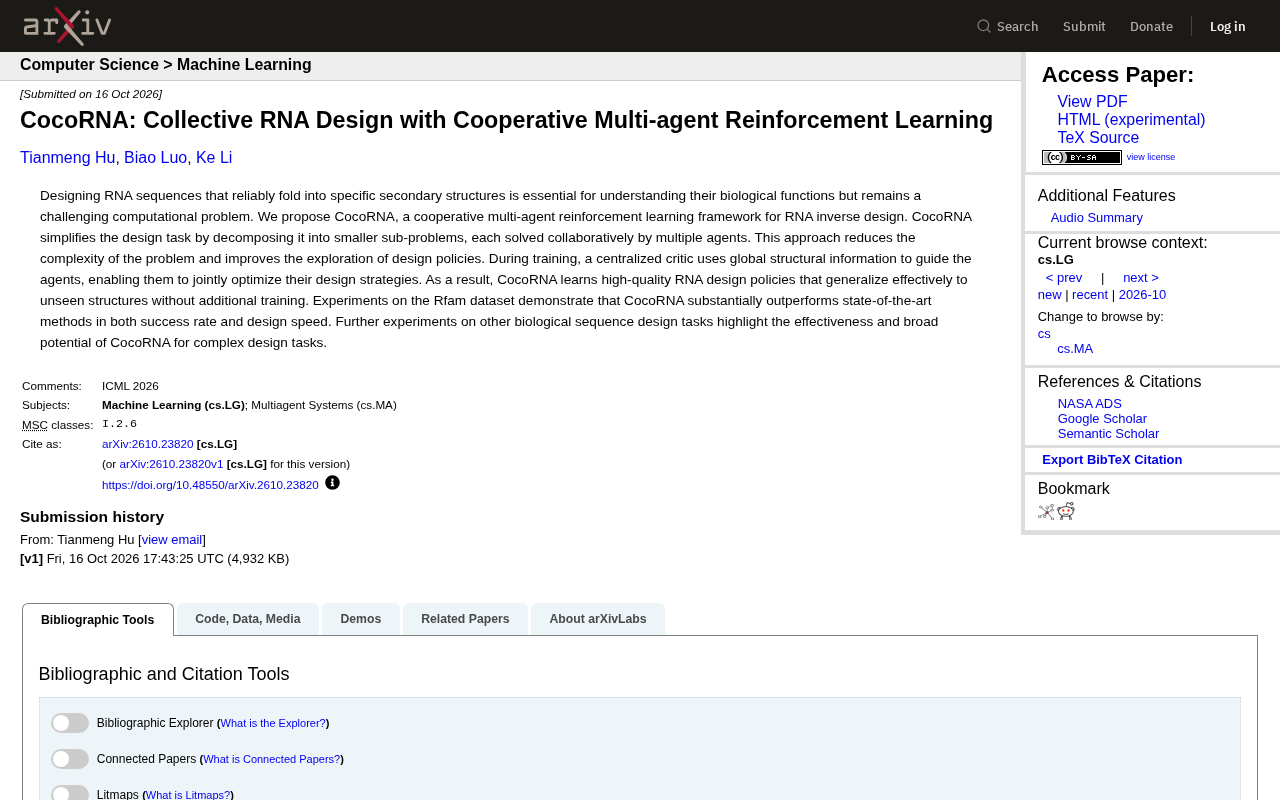
Background: The Computational Challenge of RNA Inverse Design
The core goal of RNA inverse design is, given a target secondary structure, to find a nucleotide sequence that thermodynamically tends to fold into that structure. Because the sequence space grows exponentially with length (4^L), direct search is almost infeasible. Existing methods fall roughly into two categories: optimization based on physical models (such as RNAinverse) and deep learning-based methods (such as strategies based on sequence generative models). The former relies on heuristic search, is slow, and easily gets trapped in local optima; the latter can accelerate the process but has limited generalization ability on unseen structures.
CocoRNA was proposed precisely to simultaneously improve the success rate and design speed, and to enhance generalization to unknown structures.
RNA secondary structure is a local folding pattern formed by a nucleotide sequence through base pairing (A-U, G-C, G-U), usually described in dot-bracket notation: paired bases are represented by brackets and unpaired ones by dots. This structure determines RNA stability, catalytic activity, and interactions with other molecules, so designing sequences that fold into a specific secondary structure has important application value, for example in designing artificial ribozymes, RNA switches, or drugs targeting RNA. Thermodynamically, the folding tendency of a given sequence is usually evaluated with the minimum free energy (MFE) model, i.e., the sequence tends to form the structure with the lowest free energy. The goal of RNA inverse design is to find a sequence whose MFE structure equals the target structure. Because the sequence space grows exponentially with length (4^L, where L is the sequence length), and MFE computation itself requires dynamic programming (such as the Zuker algorithm), direct exhaustive search is infeasible, so efficient search or learning methods are needed.
CocoRNA's Core Design: Decomposition and Collaboration
The innovation of CocoRNA lies in decomposing the overall design task into multiple subproblems, each solved by multiple agents collaboratively. Specifically, an RNA sequence is divided into several segments (or regions), and each segment is decided by one agent (for example, choosing the base at that position). This decomposition reduces the action space dimension of each individual agent, thereby alleviating the exploration difficulty in reinforcement learning.
During training, CocoRNA employs a centralized critic to evaluate global structural information—that is, the quality of the secondary structure corresponding to the complete sequence formed by the joint decisions of all agents. The critic passes the global reward signal to each agent, guiding them to optimize their policies toward a common goal. This "centralized training, decentralized execution" paradigm is a classic idea in multi-agent reinforcement learning, but this is its first systematic application in RNA design tasks.
Because agents share rewards, they gradually learn to act in coordination and avoid acting in isolation. More importantly, the trained policy can generalize to structures not seen during training without additional fine-tuning, which was verified in the experimental section.
The centralized critic is a training architecture in multi-agent reinforcement learning. During decentralized execution, each agent can only observe local information and choose actions independently; but during training, the critic can access the global state (the joint actions of all agents and environmental feedback), thereby more accurately evaluating the value of joint actions. This design alleviates the non-stationarity problem in multi-agent environments—because each agent's policy is changing, the environment is unstable from the perspective of a single agent. The centralized critic provides a stable learning signal through a global perspective and helps solve the credit assignment problem: when the team receives a reward, the critic can evaluate each agent's contribution to the reward, thereby more effectively updating each agent's policy. CocoRNA uses this mechanism to let the critic give a global reward based on the secondary structure quality of the complete sequence, which is then decomposed to the segment agents.
Experimental Performance: Improvements in Both Success Rate and Speed
The paper evaluated on the Rfam dataset. Rfam is a widely used RNA family database containing a variety of real secondary structures. Experimental results show that CocoRNA significantly outperforms current state-of-the-art methods in both success rate and design speed. Success rate reflects whether the designed sequence can correctly fold into the target structure, while design speed measures the time required to generate a candidate sequence. The simultaneous improvement of these two metrics indicates that CocoRNA's strategy is both effective and efficient.
In addition, the authors conducted extra experiments on other biological sequence design tasks, such as protein sequence design (presumably), to test the generality of the framework. The results show that CocoRNA's decomposition-collaboration idea can be extended to a broader range of complex design problems, demonstrating cross-domain potential.
Why Multi-Agent Reinforcement Learning Is Suited for RNA Design
RNA inverse design is essentially a combinatorial optimization problem with sparse rewards (only the complete sequence can be evaluated for structural match). Multi-agent decomposition transforms sparse rewards into denser subproblem rewards, while providing global guidance through the centralized critic, alleviating the credit assignment problem. In addition, the cooperative setting encourages agents to explore diverse joint actions, thereby enhancing the policy's exploration capability. Compared with single-agent methods, CocoRNA searches the sequence space more efficiently.
Of course, the method also has limitations. For example, the decomposition approach (how to partition segments) may affect performance, and training a multi-agent system requires more computational resources. The paper does not discuss these aspects in detail, and they are worth further study in the future.
The credit assignment problem is one of the core challenges in reinforcement learning, referring to how to reasonably assign a delayed, global reward to individual actions or agents when a team receives it. In RNA inverse design, a reward can only be obtained by comparing the folded complete sequence with the target structure, and the sequence consists of multiple segments, each contributing differently to the final result. If the global reward is directly averaged across all segments, the learning signal will be very sparse and noisy. Multi-agent decomposition combined with a centralized critic can estimate each segment's marginal contribution to the global reward through methods such as counterfactual baselines or value decomposition, thereby providing each agent with a more precise update direction. This mechanism makes learning efficient even under sparse rewards and is one of the key reasons why CocoRNA outperforms single-agent methods.
Summary and Outlook
CocoRNA demonstrates the effectiveness of cooperative multi-agent reinforcement learning in RNA inverse design, providing a scalable new paradigm for biological sequence design. Its core ideas—task decomposition, collaborative solving, and global guidance—also have reference value for other structured design problems (such as materials discovery and circuit design). With advances in reinforcement learning algorithms and biological computing resources, such methods are expected to become one of the standard tools for computational biologists.
One-line Summary
CocoRNA uses cooperative multi-agent reinforcement learning to decompose RNA inverse design, improving success rate and speed.
Paragraph Summary
CocoRNA is an RNA inverse design framework based on cooperative multi-agent reinforcement learning, aimed at solving the problems of large search space, low success rate, and poor generalization of traditional methods. It divides an RNA sequence into multiple segments, each decided by an independent agent, and uses a centralized critic to leverage global secondary structure information to guide joint policy optimization, achieving "centralized training, decentralized execution." On the Rfam dataset, CocoRNA significantly outperforms existing state-of-the-art methods in both success rate and design speed, and the learned policy can generalize to unseen structures without fine-tuning. The work also preliminarily explores the framework's generality on other biological sequence design tasks such as protein sequence design, demonstrating the potential of the decomposition-collaboration paradigm in complex combinatorial optimization problems.
Related articles

Chain of Thought Isn't Just for AI: How Humans Can Use CoT to Improve Thinking Quality
Chain of Thought isn't just a prompt trick for large models. Starting from a Hacker News discussion, this article analyzes why CoT works for human thinking too, breaks down actionable ways to transfer it, and highlights the key differences between human CoT and machine CoT.
Cloudflare Teams Up with OpenAI: Closi…
Cloudflare Teams Up with OpenAI: Closing the Loop from Vulnerability Discovery to Defense with AI
Cloudflare uses OpenAI Daybreak to investigate security vulnerabilities and generate reviewable remediation plans, while developers use Codex to boost coding efficiency and quality.

Orca Multi-Agent Orchestration in Practice: A Guide to Parallel Collaboration with Claude and Codex
Orca is Stable AI's free open-source agent workbench supporting 34 agents like Claude Code and Codex in parallel. Learn its Git worktree isolation, multi-model orchestration, and mobile management.