CodeCrab: A 100% Local AI Code Review Tool

CodeCrab is a fully local AI code review desktop tool — your code never gets uploaded to the cloud.
CodeCrab, built by developer Edy Aguirre, is a local-first AI pull request review tool that uses locally installed CLI tools to complete PR reviews in seconds — with 100% of the analysis happening on-device and no source code sent to third-party servers. It directly addresses privacy and compliance concerns around cloud-based AI coding tools, making it especially appealing to regulated industries and IP-conscious developers. As a native desktop app, it integrates deeply into local workflows without requiring API keys or cloud accounts. It earned 69 upvotes on Product Hunt, though only 2 comments, and its performance compared to cloud-hosted large models remains to be validated.
At a time when AI-assisted coding tools are everywhere, code privacy and security are becoming increasingly pressing concerns for developers. Most cloud-based AI tools require uploading source code to third-party servers — a mental hurdle that enterprises and privacy-conscious developers find hard to clear. CodeCrab, which recently appeared on Product Hunt, offers a different approach: a fully local-first AI Pull Request review tool.
What Is CodeCrab
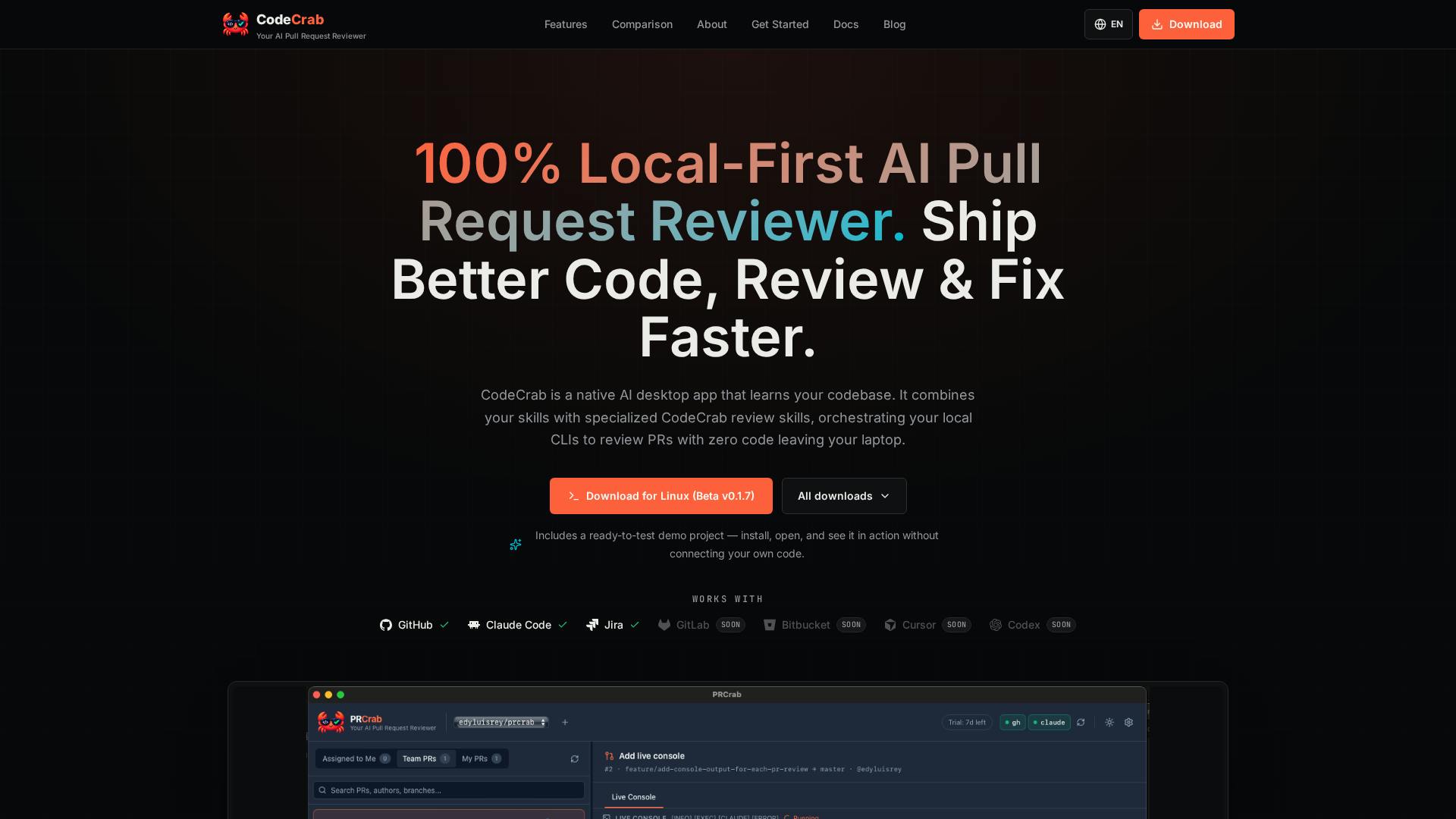
CodeCrab is a native desktop application positioned as a "100% local-first AI Pull Request reviewer." Its core value proposition is straightforward: it uses locally installed command-line tools (CLIs) to review Pull Requests in seconds, with the entire process happening 100% on the client side — your code never leaves your machine.
The product was built by developer Edy Aguirre and earned 69 upvotes on Product Hunt, ranking 17th for the day, under the categories of Software Engineering, Developer Tools, and Artificial Intelligence. While it didn't go viral, it addresses a real and high-frequency development scenario: code review.
What "Local-First" Actually Means
Traditional AI code review tools — such as cloud-based services integrated into GitHub or GitLab — typically require sending code snippets or entire diffs to a remote model for analysis. For teams dealing with sensitive business logic, operating under compliance constraints, or bound by strict NDAs, this approach carries real risk.
CodeCrab's local-first architecture is designed precisely to address this concern. It invokes CLI tools already present in the developer's local environment to execute the review logic, with all analysis happening on the local machine — no code uploads involved. This means:
- Source code never reaches any third-party server
- The tool works without a persistent internet connection
- It avoids data retention and compliance risks associated with cloud services
For heavily regulated industries like finance and healthcare, or independent developers who simply value intellectual property protection, this design has inherent appeal.
A note on "Local-First" architecture: "Local-first" as a software design philosophy has seen renewed interest in recent years, driven by demand for privacy protection and offline usability. Its core principle: data and computation happen primarily on the user's device, with cloud sync or remote services as an optional supplementary layer. In contrast, "cloud-first" architectures centralize data and logic on servers, with clients serving only as display layers. In AI coding tools, local-first is typically achieved through one of two approaches: running open-source large models locally (e.g., loading Llama or Mistral via Ollama or LM Studio), or — like CodeCrab — leveraging locally installed CLI tools (such as the GitHub CLI or Git command line) to handle analysis logic, with model inference potentially pointing to a local service. The tradeoff is that users must maintain their own local environment, and compute performance is constrained by local hardware, which may fall short compared to the massive cloud-hosted models with hundreds of billions of parameters.
A Review Experience Built for Real Development Workflows
Pull Request review is a critical part of modern collaborative development — and often one of the most labor-intensive. Senior engineers spend significant time reading diffs line by line, understanding context, and crafting feedback. CodeCrab aims to accelerate this process with AI, claiming to complete reviews in "seconds."
As a native desktop app rather than a browser extension or cloud service, CodeCrab can integrate more deeply into a developer's local workflow, reading local repository state directly and reusing already-configured CLI environments. This design reduces setup friction — developers don't need to obtain a separate API key or set up a cloud account just to use the tool.
A note on Pull Requests: A Pull Request is the core collaboration mechanism in modern distributed version control workflows. A developer submits a merge request from a feature branch to a target branch, triggering a code review process among team members. A typical PR review covers code logic correctness, security vulnerabilities, style conventions, test coverage, and potential performance issues. For mid-to-large codebases, a PR diff can span hundreds to thousands of lines of changes, making manual review extremely costly. AI-assisted PR review tools have emerged to address this efficiency bottleneck — by automatically flagging potential issues and drafting review comments, they reduce the cognitive burden on reviewers. Existing cloud-based competitors in this space include GitHub Copilot code review, CodeRabbit, and Sourcery. CodeCrab enters this market with privacy protection as its core differentiator.
Positioning and Perspective
In terms of product shape, CodeCrab represents a trend worth watching: AI tools are diverging from "cloud-first" toward "local-first." As locally runnable large models and CLI tool ecosystems mature, keeping inference and analysis capabilities on the user's device is becoming an increasingly viable option.
That said, its limitations deserve honest acknowledgment. The quality of local reviews depends heavily on the CLI tools and model capabilities available on the user's machine — which may lag behind unified cloud-hosted large models in terms of performance or depth of understanding. Additionally, the product currently has only 2 comments on Product Hunt, meaning public feedback is limited and real-world review quality across different use cases still needs more validation from users.
For teams looking for a code review solution that balances efficiency with privacy, CodeCrab offers a conceptually clear entry point: let AI read your code, but keep that code on your machine at all times. Whether it can carve out a durable niche in the crowded developer tools market will depend on future feature iteration and community reputation.
Related articles

Felix Rieseberg Personal Homepage
Felix Rieseberg's personal homepage sparks attention on Hacker News. This article covers the Slack engineer's technical background, the rise and fall of nativefier, and the value of a developer homepage as a tech calling card.

@ai-sdk/vue 3.0.306 Patch Release Syncs with [email protected] Update
@ai-sdk/vue 3.0.306 released, synced with [email protected]. A routine patch release for the Vercel AI SDK ecosystem with no public API changes; the Vue adapter layer stays version-aligned with the core package.

Gemini 4 Argon API Launches: The Era of Million-Token Output Begins
Google launches Gemini 4 Argon with sparse MoE architecture, up to 1M output tokens, and a 68.90% Vals Index score, available across API, AI Studio, and the Gemini app.