Codex + Claude Code Enterprise E-Commerce in Practice: From Vibe Coding to AI Engineering

A practical guide to advancing from Vibe Coding to AI engineering with Codex and Claude Code for real enterprise projects.
Based on hands-on Bilibili tutorial content, this article maps out an AI programming system built around Codex and Claude Code. The central argument is that a tool's value depends primarily on its backend model. Development is broken into three tiers: Vibe Coding for demos, Plan Mode as a bridge, and Super Power-based Spec-Driven Development for true enterprise-grade work. For model selection, GLM leads domestically while DeepSeek offers the best value. The article also highlights an underrated business opportunity in model aggregation platforms like OpenRouter, noting that real AI profits come from compute hardware and token sales — not consumer apps.
AI-assisted programming is reshaping the way developers work. The two most capable tools available today — Codex and Claude Code — combined with an engineering-driven workflow, can now support real enterprise-level project development. This article, based on practical tutorial content from a Bilibili creator, walks through how to build an e-commerce project from scratch using both tools, and clarifies the fundamental difference between "Vibe Coding" and "AI engineering-driven programming."
Why Codex and Claude Code
Among the many AI coding tools available, Codex and Claude Code are widely regarded as the two strongest options right now. Domestic tools like ByteDance's offerings and Cursor also perform well, but the core gap often comes down to the underlying model.
A key insight from the course: the most critical factor in AI-assisted programming is the backend model — the tool itself comes second. Claude Code is widely adopted not only for its model capabilities, but also because it embeds a complete "AI engineering programming" system internally, with extensive optimizations for professional-grade development. Reading through Claude Code's source code reveals that it is itself a product of rigorous engineering practices.
Codex was initially weaker than Claude Code, but with the latest GPT versions and ongoing internal optimizations, the gap is closing fast. There's also a practical consideration that can't be ignored: Claude accounts are frequently banned, especially under certain network conditions, and recovering access can be costly — which has pushed many developers toward Codex.
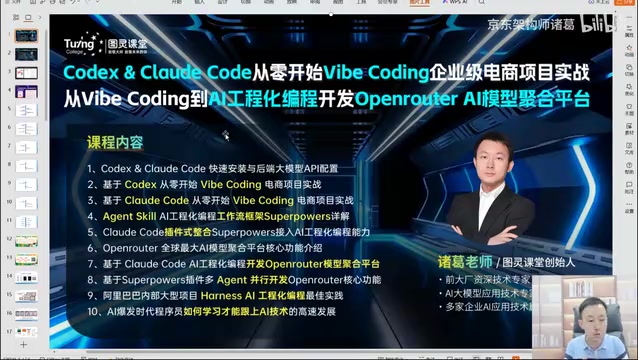
Development Environment: VS Code Takes the Lead
The tutorial author is clear that his development environment is built around VS Code, with the Claude Code plugin installed, allowing development to happen directly within the chat interface. This reflects a broader industry trend worth paying attention to.
Traditional heavyweight IDEs like the IntelliJ family feel somewhat dated in the AI era. The author uses a slightly exaggerated but grounded analogy: Eclipse was once displaced by IntelliJ, and now IntelliJ itself faces disruption from AI-powered tools. More and more developers are migrating to VS Code, and Cursor itself is built on top of VS Code.
It's worth noting that this is a matter of personal preference, not the only valid choice. Traditional IDEs remain usable — but the direction of tooling migration is becoming increasingly clear.
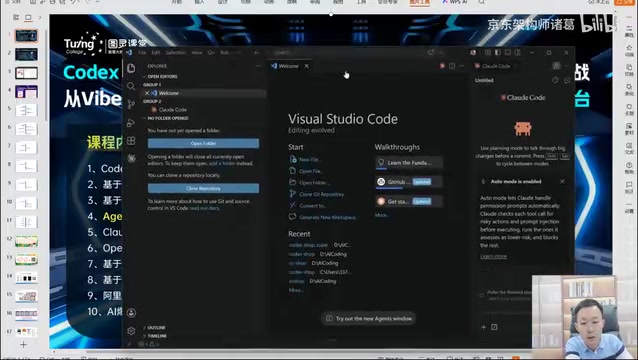
Three Development Modes: From Vibe Coding to Engineering
The most valuable aspect of this tutorial series is that it breaks the same project into three progressively advanced development modes, catering to learners at different skill levels.
Mode 1: Vibe Coding
Vibe Coding is a concept that originated overseas. The core idea is that product managers or anyone with an idea can simply describe their requirements clearly, and the AI tool will write the code — no manual implementation by a developer required.
But this approach has clear limitations. The author is direct: Vibe Coding is only capable of producing demo-level toy projects. As a project grows in size and complexity, problems pile up — the generated code may become a maintenance nightmare; when bugs hit production, someone without technical knowledge can't effectively direct the AI to diagnose and fix them, leading to a dead loop where the project stalls.
The course also calls out a phenomenon: early on, some non-developer AI content creators claimed they had "replaced programmers with Vibe Coding" — but looking closely at what they actually built, it was mostly simple cross-border e-commerce landing pages, Pomodoro timers, or ring lights — tools so minimal that two sentences of prompting could generate them. Real enterprise-level projects — complex business logic, high concurrency, microservices architecture — are simply beyond what Vibe Coding can handle.
Mode 2: Plan Mode
The second mode is plan-based development. Both Claude Code and Codex offer a Plan mode. Compared to pure Vibe Coding, it plans before executing, which supports slightly more complex projects and serves as a transitional form between "toy" and "engineering."
Mode 3: AI Engineering-Driven Programming (Enterprise-Grade)
The third mode is the main focus, and it's what many small-to-medium companies are already practicing — development based on the Claude Code plugin Super Power.
Super Power is essentially a complete collection of AI engineering programming skills, containing anywhere from a dozen to several dozen individual skills that span the entire workflow: from requirements analysis, development, and testing, to deployment and launch. It belongs to the same family of ideas as tools like Spec Code and Spec Kit, which follow a "Spec-Driven Development (SDD)" philosophy. Codex has equivalent capabilities on its side as well.
Only by working within this engineering-driven workflow can you truly develop enterprise-grade projects that are maintainable and scalable.
Spec-Driven Development (SDD) is a software development paradigm centered on structured specification documents as the primary driver. Rather than asking AI to "write code" directly, developers first produce requirements specifications (Specs), architecture designs, and interface contracts — and the AI then generates, validates, and iterates on code based on those documents. The key advantage is that the specification acts as a "contract" between the developer and the AI, making every step of code generation traceable, reviewable, and auditable. Tools like Spec Kit and SpecCode standardize this process; Super Power goes further by packaging skills into reusable pipeline nodes, covering the full chain from user story decomposition to unit test generation. Compared to Vibe Coding's "generate from a single sentence," SDD's essence is reintroducing the rigor of software engineering into AI-assisted development — ensuring projects remain maintainable as they scale.
Choosing a Backend Model
In practice, Codex uses the latest GPT version as its backend. For Claude Code, due to concerns about account bans and network restrictions, the author opted to connect domestic Chinese models instead.
After hands-on testing of the major domestic LLMs, the author's assessment is: GLM (Zhipu AI) is currently in the top tier domestically and the most practical to use; DeepSeekAd offers the best price-to-performance ratio — cheap and capable; Kimi, MiniMax, MiMo, Alibaba Tongyi, and Tencent Hunyuan are all usable as well. These conclusions come from personal testing and aren't definitive rankings, but they offer useful guidance for model selection.
An Underrated Revenue Opportunity: Model Aggregation Platforms
The tutorial also plans to build a second project — an AI model aggregation platform similar to OpenRouter. OpenRouter is described as the world's largest AI model aggregation platform, bringing together virtually all mainstream models while offering generous free quotas and model capability rankings.
The author shares a sharp observation about profitability in the AI industry: most consumer-facing AI applications (like Doubao or Tencent Yuanbao) are losing money. The businesses actually making money are hardware that sells compute (memory, chips, semiconductors) and businesses that sell tokens. Model aggregation "wrapper" platforms are exactly that — buying tokens at lower prices and reselling them. According to the author, there are small teams of around ten people running such platforms and generating hundreds of millions of RMB in annual revenue.
This perspective is a reminder to developers: the opportunities in the AI wave aren't limited to building applications — choosing the right business model matters just as much.
OpenRouter's business model is fundamentally API forwarding and traffic aggregation: it wraps the interfaces of various model providers into a unified layer, so developers can access GPT, Claude, Gemini, open-source models, and dozens more through a single SDK, paying only for the tokens they consume. The platform captures margin through price spreads or transaction fees. The moat here isn't technical complexity — it lies in the breadth of the model catalog, competitive pricing, stable account and quota supply, and the developer community loyalty built around it. Teams running similar businesses in China often layer in an additional use case: acting as "API relay" services that help domestic developers bypass access restrictions and centrally manage multiple overseas model accounts — which further expands the addressable market. Understanding this business logic helps developers realistically evaluate the profitability and competitive landscape when considering this as a second project direction.
Closing Thoughts
For developers, the core message from this tutorial series is clear: AI-assisted programming won't replace those who keep learning — but it will render obsolete those who stop growing. The evolution of tooling from Vibe Coding to engineering-driven development actually proves that "knowing your craft" in the AI era isn't a burden — it's the prerequisite for wielding these tools effectively and shipping enterprise-grade projects. Mastering Codex, Claude Code, and engineering pipelines like Super Power is where the real focus should be right now.
Related articles

Chain of Thought Isn't Just for AI: How Humans Can Use CoT to Improve Thinking Quality
Chain of Thought isn't just a prompt trick for large models. Starting from a Hacker News discussion, this article analyzes why CoT works for human thinking too, breaks down actionable ways to transfer it, and highlights the key differences between human CoT and machine CoT.
Cloudflare Teams Up with OpenAI: Closi…
Cloudflare Teams Up with OpenAI: Closing the Loop from Vulnerability Discovery to Defense with AI
Cloudflare uses OpenAI Daybreak to investigate security vulnerabilities and generate reviewable remediation plans, while developers use Codex to boost coding efficiency and quality.

Orca Multi-Agent Orchestration in Practice: A Guide to Parallel Collaboration with Claude and Codex
Orca is Stable AI's free open-source agent workbench supporting 34 agents like Claude Code and Codex in parallel. Learn its Git worktree isolation, multi-model orchestration, and mobile management.