Codex, Claude Code, OpenHands, or Hermes: How to Choose the Right AI Agent

A practical guide to choosing between Codex, Claude Code, OpenHands, and Hermes based on your actual needs.
Codex, Claude Code, OpenHands, and Hermes all carry the 'AI Agent' label, but they serve very different purposes. This article uses a personal knowledge base scenario to break down each tool's core strengths — from Codex's project-level code execution to Claude Code's pair programming style, OpenHands' multi-tool orchestration, and Hermes' long-term memory system — helping you pick the right starting point.
Don't Follow the Hype: Understand Each Tool's Purpose First
Codex, Claude Code, OpenHands, and Hermes have all been making waves lately, and one of the most common questions from newcomers is: "Where do I even start?"
The biggest mistake beginners make is jumping into these tools before understanding what they're actually built for. The result? Using the wrong tool for the wrong job — and walking away thinking "AI just doesn't work."
The truth is, while all four carry the "AI Agent" label, they serve very different use cases. Instead of debating which one is the most powerful, start by asking: what problem am I actually trying to solve right now?
What is an AI Agent? An AI Agent is an AI system capable of perceiving its environment, planning autonomously, and executing multi-step tasks. Unlike a regular chatbot, an Agent has "tool-use" capabilities — it can read and write files, run code, call APIs, and browse the web, forming a closed loop of "perceive → plan → act → feedback." All four tools fall under the category of "code agents" or "general-purpose agents," but they differ in autonomy, memory mechanisms, and integration depth.
To make the differences concrete, let's use a specific scenario: you want to build a personal knowledge base website, and you'd like AI to help modify pages, fix errors, organize content, and eventually remember your preferences. That sounds like one task — but break it down and you'll find it calls on four distinctly different capabilities.
Codex: The AI Developer That Works Directly Inside Your Project
Think of Codex as an AI developer who can walk straight into your project folder and get to work.
OpenAI Codex started as a language model trained specifically for code generation, with its evolution deeply integrated into GitHub Copilot. The newer Codex CLI/Agent can directly manipulate local file systems, execute shell commands in a sandboxed environment, and complete engineering tasks through a "read → modify → verify" loop. At its core, it's a task-oriented Agent with code understanding and execution capabilities.
Here's a practical example: if you already have a website project, you can simply say "add a search bar and fix the startup error" — and it will read the code, modify files, run commands, and verify the results. It's purpose-built for clear-cut engineering tasks like this.
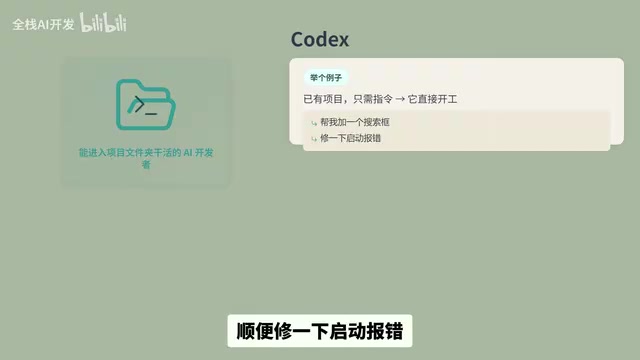
A key principle to keep in mind: if you already have a project and need to add features, fix bugs, or refactor code, Codex should be your first consideration. But if you have no existing codebase and just want to generate a full-blown commercial system from a single sentence, temper your expectations. It excels at making steady progress within an existing engineering framework — not conjuring large systems out of thin air.
Claude Code: Your Always-Available Pair Programming Partner
Claude Code, by contrast, is more like a pair programming partner sitting right next to you, ready to answer questions at any moment.
"Pair Programming" originates from Extreme Programming (XP), a software development methodology where two developers share one computer: one writes code while the other reviews in real time and provides feedback. This approach is proven to significantly reduce defect rates and accelerate knowledge transfer. Claude Code brings this classic model into the digital age — it doesn't just output code, it also explains design intent, analyzes contextual dependencies, and answers "why is it written this way?" It's especially well-suited for users who are learning or working with an unfamiliar codebase.
Back to our scenario: your project won't run, and you don't just want it to fix the code — you want to understand what's going on. "What does this error mean?" "What does this file do?" "Where should I start?" Claude Code lets you ask as you go, helping you deeply understand the codebase before moving forward step by step.
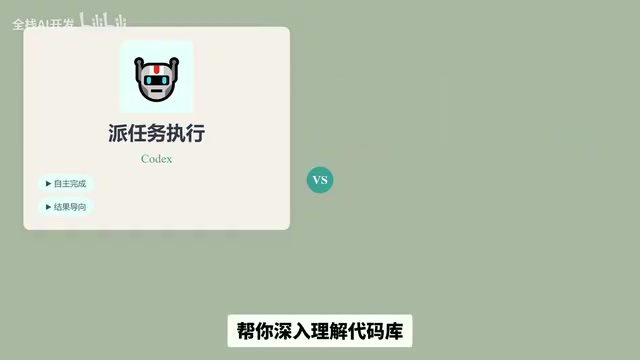
Here's a simple way to summarize the core difference:
- Codex: You assign a task and let it execute — best for clear, targeted changes.
- Claude Code: You write and ask together, with it alongside the whole time — best for learning while doing.
If you need to make a well-defined change, go with Codex. If you want to genuinely understand and grow while writing code, go with Claude Code.

OpenHands: The Open-Source AI Agent Orchestration Hub
OpenHands (formerly OpenDevin) isn't just a code-writing tool — at its core, it's an open-source agent control hub.
OpenHands uses a "sandboxed isolation + multi-tool orchestration" architecture. Its core is a control layer that can uniformly schedule a browser, terminal, code editor, and external APIs. It follows the "CodeAct" paradigm — translating natural language instructions into executable code actions rather than simple text outputs. This architecture is what gives it the ability to handle complex, cross-system tasks: using a single entry point, you can have it operate on local files and remote services simultaneously. It's also why strict permission boundaries are an absolute must.
Back to our knowledge base example: you don't just want to modify the website — you want to send a message from a chat app and have it look up information, organize files, invoke various skills, and even handle your calendar and email. The core value of this kind of tool isn't writing code; it's linking "entry point → large model → various tool skills" into a hub that can orchestrate multiple capabilities.
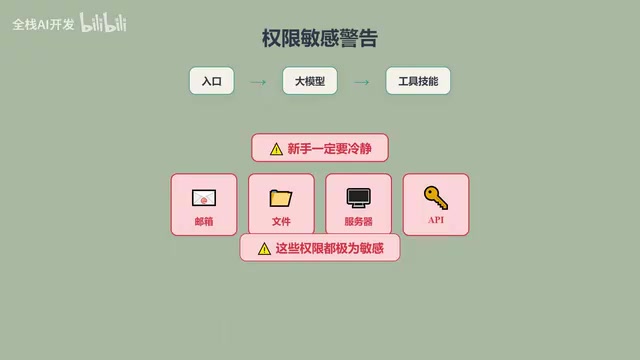
A word of caution for beginners: being able to connect to many things doesn't mean you should connect everything at once. Email, file servers, and various API permissions are all highly sensitive. Start with small, low-stakes tasks before handing over full access. This is both a security consideration and a way to gradually understand the tool's behavior within a controlled scope.
Hermes: A Growing AI Assistant That Retains Memory and Skills
Finally, there's Hermes — best described as an open-source, adaptive assistant that accumulates memory and skills over time.
Hermes achieves "memory retention" through two core mechanisms: vector databases (such as Chroma or Weaviate) — which encode the semantic content of past interactions as high-dimensional vectors for storage, then retrieve relevant memories via similarity search when needed. This is entirely separate from the large model's own parametric memory; it's an expandable, "plug-in" external memory system. The second mechanism is structured workflows — solidifying tasks you repeatedly perform into reusable automation templates, so that each repetition builds lasting efficiency.
What makes Hermes appealing isn't what it does for you today — it's that it converts each experience into a reusable workflow. If you regularly ask it to organize research, write scripts, or handle research tasks, it retains those experiences and gradually shapes them into a personalized workflow that's uniquely yours.
That said, it's not the right first choice for everyone. If you just need to fix a website error today, there's no reason to wrestle with long-term memory, self-hosting, and skill systems. Hermes is best suited for users who are willing to invest over the long term and continuously build out their personal workflows.
AI Agent Selection Checklist: Match Your Needs Directly
With so many options, how do you decide? Here's a direct lookup by need:
| Your Need | Recommended Tool |
|---|---|
| Modifying an existing project, fixing bugs, refactoring | Codex |
| Writing code while having someone explain things in real time | Claude Code |
| Building an open-source personal assistant hub | OpenHands |
| Long-term memory, skill accumulation, self-hosting | Hermes |
Remember: don't try to learn all of them at once. Pick the one that best fits your current problem and start there.
Three Common Pitfalls to Avoid
Beyond choosing the right tool, there are three traps worth steering clear of:
First, don't treat AI Agents like an all-powerful wish machine. The vaguer your instructions, the more likely you'll get outputs that look impressive but can't actually be used. Clear task decomposition always beats fancy one-liners. No matter how capable an Agent's planning is, it depends on the quality of its input — "Garbage In, Garbage Out" applies just as much in the Agent world.
Second, don't grant excessive permissions from the start. Email, files, servers — if you can hold off on connecting them, do so. Permission management is the most commonly overlooked yet most accident-prone area when using AI Agents. The more autonomous an Agent is, the greater the potential damage if it misinterprets a task or falls victim to a prompt injection attack. The Principle of Least Privilege is your most basic line of defense.
Third, don't blindly chase the hottest tool. The real skill to develop is the ability to break down tasks clearly so the AI can execute them step by step. Many people's real problem isn't that the tool isn't powerful enough — it's that they're using it in the wrong context.
Closing Thought: Think of AI Agents Like Employees You're Hiring
AI Agents aren't magic. At their core, they're more like employees. You need to be clear about what role you're actually hiring for: a developer (Codex), a pair programming partner (Claude Code), a personal assistant hub (OpenHands), or a long-term, growth-oriented assistant (Hermes).
Choosing the right role matters far more than chasing the most hyped tool. Get clear on what your problem is right now, pick the tool that fits it most closely, and start there. That's the most reliable entry point for anyone starting from scratch.
Related articles

Disaster and Glory of the Apollo Program: The History We Must Revisit Before Returning to the Moon
From the fatal Apollo 1 fire to Apollo 8's daring lunar orbit to Apollo 11's successful landing—revisiting the disasters, fears, and compromises of the Apollo program and their lessons for today's return to the Moon.

Netflix Trust Exercise Turns Into Firing Trap: Where Are the Boundaries of Corporate Trust?
A Netflix employee was fired after sharing private info in a trust exercise. We analyze the risks of corporate trust exercises and how employees can protect themselves.

AMD CDNA5 Architecture Deep Dive: Technical Evolution and the AI Computing Competition Landscape
Deep analysis of AMD's CDNA5 architecture covering Chiplet packaging upgrades, HBM memory evolution, and low-precision compute optimization, examining how AMD challenges NVIDIA's AI chip dominance.