Codex Claude Plugin Deep Dive: Impressive Code Review, But Four Critical Flaws You Can't Ignore

OpenAI's Codex plugin for Claude shows strong code review but suffers four fatal flaws as a half-baked product.
OpenAI developed a Codex coding plugin for competitor Claude, offering standard code review, adversarial security scanning, and code rescue. After a week of deep testing, four critical flaws emerged: frequent plugin conflicts hijacking commands, chaotic output burying critical findings, adversarial scanning defaulting to dangerously narrow scope creating false security, and severe stability issues. Overall, it remains a half-finished product.
OpenAI Built a Codex Plugin for Claude: A Week of Deep Testing Reveals a Half-Baked Product
OpenAI has built a dedicated coding plugin—Codex Plugin—for its competitor Claude. In the AI world, this is the equivalent of McDonald's selling KFC's Original Recipe chicken. Many media outlets have hyped it as a "milestone that breaks down Big Tech barriers and ushers in the multi-agent programming era." But after a week of intensive hands-on testing, we found that the real picture of this Codex Claude plugin is far more complex than the marketing suggests—it's a half-finished product with outstanding strengths but fatal weaknesses. Its true success lies in precisely targeting a massive user group that the market has overlooked.
Core Features Overview: A Lightweight Plugin with Only 7 Commands
The Codex Plugin (CC Plugin for short) has an extremely streamlined architecture with only 7 commands total. The core functionality boils down to three capabilities:
- Standard Code Review: Performs routine quality and security checks on code
- Adversarial Code Review: Conducts deep security scanning from an attacker's perspective
- Code Rescue: Automatically generates fix proposals for discovered issues
It looks clean and powerful on paper, but from actual user experience to underlying logic, this AI code review plugin falls short across the board.
Four Critical Flaws: From Ecosystem Compatibility to Data Security
Input Requests Get Hijacked—Plugin Conflicts Run Rampant
Claude's plugin system uses a keyword-matching intent recognition mechanism. Essentially, after the large language model receives user input, it determines which tool to invoke based on semantic similarity. This architecture differs from OpenAI's Function Calling—the latter allows developers to set explicit invocation priorities and mutual exclusion rules for each function. Claude's plugin ecosystem currently lacks a native conflict arbitration layer, meaning the system cannot guarantee deterministic invocations when multiple plugins have semantically overlapping trigger words. This architectural flaw is virtually invisible in single-plugin scenarios but gets dramatically amplified in production environments with multiple coexisting plugins.
Specifically regarding this conflict: the platform requires each plugin to use a dedicated prefix plus keywords to avoid collisions, but Codex violated this by using generic terms like "Review" and "Result," directly clashing with similar plugins like Superpower. In our testing, when we executed the "Codex Review" command, the Superpower plugin intercepted it first; when we entered "Codex Result" to view results, it got hijacked again. This kind of fundamental compatibility issue shows that OpenAI had a seriously insufficient understanding of Claude's plugin ecosystem before launch.
Chaotic Output—Critical Information Gets Buried
The Codex plugin has neither a dedicated review results panel nor color-coded highlighting by risk level or pinned conclusions. In our testing, a P1-level critical bug report was completely buried within a dozen rounds of conversation—we had to scroll through extensively just to find it.
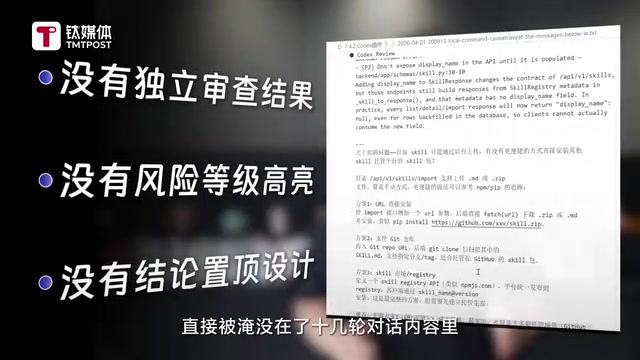
Stability is equally concerning: the same adversarial review task sometimes completed in 38 seconds, and other times got stuck at the "Starting" state for nearly three minutes before requiring manual termination—an absurd level of variability.
Adversarial Security Scanning "Cuts Corners," Code Rescue Is "Half-Baked"
Adversarial Code Review is a security assessment methodology rooted in Red Teaming philosophy, requiring reviewers to examine code from an attacker's perspective rather than a defender's. Traditional static analysis tools (like SonarQube and Semgrep) rely on predefined rule libraries for pattern matching—they have high coverage for known vulnerability types but are virtually powerless against business logic vulnerabilities and combined attack chains. The differentiated value of AI-driven adversarial review lies precisely in its ability to understand the business semantics of code and reason about cross-file, cross-module attack paths. However, this capability is highly dependent on the completeness of the scanning scope.
Adversarial review should cover the entire project codebase for comprehensive, no-blind-spot security scanning. But in its default state, it only scanned the files responsible for user login in the project. While it did uncover four vulnerabilities, it completely ignored equally critical risks like SQL injection and SSRF in other folders within the same repository. Only when we manually added instructions explicitly requesting "deep comprehensive investigation across security defects, logic defects, and design defects" did it reluctantly expand its scanning scope. Developers unfamiliar with this hidden logic can easily fall into a false sense of security.
Related articles
 Product Reviews
The Programmer's Desk Setup Guide: Building a Workspace That Feels Like Home
Discover how programmers build productive, comfortable workspaces. From multi-monitor setups to ergonomic design, explore the desk philosophy that drives focus and flow.
 Product Reviews
Qoder vs Cursor Real-World Comparison: Which $20/Month AI IDE Is Better?
Hands-on comparison of Qoder vs Cursor AI IDEs: Agent autonomy, human interaction count, and architecture decisions. Qoder needed only 2 interactions vs Cursor's 8.
 Product Reviews
Cursor Cloud Agent Demo: Eliminating Bottlenecks Across the Entire Software Development Lifecycle
Deep analysis of Cursor's Cloud Agent demo showing how cloud VMs, automated test artifacts, and a full-chain control plane systematically eliminate human bottlenecks across the software development lifecycle.