Codex Cloud Deep Dive: How OpenAI's Cloud-Based AI Coding Agent Is Reshaping the Developer Workflow

Codex Cloud moves AI coding tasks to the cloud, enabling async delegation, cross-device continuity, and automated code delivery.
OpenAI's Codex Cloud upgrades the AI coding assistant from a local tool to a cloud-based autonomous agent: tasks run independently of your device, letting developers switch to their phone or give voice instructions mid-walk. A chat-based onboarding flow auto-detects repo requirements and generates reusable named environment snapshots with secure per-user credential overrides. On completion, the AI can automatically create Pull Requests, run tests, and flag items needing human approval — shifting developers from executors to task initiators and reviewers. The product charts a clear path from real-time AI assistance toward asynchronous delegation, though real-world reliability on complex projects remains to be proven.
OpenAI's new Codex Cloud moves the AI coding assistant from your local terminal into the cloud, delivering a fundamentally different kind of asynchronous development experience. Based on the official demo video, the most significant shift is this: once a task is kicked off, it runs entirely independent of your local device. You can close your laptop, pick up your phone, put on headphones and go for a walk — the task keeps running in the background and notifies you when it's done.
Cloud Execution: Tasks No Longer Tied to Your Device
The most immediately compelling pitch for Codex Cloud is that coding task execution happens entirely in the cloud. In the demo, the presenter launches a task and then closes the local window — and the task keeps running. That feeling of being "freed" from your machine is something no local tool can offer.

For developers, this addresses a long-standing pain point: with existing AI coding tools, your local machine has to stay on, the terminal window has to stay open, and any interruption risks killing the task. Cloud execution fully decouples a task's lifecycle from your personal device. You can pick up where you left off from any device at any time, even appending new instructions from your phone to a task that's already running — without disrupting its execution.
Taking it a step further is voice interaction. The demo mentions putting on headphones, starting a voice session, letting a task run in the background while you go for a walk, and having it report back when it's done. This combination of "async + multimodal" transforms AI coding from "staring at a screen waiting for results" into "delegate and check in whenever you want."
This architectural shift relies technically on an Agentic Execution model: the AI is no longer just a line-by-line code completion tool — it operates as a persistent, autonomous agent with dedicated compute resources, a filesystem, and network access. Unlike earlier AI coding tools built on browser extensions or local Language Server Protocol (LSP) integrations, a cloud-based agent can maintain state across sessions and continue executing multi-step tasks while the user is offline — such as chaining tool calls, modifying multiple files, and running test suites. Products like GitHub Copilot Workspace and Devin have explored similar territory, but Codex Cloud differentiates itself by making "device independence" and "multimodal continuity" core to the primary product experience.
Chat-Based Environment Setup: Configure Once, Reuse Everywhere
The process of spinning up a cloud environment has been redesigned from the ground up. When you create a new cloud environment, Codex Cloud walks you through a chat-based onboarding flow: you hand it a code repository, and it investigates what configuration that repo might need during initialization.

The configuration capabilities cover fairly advanced scenarios — including network settings, environment variables, and secrets management. The demo emphasizes that this isn't simple template filling; the system actively analyzes repository requirements and makes recommendations. For complex projects with heavy dependencies, this kind of automated environment detection can dramatically reduce setup overhead.
Secrets Sharing and Team Collaboration
One notable design detail in the environment configuration is how secrets are handled. When you share a configured environment with teammates, you can allow each person to override the defaults with their own secrets.
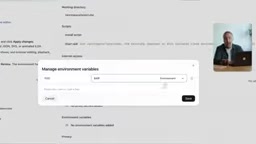
This override can be done inline or pulled from a personal vault. This detail reflects deliberate thinking about team collaboration and security boundaries: you can share an environment without exposing sensitive credentials — each team member keeps control of their own.
Once configured and published, you get a named environment — essentially a snapshot. Its greatest value is "set it up once, reuse it endlessly." Instead of repeatedly rebuilding the same dev environment from scratch, you can spin up multiple independent tasks in parallel from the same snapshot. The entire team can use it directly. For multi-person engineering teams, this is a genuine productivity gain.
The Named Environment snapshot mechanism is essentially an AI-native implementation of the Environment as Code philosophy. Traditional Infrastructure as Code tools (Docker, Nix, Dev Containers) also pursue reproducible development environments, but they typically require developers to manually author and maintain config files. Codex Cloud's difference is that the initial configuration is automatically inferred by AI rather than filled in manually — once the snapshot is locked in, other team members get a perfectly consistent baseline environment with zero friction, while the Personal Vault mechanism lets each person inject their own private credentials on top of the shared config layer, avoiding the security risks of hardcoded or shared credentials.
From Task to PR: A Built-In Code Review Pipeline
Once a task completes, Codex Cloud offers several paths forward. You can have it create a Pull Request through the standard flow, or take what the demo presenter specifically recommends: the new code review workflow.

Even more interesting is the automated delivery capability. In the demo, the presenter simply gives a natural language instruction to the assistant "Dot" — go create a PR, check the results, run the tests, and flag anything that needs human approval — then steps away to handle other things. This pipeline chains together "write code → submit for review → run tests → human sign-off" into a loop that can be partially delegated to AI.
A Pull Request (PR) is the standard gated merge process in modern software teams: a developer submits changes to a separate branch, which goes through code review and automated testing (CI/CD) before being merged into the main branch. Incorporating this flow into an AI agent's execution chain means the AI is no longer just responsible for "writing code" — it's also responsible for delivering code: constructing commits that conform to team standards, triggering test pipelines, and flagging risk points that require human judgment. This is a critical inflection point in the evolution of AI coding tools from "co-pilot" to "autonomous engineer" — and it's also one of the most hotly debated capability boundaries in the industry today: the reliability of automated PRs directly determines whether human review can genuinely happen less frequently, or just gets pushed later in the pipeline.
What This All Means
Codex Cloud sends a clear signal about where things are heading: AI-assisted coding is moving from real-time assistance to asynchronous delegation. The developer's role increasingly resembles that of a task initiator and reviewer, while the actual execution is handed off to cloud-based AI agents running autonomously over extended periods.
Combined with voice interaction, cross-device continuity, reusable environment snapshots, and a built-in code review pipeline, this toolset is trying to free developers from the constraint of "having to sit in front of a computer." Of course, a demo video alone isn't enough to judge stability and real-world performance on genuinely complex projects — especially the reliability of the automated PR and testing steps, which will need to be validated in actual use. But the workflow it describes does point toward one plausible shape of AI-assisted development in the future.
Related articles

Free Unlimited Claude Code Solution: Agnes AI + CC Switch Setup Guide
No paid subscription needed — pair the free AI platform Agnes AI with the open-source tool CC Switch to provide a backend for Claude Code, enabling unlimited free calls to text, image, and video models. This guide covers the full setup, test results, and usage boundaries.

A Complete Zero-Cost Guide to Getting Started with Claude Code for Beginners in China
A beginner's guide to Claude Code for users in China: two installation methods (command line and IDE plugin), full configuration steps for replacing the official API with the free domestic LongCat model, and a hands-on demo of building a small tool with natural language, plus tips.

When the NSA Gets Involved: The AI Supply Chain Crisis Behind Open-Source CVEs and API Key Hijacking
Multiple open-source projects disclosed severe CVEs in one day, PHP flaws alarmed the FBI, and Railway and OpenCode were breached with API keys stolen. This article breaks down the vulnerability window, AI-accelerated exploitation, and the AI supply chain crisis behind the API key black market, with a developer defense checklist.