Codex GPT-5.6 1M Context Configuration Tutorial & Pitfall Guide

How to configure Codex's 1M context window and why you probably shouldn't use it yet.
OpenAI Codex now supports GPT-5.6-Sol's 1M context window for subscription users. This guide covers two configuration methods (Config.toml and CLI), while warning about significant tradeoffs: doubled pricing beyond 272K tokens, measurable model capability degradation at longer contexts due to the 'Lost in the Middle' effect, and increased noise interference. The practical recommendation is to stay under 500K tokens and invest in intelligent context management instead.
Introduction: 1M Context Is Here, But Do You Really Need It?
OpenAI's Codex recently received a noteworthy update—the GPT-5.6-Sol model now officially supports a 1M (million-level) context window. Previously, this ultra-long context capability was only available to API users, but now GPT subscription users can access it directly.
The "context window" refers to the maximum amount of text a large language model can "see" and process in a single inference pass, typically measured in tokens. Tokens are the smallest units of text processing for models—in English, each word corresponds to roughly 1–1.5 tokens, while in Chinese, each character typically maps to 1–2 tokens. 1M tokens is approximately equivalent to 7.5 million English words or 3–5 million Chinese characters, enough to accommodate dozens of complete books. A larger context window theoretically allows the model to reference more conversation history and background material, but this doesn't mean processing quality scales proportionally with window size.
According to analysis by Bilibili creator DP, while this update appears enticing, it conceals a series of tradeoffs involving pricing, model capability, and noise interference. This article combines official announcements with real-world test data to outline configuration methods for the 1M context and provide a practical "pitfall avoidance guide."
Please note that the following content is based on publicly shared information and is for reference only—always defer to official OpenAI documentation.
Key Takeaways from the Official Announcement
According to the official announcement, three key pieces of information deserve attention:
- Limited to GPT-5.6-Sol model only: Note that this is 5.6-Sol specifically, not all 5.6 models—only the Sol variant supports 1M context in Codex. The Sol series is a variant within OpenAI's model family optimized for specific capability dimensions. In the GPT-5.6 series, the Sol version was chosen as the carrier for 1M context, meaning its architecture was specifically adapted for long-sequence processing—potentially employing more efficient attention mechanisms (such as sparse attention, hierarchical attention, or hybrid sliding window attention schemes) to handle the computational overhead of ultra-long sequences. However, such adaptations often come with tradeoffs in other capability dimensions.
- Available to subscription users: Previously, 1M context was API-only; now GPT subscription users can also access it.
- Simple activation methods: The official documentation provides both permanent configuration and temporary activation options.
This means that if you're a subscription user, you were previously limited to the standard context window, but can now break through to million-level token processing capability.
Brief Overview of the Codex Product
Before diving into configuration methods, it's worth briefly explaining Codex's product form. OpenAI Codex is an AI coding agent platform designed for software engineering that can autonomously execute code writing, debugging, refactoring, and other tasks within a cloud sandbox environment. Codex offers multiple access methods: Codex CLI (command-line tool), VS Code plugin integration, and a standalone Codex Web App. Unlike standard ChatGPT conversations, it focuses more on understanding and operating at the code repository level, which creates higher demands for context length—a mid-sized project's codebase can easily span hundreds of thousands of lines. This is precisely why 1M context is attractive for Codex scenarios.
Two Methods for Configuring 1M Context in Codex
Method 1: Permanently Modify the Codex Config.toml File
The first method involves directly modifying the Codex Config.toml file to specify GPT-5.6-Sol as the model and configure context length and compression length parameters.
TOML (Tom's Obvious, Minimal Language) is a human-readable configuration file format widely used in development tool configuration management. Codex uses Config.toml as its global configuration entry point, where users can specify default models, context length, compression strategies, and other parameters. The "compression length" parameter refers to the threshold at which the system automatically summarizes and compresses earlier content when conversation history exceeds the set limit, preserving more effective information within the available window.
This method's key characteristic is configure once, apply globally—after modification, all your Codex entry points (including Codex CLI, Codex VS Code plugin, and Codex App) will automatically apply the 1M context setting. It's ideal for users who are committed to long-term use of ultra-long context.
Method 2: Temporary CLI Activation
The second method is a temporary solution for single sessions. If you just want to test a specific scenario, you can specify the model and attach corresponding parameters via command-line arguments when launching CLI. It's essentially identical to the configuration file approach but only applies to the current session.
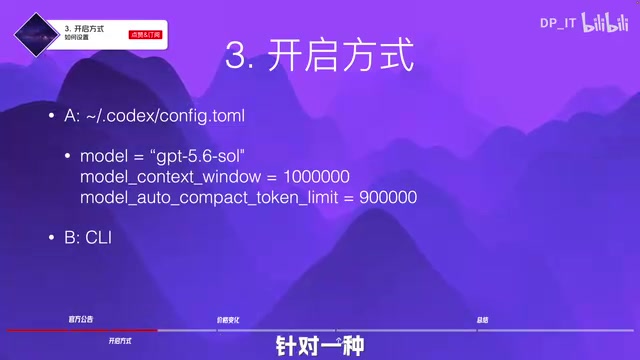
From the test screenshot, we can see that after launching Codex with the temporary command-line method, the context window displays as 1M—configuration successful. For users who don't want to manually type configurations, you can also copy ready-made configuration content from publicly shared articles.
1M Long Context Pricing: The Cost of Doubling
Many people instinctively assume "longer context is always better," but DP stated directly in his video: this content is essentially meant to "pour a bottle of cold water" on everyone. The core issue starts with pricing.
Tiered Pricing for Short vs. Long Context
GPT-5.6-Sol pricing features a clear tiered mechanism: 0 to 272K is the short context range, while anything above 272K enters the long context range. The price difference between the two is significant:
- Input pricing: Short context is at the standard rate; long context input price is doubled (×2).
- Output pricing: Increases from 30 to 45, approximately 1.5× the standard rate.
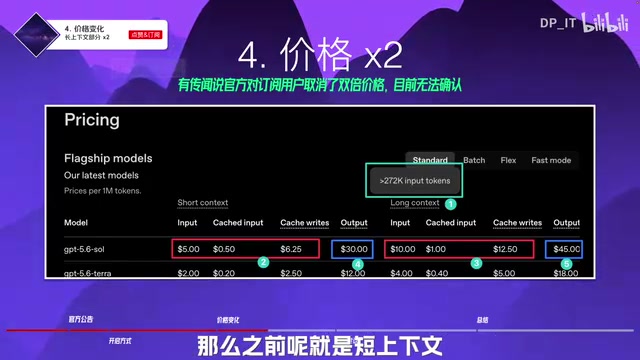
This price difference is backed by solid computational cost reasoning. The attention mechanism in Transformer architecture has computational complexity proportional to the square of sequence length (O(n²)). Even with various optimization techniques (such as FlashAttention, Ring Attention, etc.), the GPU memory and computation time required to process 1M tokens far exceeds that of 272K. Additionally, KV Cache (key-value cache) storage requirements grow linearly with context—1M tokens of KV Cache may require tens of GB of GPU memory. These hardware resource costs are directly reflected in user-facing pricing.
More importantly, as context length grows, cache read prices also increase—because there's simply more content to read. Combining all costs, you can roughly estimate that the overall cost of using long context is approximately twice that of short context.
The Hidden Cost: Model Capability Declines as Context Grows
Price doubling is just the surface issue. What truly warrants caution is the trend of declining model capability as context length increases.
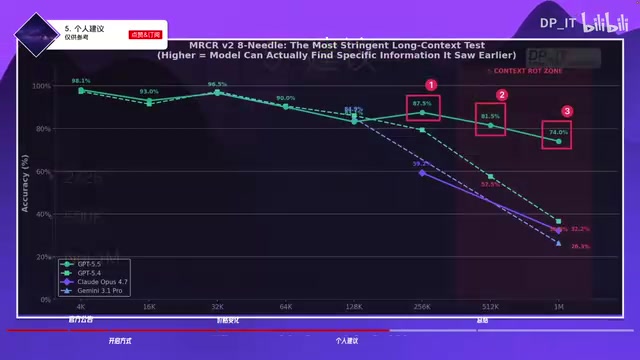
DP cited a set of trend data (note: these numbers don't represent exact values but illustrate the trend): using GPT-5.5 as an example, capability performance at different context lengths is approximately—
- 256K context: Capability ≈ 87.5
- 512K context: Capability ≈ 81.5
- 1M context: Capability ≈ 74
In other words, the longer the context, the more model capability actually degrades. When you stretch context from 256K to 1M, you're paying nearly double the price while receiving noticeably diminished model performance.
This phenomenon is known as the "Lost in the Middle" effect—a known limitation of current Transformer architectures. Research shows that models pay the most attention to information near the beginning and end of the context, while information in the middle tends to be overlooked. When context expands from 256K to 1M, this uneven attention distribution problem is amplified many times over. Furthermore, the average document length used during pretraining for most models is far shorter than 1M—ultra-long context scenarios essentially constitute out-of-distribution inference, naturally causing generalization capability to decline.
Noise Interference: The Silent Killer of Long Context
Beyond capability itself, there's another hidden factor: as context grows, noise in the conversation increases dramatically. Lengthy historical content dilutes the model's attention, directly impacting task completion accuracy and alignment with user expectations. The longer the context, the more pronounced this "gets worse the more you use it" feeling becomes.
From an information theory perspective, when large amounts of task-irrelevant information are mixed into the context, the model must find a "needle" in an increasingly large "haystack," causing the Signal-to-Noise Ratio to plummet. For Codex's coding scenarios, this means that if you dump an entire code repository into the context without filtering, massive amounts of irrelevant files, comments, and test code will scatter the model's attention resources. This can actually perform worse than carefully selecting 50–100K of highly relevant code snippets. This is also why the industry increasingly emphasizes RAG (Retrieval-Augmented Generation—first retrieving the most relevant content snippets, then feeding them to the model) and intelligent context management strategies, rather than relying solely on window expansion.
As DP emphasized: 1M context "doesn't mean you just pay more money and keep model capability unchanged." Expecting the model to maintain the same working efficiency in the 256K-to-1M range as it does within 256K is unrealistic.
Practical Recommendations: Choose Context Length by Scenario
Based on the above analysis, DP offers tiered recommendations:
Beginners: Use the Default 272K
If you don't yet fully understand concepts like context, long context, price doubling, or input/output, the answer is simple: stick with official default parameters (272K) without overthinking—this is the optimal choice for you.
Complex Project Users: Keep It Under 500K
If your project is relatively complex and genuinely requires longer context, it's recommended to keep the context window under 500K—this is already quite an extreme value. As for 1M context, let's just say "it sounds great, but in practice, it's just okay."
For users who genuinely need to process large codebases, a better approach is to combine intelligent context management strategies: exclude irrelevant directories via .codex-ignore files, use project-level prompts to precisely describe project structure, and appropriately decompose task granularity—letting the model work efficiently within limited high-quality context rather than blindly pursuing window size.
Conclusion: Conversation Management Matters More Than Long Context
The true insight from this update may be: for Codex, what matters most isn't how long the context window is, but whether you can reasonably manage and organize your conversations. Proper conversation management is the real key to improving practical usage efficiency.
Of course, 1M context isn't entirely without merit. In fact, mainstream large models today essentially all support the 1M level—Google's Gemini 1.5 Pro already supports 2M tokens, Anthropic's Claude series continues expanding context boundaries, and Chinese products like Kimi use long context as a selling point. This represents the industry's direction. However, the widespread consensus is: window size is merely a necessary condition. The real challenge lies in maintaining consistent comprehension quality and reasoning capability within ultra-long contexts—involving multiple underlying technical issues such as positional encoding extrapolation (like RoPE length generalization), attention mechanism efficiency optimization, and training data distribution coverage.
What we truly look forward to is achieving better balance in the future: extending the current 256K/272K stability range up to 500–600K before gradual decline begins—only then will 1M context hold genuine practical value.
But for now, when facing the temptation of 1M context, consider the multiple factors of pricing, model capability, noise interference, and attention dispersion before making a cautious choice. For the time being, it's still just "looks great on paper."
Key Takeaways
Related articles

Chain of Thought Isn't Just for AI: How Humans Can Use CoT to Improve Thinking Quality
Chain of Thought isn't just a prompt trick for large models. Starting from a Hacker News discussion, this article analyzes why CoT works for human thinking too, breaks down actionable ways to transfer it, and highlights the key differences between human CoT and machine CoT.
Cloudflare Teams Up with OpenAI: Closi…
Cloudflare Teams Up with OpenAI: Closing the Loop from Vulnerability Discovery to Defense with AI
Cloudflare uses OpenAI Daybreak to investigate security vulnerabilities and generate reviewable remediation plans, while developers use Codex to boost coding efficiency and quality.

Orca Multi-Agent Orchestration in Practice: A Guide to Parallel Collaboration with Claude and Codex
Orca is Stable AI's free open-source agent workbench supporting 34 agents like Claude Code and Codex in parallel. Learn its Git worktree isolation, multi-model orchestration, and mobile management.