Codex Integrates with Zotero: Batch Literature Review and Deep-Read Tools Tested

Use Codex's Skill mechanism to add batch review and single-article deep reading to the Zotero literature library.
The article introduces two literature processing functions developed and tested by the UP host based on Codex's Skill mechanism: one is batch reading PDFs by Zotero collection to generate brief reading cards for each paper, then organizing them into review cards with research questions, core methods, experimental results, and limitations, plus a cross-paper comparison table; the other is deep reading of a selected single article, expanding across technical route, experimental explanation, and limitations with follow-up questions. The author emphasizes that the review uses only existing library documents for traceability, the comparison table locates comparable objects rather than auto-ranking, and deep reading must distinguish author-stated limitations from model inferences. The recommended workflow is Zotero collection organization → review to build overall understanding → screen key papers → batch deep reading → verify against the original text, with the tool compressing information while judgment remains with humans.
Title
Codex Integrates with Zotero: Batch Literature Review and Deep-Read Tools Tested
Meta Description
Hands-on testing of two new Codex functions for Zotero: generating literature reviews in batch by collection, and screening key papers for deep reading. Detailed explanation of the review's comparison table and citation verification, the three-layer structure of the deep-read method and experimental analysis, plus a complete workflow and usage recommendations.
Article Content
The more literature you hoard, the fewer papers you actually finish reading—this is a common dilemma for many graduate students. In the previous installment, we solved the problem of paper retrieval, download, and importing into Zotero. In this installment, the UP host continues to develop and test two new functions: batch generation of literature reviews based on Zotero collections, and screening key articles from the literature for deep reading. Both functions are invoked through Codex's Skill mechanism and work with the existing Zotero literature library.
Review and Deep Reading: Two Scenarios, Two Tools
Before getting started, clarify the positioning differences between the two functions. Review is suitable when you have just entered a research direction: you want to know what each of these articles does, how the methods relate to one another, what common problems exist, and which few papers are worth focusing on next. Deep reading, on the other hand, targets a single selected article, with the goal of understanding how its method works specifically, how the experiments are designed, what conclusions the results actually support, and whether you can borrow from it.
The UP host recommends the following order: first use review to build an overall understanding of this batch of literature, then invest time in deep reading the most relevant papers. This order follows cognitive规律—first see the forest, then the trees.
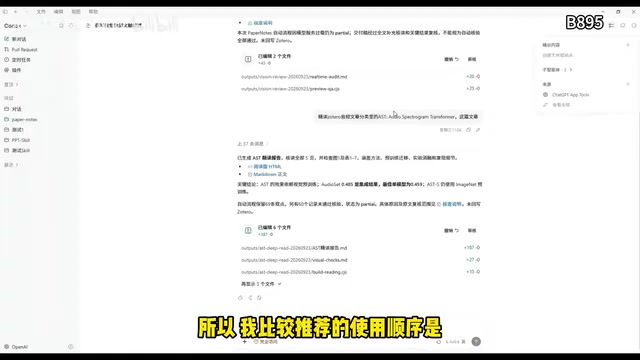
Review Function Test: From PDFs to Structured Cards
Workflow and Limitations
Before use, confirm that there are already documents under the corresponding Zotero collection. When invoking the Skill, you can give more specific instructions, such as which collection to read, around what question, and how to organize the results. The UP host particularly emphasizes one limitation: only existing documents in Zotero can be used. This constraint ensures the traceability of the review and prevents the model from introducing external content out of thin air.
The entire workflow is: first read the PDFs, organize a brief reading card for each article, then organize these materials into review cards, mainly retaining the research question, core method, key experimental results, and limitations. The value of doing this is that different papers are compared under the same problem framework, rather than each speaking its own piece.
Zotero is an open-source literature management tool whose core capability is organizing items by collection, capturing PDF metadata, and generating citations. The "Zotero collection" mentioned in the article corresponds to its collection structure; a collection can contain multiple documents and their attachments. The constraint "only existing documents in Zotero can be used" essentially limits the model's accessible scope to the local library; the model does not search online or fill in gaps out of thin air, so every judgment appearing in the review can correspond to an original file openable within the library, greatly reducing verification costs.
Codex's Skill mechanism can be understood as a pre-packaged combination of reusable instructions and scripts: the user describes the task in natural language (which collection to read, around what question, how to organize the results), and the Skill handles steps such as scheduling PDF reading, per-article processing, and aggregated output. Solidifying the workflow into a Skill rather than hand-writing prompts each time has the benefit of unified processing rules, consistent formatting across multiple documents, and easier subsequent template adjustments.
Coverage and Comparison Table
After the results come out, the first thing to look at is the coverage of this batch of articles: which were actually processed, which were not completed, and which are left for future research. Then look at the comparison table, which can quickly locate what problem each article focuses on, what method it uses, and under what conditions the experiments were conducted.
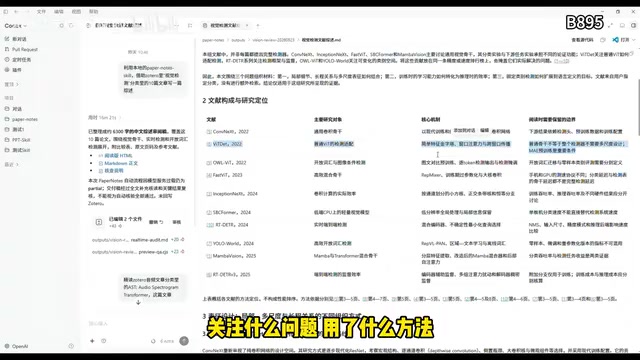
The UP host is clear-headed about the positioning of this comparison table: its value is to help you find objects worth further comparison, not to automatically rank who is best and who is worst. Academic evaluation requires context, and automatic ranking can easily mislead.
Brief reading cards and review cards are two different levels of output. A brief reading card targets a single document, equivalent to a structured reading note, extracting the research question, core method, key experiments, and limitations; a review card then performs a horizontal synthesis on top of multiple brief reading cards, placing different papers into the same problem framework for comparison. The significance of the two-level structure is that single-article information is first compressed into comparable fields, so that horizontal comparison does not degenerate into a stack of abstracts.
The comparison table is essentially a matrix, with rows as documents and columns as dimensions such as problem/method/experimental conditions, and cells filled with the value of that document on the corresponding dimension. The value of the matrix lies in exposing gaps and overlaps—which problems are jointly focused on by multiple documents, and which method combinations have not yet been attempted. It serves the decision of "what to compare next," rather than giving a ranking of pros and cons, because scoring criteria across papers are often not unified.
Body Organization and Citation Verification
For the body part organized by theme, what the UP host focuses on is whether it connects several papers. In the actual test, the model did perform synthesis; viewpoints came from different articles, and each key judgment had a corresponding source. When returning to the original text for verification, a certain passage describing the organizational structure of convolutional neural network architectures was indeed supported by the original text.
Finally, check whether it clearly lists experimental conclusions, experimental conditions, and future research. Experimental conclusions should be conditional, and future research should also be grounded. The UP host's positioning of this review is: suitable for entering a new topic, preparing for group meetings, or screening articles for the next step of deep reading; if it is to be used directly for paper writing, it still needs supplementary literature, reorganized argumentation, and item-by-item verification of key citations.
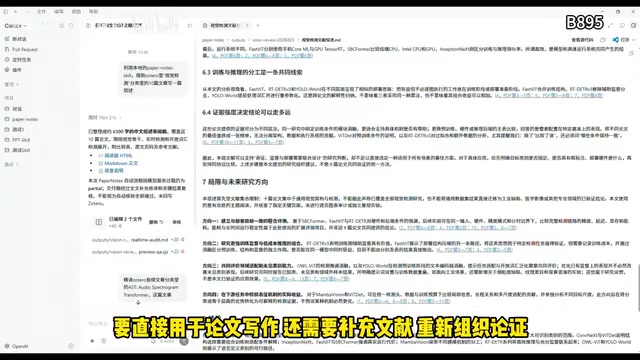
Deep-Read Function Test: Three-Layer Expansion of Method, Experiment, and Limitations
The goal of deep reading is to expand a single article to a sufficiently specific level. When reviewing the analysis report, the UP host focuses on three key points.
Whether the Method Section Explains the Technical Route Clearly
Check whether it can clearly explain what the input is, which key steps it goes through, what problem each step solves, and what result is finally obtained. If it merely repeats the abstract and lists a few method names, its help for truly understanding the paper is very limited. Good deep reading should be able to draw a technical route diagram, not just paste labels.
Experimental Explanation Rather Than Number Copying
The second key point is whether it can explain the experiment, rather than just copying the experimental numbers. The UP host will ask three questions: What experiments did the authors use to test their method? Which part of the judgment do the results support? And which conclusions cannot be directly derived from this experiment?
If you want to reproduce it, conditions such as training data, evaluation protocol, and supervision method are also important. Missing one condition may lead to misunderstanding the article's results.
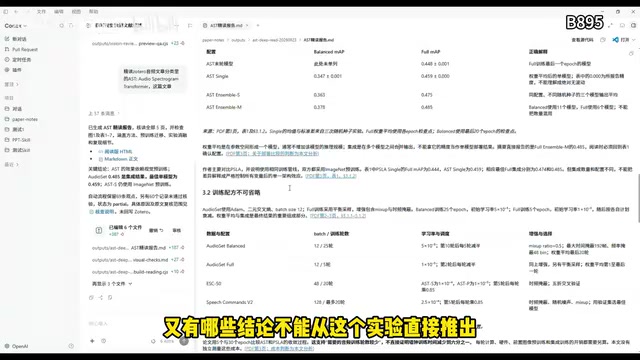
When reproducing a paper, the three conditions of training data, evaluation protocol, and supervision method determine whether results can be compared fairly. Training data involves scale, source, and splitting method; evaluation protocol refers to what metric is used, on what test set, and according to what rules it is calculated; supervision method distinguishes settings such as full supervision, weak supervision, and self-supervision. The same method with a different protocol may yield very different numbers, so if a deep-reading report does not explain these conditions, readers can easily place incomparable numbers side by side.
When judging "what conclusions the results support," it is necessary to distinguish between propositions directly verified by experiments and inferences obtained by extrapolation. Ablation experiments usually support the necessity of a certain module, and comparative experiments support relative advantages, but neither can generally directly infer the method's generalization ability on out-of-distribution data. Clarifying this boundary in deep reading is more valuable than restating accuracy numbers.
Limitations and Follow-Up Questions
The third part is limitations and questions worth following up. Here it is necessary to distinguish two situations: limitations acknowledged by the authors themselves, and analysis proposed based on current evidence. The former is information from the original text, while the latter is the model's inference, and you should be aware of this when using it.
For multiple articles, batch deep reading can be initiated by collection. Its goal is to generate an independent report for each article, then view them uniformly through an index. Its use is still different from review: review helps you see the relationships between articles, while batch deep reading expands each article separately, so it usually requires more processing time. The UP host recommends prioritizing it for key literature that has already been screened, rather than running it indiscriminately over the entire library.
Complete Workflow and Usage Recommendations
Combining the content of the previous installment, this workflow can be connected: first retrieve and download literature, and organize it by research topic in Zotero; then use review to understand the overall picture of this batch of articles and screen out key ones; finally deep-read the key articles and return to the original text to verify key content.
The UP host's expectation is to reduce the time spent repeatedly organizing materials and devote more energy to understanding methods, judging evidence, and thinking about one's own research questions. This positioning is relatively pragmatic—the tool is responsible for compressing information, while judgment still remains with humans. Those who need tutorials and Skill configurations can get them in the comment section.
From a broader perspective, the value of such tools is not to replace reading, but to help you decide what to read, where to read first, and what questions to focus on while reading. Review is responsible for building the map, and deep reading is responsible for going deep into strongholds; only by combining the two can the literature library truly become research productivity.
One-line Summary
Use Codex's Skill mechanism to add batch review and single-article deep reading functions to the Zotero literature library.
Paragraph Summary
The article introduces two literature processing functions developed and tested by the UP host based on Codex's Skill mechanism: first, batch reading PDFs by Zotero collection, first generating a brief reading card for each article, then organizing them into review cards containing research questions, core methods, experimental results, and limitations, as well as a cross-paper comparison table; second, performing deep reading on a selected single article, expanding from three layers: technical route, experimental explanation, limitations, and follow-up questions. The author emphasizes that the review uses only existing documents in the library to ensure traceability; the comparison table is used to locate comparable objects rather than automatic ranking; and deep reading needs to distinguish between limitations stated by the authors and model inferences. The recommended workflow is Zotero collection organization → review to build overall understanding → screening key points → batch deep reading → returning to the original text for verification; the tool is responsible for compressing information, while judgment is still completed by humans.
Related articles

Replit at Web Summit Lisbon: AI Coding Platform Accelerates European Expansion
Replit participated in Web Summit Lisbon 2026 Day 1 as Replit Live. This article examines its transition from an online IDE to an AI app-building platform and analyzes its European market opportunities and compliance challenges.

Codex + Obsidian + Zotero: An AI-Powered Automated Paper Reading Workflow
A Codex + Obsidian + Zotero paper management and retrieval workflow: Zotero manages references, Codex calls GPT for close reading and notes, Obsidian with DataView builds indexes, enabling Q&A with your paper library and quick literature review material — includes close-reading template and two Skill setup steps.

The Overlooked Truth: Doctors Once Believed Black People Couldn't Get Diabetes
A century ago, American doctors widely believed Black people couldn't get diabetes, which was labeled a "luxury disease." Vox's Khalil Explains traces this history and reveals Black patients still face a ~20% gap in access to GLP-1 drugs.