Codex OSS Maintainer Toolkit: AI-Powered Automation for Open Source Projects
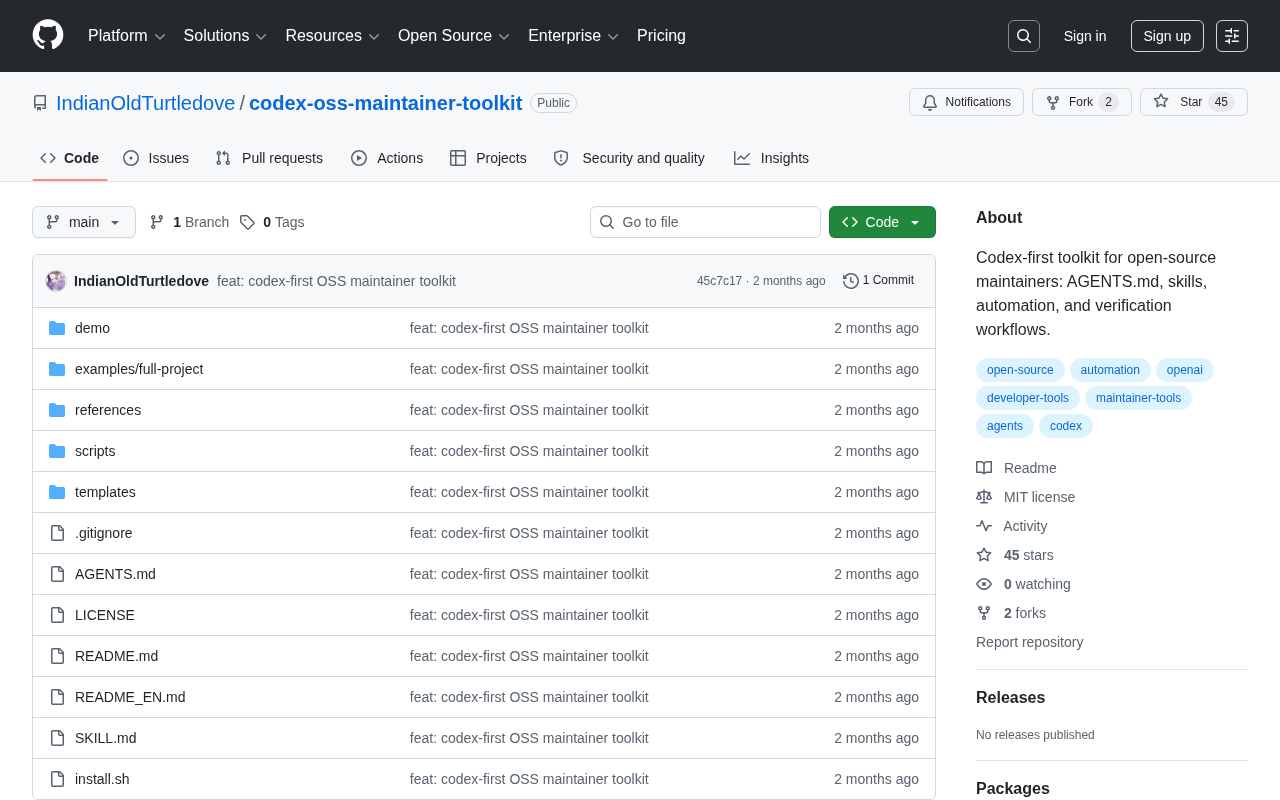
A Codex-first toolkit automating open source project maintenance with AI agents and AGENTS.md specs.
codex-oss-maintainer-toolkit is a Python-based open source project that provides maintainers with an AI-first workflow built around Codex. It includes AGENTS.md configuration for governing AI behavior, reusable skill definitions for tasks like code review and issue triage, automation pipelines, and verification workflows to ensure quality. The project represents a growing trend toward standardized AI collaboration in open source maintenance.
Project Overview
As AI coding assistants become mainstream, open source project maintainers face new challenges in efficiently leveraging AI tools for project management. codex-oss-maintainer-toolkit is a Codex-centric open source maintainer toolkit designed to provide maintainers with a complete AI-assisted workflow, covering key aspects such as AGENTS.md configuration, skill definitions, automation pipelines, and verification workflows.
Developed by GitHub user IndianOldTurtledove and written in Python, the project has earned 45 stars so far. While modest in scale, its concept and direction are worth paying attention to.
Core Components
AGENTS.md: The Specification File for AI Collaboration
AGENTS.md is a specification file format that has recently emerged in the AI-assisted development space. Similar to the traditional CONTRIBUTING.md, it is specifically designed for AI agents. It defines the behavioral boundaries of AI within a project, the scope of executable operations, and the rules to follow. Through this file, maintainers can precisely control how AI assistants behave within their projects.
Skills
The skills module in the toolkit allows maintainers to define a series of reusable operation templates. These skills can include:
- Automated code review
- Issue triage and label management
- PR compliance checks
- Documentation generation and updates
With predefined skill sets, AI agents can execute maintenance tasks within clearly defined boundaries, reducing the need for manual intervention.
Automation
The automation module serves as the toolkit's execution engine, chaining defined skills into complete workflows. Maintainers can set trigger conditions so that AI automatically performs corresponding maintenance operations when specific events occur — for example, automatically running code style checks and dependency security scans when a new PR is submitted.
Verification Workflows
Verification workflows form the quality assurance layer of the entire toolkit. They ensure that every operation performed by AI is validated, mitigating potential risks introduced by automation. This includes:
- Correctness verification of output results
- Compliance checks for operation permissions
- Assessment of change impact scope
Why This Direction Matters
The Codex-First Design Philosophy
"Codex-first" means the entire toolchain was designed from the ground up with AI agents as first-class citizens. This isn't simply layering AI functionality on top of existing tools — it's a fundamental rethinking of how open source maintenance workflows should collaborate with AI. This design philosophy represents an important trend in open source tooling evolution.
Pain Points in Open Source Maintenance
Maintainers of large open source projects often face enormous workload pressure: massive volumes of issues to triage, PRs to review, documentation to update, and communities to manage. If AI-assisted tools can reliably handle the repetitive portions of this work, they could significantly alleviate maintainer burnout.
A Standardized AI Collaboration Framework
The industry currently lacks unified standards for governing AI agent behavior within projects. The emergence of specification files like AGENTS.md, along with supporting toolchains, could help drive industry consensus, making AI-assisted development more controllable and predictable.
Use Cases
This toolkit is particularly well-suited for:
- Day-to-day maintenance automation of medium to large open source projects
- Projects that need to handle a high volume of community contributions
- Teams looking to establish AI-assisted development standards
- Developers exploring AI agent applications in software engineering
Conclusion
While codex-oss-maintainer-toolkit is still in its early stages, it represents a clear trend: AI is not just a tool for writing code — it will increasingly become a key participant in project management and maintenance. As AI capabilities continue to improve, these "AI-first" maintenance tools will become increasingly important. For developers interested in the open source ecosystem and AI engineering, this is a project direction worth tracking over time.
Related articles
 Product Reviews
The Programmer's Desk Setup Guide: Building a Workspace That Feels Like Home
Discover how programmers build productive, comfortable workspaces. From multi-monitor setups to ergonomic design, explore the desk philosophy that drives focus and flow.
 Product Reviews
Qoder vs Cursor Real-World Comparison: Which $20/Month AI IDE Is Better?
Hands-on comparison of Qoder vs Cursor AI IDEs: Agent autonomy, human interaction count, and architecture decisions. Qoder needed only 2 interactions vs Cursor's 8.
 Product Reviews
Cursor Cloud Agent Demo: Eliminating Bottlenecks Across the Entire Software Development Lifecycle
Deep analysis of Cursor's Cloud Agent demo showing how cloud VMs, automated test artifacts, and a full-chain control plane systematically eliminate human bottlenecks across the software development lifecycle.