Codex vs Claude Code: An In-Depth Comparison of Two Leading Coding Agents

Codex vs Claude Code: multi-agent command center vs terminal-native workbench design philosophies compared
OpenAI Codex and Claude Code represent two fundamentally different AI programming design philosophies. Codex is a multi-agent parallel task system that excels at decomposing complex engineering problems across agents in isolated environments, emphasizing full task lifecycle management and evidence chain tracking. Claude Code is a terminal-native development partner that deeply integrates into developers' existing toolchains through MCP protocol and Hooks mechanisms, emphasizing CLI connectivity and workflow automation. They suit horizontal decomposition and vertical deep-dive development scenarios respectively.
The One-Line Framing: Command Center vs Workbench
The two most talked-about Coding Agents right now—OpenAI Codex and Claude Code—are both working on "getting AI to write code," but their design philosophies are fundamentally different.
Codex is like a multi-agent engineering command center, emphasizing task decomposition, parallel execution, and evidence aggregation. Claude Code is more like a terminal-native development workbench, emphasizing CLI tool integration and workflow automation. Understanding this core difference anchors everything that follows.
Codex: A Multi-Agent Parallel Task System
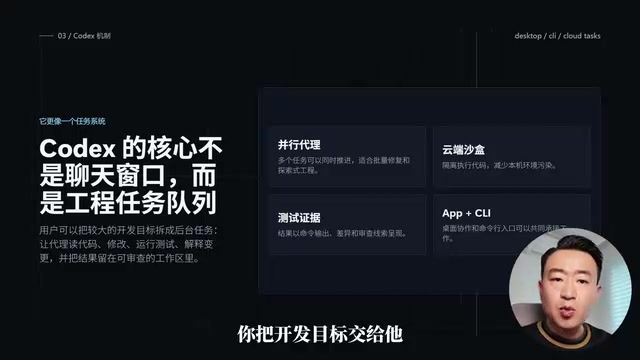
Codex's core strength lies in decomposing complex engineering problems across multiple agents working in parallel. A typical scenario: one agent locates failing tests, another refactors duplicated logic, another adds verification test cases, and finally the results are compiled into reviewable changes with supporting evidence.
The concept of a "multi-agent system" isn't new—its theoretical roots trace back to distributed artificial intelligence research in the 1980s. In software engineering contexts, the core value of multi-agent systems lies in "divide and conquer": breaking complex tasks into subtasks handled by specialized agents in parallel, with a coordination layer aggregating results. Compared to a single large model processing tasks serially, the advantage of multi-agent parallelism isn't just speed—it also allows different agents to hold different "perspectives." For example, one agent focuses on security vulnerability scanning while another focuses on performance optimization; their conclusions cross-validate each other, reducing the risk of single-point blind spots.
So Codex isn't just a chat window—it's more like a task system. You hand it a development objective, and it reads code, modifies code, runs tests, explains changes, and leaves artifacts in a trackable workspace—all within an isolated execution environment. This isolation is typically implemented using container technology (such as Docker), ensuring that multiple agents running in parallel don't produce race conditions or state pollution. Additionally, clean isolated environments bring reproducibility: the execution process of each task can be fully recorded and replayed. This is the technical foundation of Codex's "evidence chain" capability and a critical support for enterprise-level compliance auditing.
This full lifecycle management of "assign-execute-verify-deliver" is the key characteristic that distinguishes Codex from other AI programming tools. For scenarios requiring batch fixing of test failures, simultaneously exploring multiple refactoring approaches, or preparing PR review materials, Codex's multi-agent parallel capabilities feel very natural.
Claude Code: A Terminal-Native Deep Development Partner
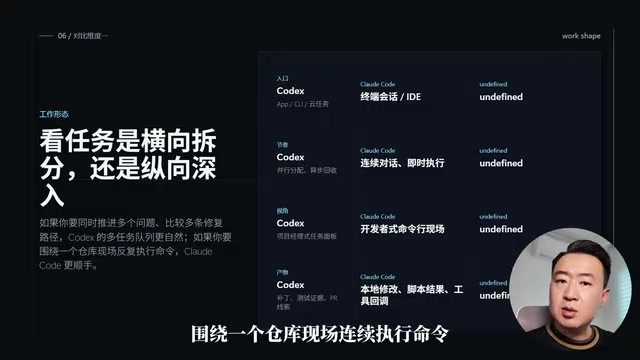
Claude Code's entry point is closer to where developers actually work every day—the terminal, repositories, scripts, IDEs, and CI. It places the Coding Agent in the command line, allowing the model to maintain continuous dialogue around local context and directly participate in the development loop.
Much of Claude Code's extensibility comes from two mechanisms:
- MCP (Model Context Protocol): Used to connect external tools and data sources, such as databases, monitoring systems, internal documentation, etc.
- Hooks: Used to trigger scripts before and after key events like edits, commits, and tests.
MCP is a standardized protocol open-sourced by Anthropic in November 2024. Its design borrows from LSP (Language Server Protocol)—LSP unified the communication protocol between IDEs and language servers, while MCP attempts to unify how context is passed between AI models and external systems. Before MCP, every AI application needed custom integration code for each tool, making maintenance costs extremely high. Through MCP, Claude Code can use a single protocol to connect databases, monitoring systems, internal wikis, and other heterogeneous data sources. Developers only need to implement an MCP Server once, and it can be called by any MCP-compatible client—extending Claude Code's capabilities from the "model capability boundary" to the "tool ecosystem boundary."
Hooks represent the classic event-driven extension pattern in software engineering—Git Hooks, React Hooks, and Webpack Hooks are all typical implementations of this pattern. By introducing Hooks into the AI programming workflow, Claude Code allows developers to automatically trigger code formatting "before AI commits code," automatically run unit tests "after AI modifies files," and perform permission checks "before AI executes commands." This design essentially brings AI agent behavior under existing engineering governance, rather than letting AI run freely outside established norms.
For developers who prefer scripted workflows, this design is very straightforward. You can frequently run project scripts, query internal documentation, connect to databases or monitoring tools, then automate verification steps—the entire process stays close to your local toolchain.
Three Dimensions of Deep Comparison: Codex vs Claude Code
Dimension One: Work Mode Differences
Codex is better suited for horizontal decomposition—multiple tasks, multiple paths, and multiple validations progressing simultaneously. Claude Code is better suited for vertical deep-dives—working around a single repository, continuously executing commands on-site, observing results, and iterating.
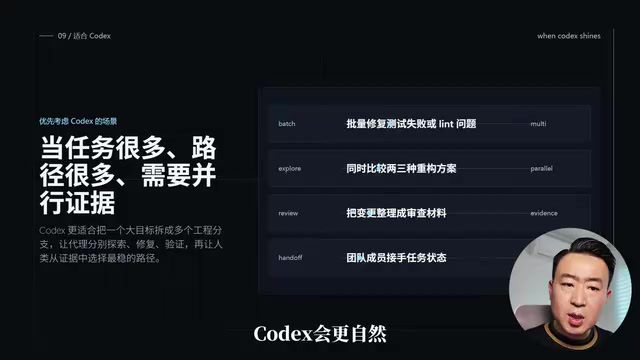
Put simply: if your problem is naturally decomposable and requires multiple verification paths, Codex is more appropriate. If your problem is tightly coupled to the terminal, scripts, and internal tools, Claude Code is more ergonomic.
Dimension Two: Extension Approaches
Both can invoke tools, but their design emphasis differs. Codex emphasizes the task lifecycle—from assignment, execution, and verification to review and delivery, it's a complete engineering management pipeline. Claude Code emphasizes plugging existing systems into a command-line agent, making AI part of your existing toolchain.
This difference also reflects two distinct AI integration philosophies: Codex tends to build a new engineering orchestration layer where AI is the core scheduler; Claude Code tends to make AI an "enhancement plugin" for existing engineering systems, maximizing reuse of developers' existing tool investments.
Dimension Three: Security and Control Strategies
This is an easily overlooked but critically important dimension. The more autonomously AI can modify code, the less you should focus solely on capabilities. What truly matters is:
- Whether permission boundaries are clear
- Whether command whitelists are controllable
- Whether repository scope is restricted
- Whether test evidence is complete
- Whether code review processes are in place
- Whether the full process can be replayed when issues arise
Both tools have their own designs in these areas, and choices should be evaluated in conjunction with your team's security policies. Codex's isolated execution environment naturally supports operation replay and auditing; Claude Code's Hooks mechanism allows teams to insert custom security validation logic at critical points in AI behavior. Their security control philosophies differ, but both point toward the same goal: keeping AI's autonomous actions within controllable boundaries.
Trend Analysis: From AI Assistant to Part of the Engineering Process
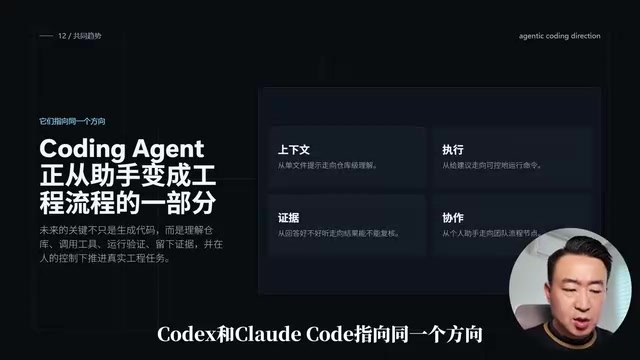
The development of Coding Agents has gone through three distinct phases: the first was "code completion" tools represented by GitHub Copilot; the second was "conversational code generation" represented by ChatGPT Code Interpreter; the third is the current phase of "autonomous execution agents" represented by Codex and Claude Code.
Related articles
 Product Reviews
The Programmer's Desk Setup Guide: Building a Workspace That Feels Like Home
Discover how programmers build productive, comfortable workspaces. From multi-monitor setups to ergonomic design, explore the desk philosophy that drives focus and flow.
 Product Reviews
Qoder vs Cursor Real-World Comparison: Which $20/Month AI IDE Is Better?
Hands-on comparison of Qoder vs Cursor AI IDEs: Agent autonomy, human interaction count, and architecture decisions. Qoder needed only 2 interactions vs Cursor's 8.
 Product Reviews
Cursor Cloud Agent Demo: Eliminating Bottlenecks Across the Entire Software Development Lifecycle
Deep analysis of Cursor's Cloud Agent demo showing how cloud VMs, automated test artifacts, and a full-chain control plane systematically eliminate human bottlenecks across the software development lifecycle.