Codex vs Claude Code Real-World Comparison: How Big Is the Gap at the $20 Tier?

A month-long hands-on comparison of Codex vs Claude Code across pricing, capabilities, and killer features.
Based on one month of daily switching between Codex and Claude Code on real projects, the author compares them across pricing, product form factor, context window, code quality, ecosystem, and killer features. Key findings: Codex offers better entry-level value, Claude Code's larger context window suits large projects, code quality is close but each excels in different areas, ecosystems differ in curated vs open approaches, and Codex's Goal Mode autonomous capability is its unique weapon.
There's no shortage of comparison articles about OpenAI Codex and Anthropic Claude Code online, but most authors have only used one of them in depth, making their conclusions inevitably one-sided. This article is based on one month of parallel real-world testing—switching between both tools daily on actual projects, switching to Claude Code when Codex credits ran out, and switching back when Claude Code got rate-limited—laying out all the pitfalls and honest conclusions in one place.
Pricing Looks Symmetric, But the Details Tell a Different Story
The pricing structures on both sides are nearly identical: $20/month for the entry tier, $100 for the advanced tier, and $200 for the top tier. But the devil is in the details.
Codex's $20 is an all-in-one package. ChatGPT Plus at $20 doesn't just include Codex—you also get GPT 5.5 for chat, DALL·E for image generation, and Sora for video. Meanwhile, Claude Code's $20 is a single-item price—Claude Pro's $20 gets you Claude itself, with no extra image or video features. For the same $20, one gives you a full-course meal while the other gives you just one main dish.
The more critical gap is in usage credits. Claude Code's $20 tier has very tight limits. A large number of real users report that for even moderately complex tasks, ten or so exchanges exhaust the credits for a given time window. You're in the middle of solving a problem when suddenly you get "Credits exhausted, please wait 5 hours"—being interrupted mid-flow is an absolutely terrible experience. Codex offers considerably more generous credits at the same price point, letting you accomplish noticeably more with the same $20.
Conclusion: For dipping your toes in, Codex crushes it on value; for heavy use, both sides require the $100 tier to be sufficient.
Product Form Factor: Which Is Easier to Get Started With?
Codex offers four ways to use it: a desktop app (with a friendly UI, file explorer, and task sidebar), a VS Code extension, a command-line tool, and a cloud version inside ChatGPT's web interface. Claude Code offers three: command line, desktop app, and editor plugin.
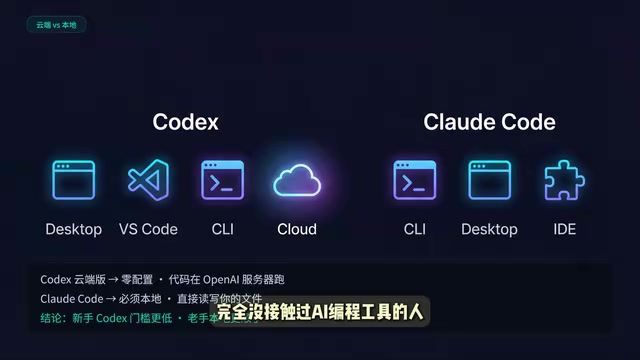
The surface differences are minor, but there's one key distinction: Codex has a cloud version; Claude Code doesn't. This means with Codex's cloud version, code runs on OpenAI's servers—you don't need to install anything on your machine, making it ideal for people who want to try it without setting up a dev environment. Claude Code must run locally—the upside is direct read/write access to files on your machine with seamless integration into your development environment; the downside is you need to configure the environment first, which creates a barrier for non-technical users.
For someone who's never touched an AI coding tool before, Codex has a lower barrier to entry. For experienced developers, running locally is actually smoother, so this barrier is a non-issue.
Core Capabilities Face-Off: Four Dimensions Compared
Context Window: The Working Memory Battle
Tokens are the basic units that large language models use to process text—roughly "word fragments." In English, one word equals approximately 1–1.5 tokens; in Chinese, one character equals roughly 1–2 tokens. The context window is the maximum number of tokens the model can "remember" and process in a single conversation—essentially the model's working memory capacity. Content beyond this window is "forgotten." For coding tasks, a medium-sized project's entire source code often falls between tens of thousands to hundreds of thousands of tokens. The larger the context window, the more files the AI can "see" simultaneously, resulting in a more coherent understanding of the overall project.
Codex is based on GPT 5.5, with a context window of approximately 400K tokens (roughly equivalent to 300,000 Chinese characters); Claude Code is based on Opus, with approximately 1 million tokens—the latter is 2.5x the former, equivalent to a medium-length novel.
The gap sounds massive, but it depends on the scenario. For everyday tasks (writing functions, tweaking styles, fixing small bugs), 400K tokens is more than enough—both feel identical in practice. But when you need AI to understand an entire large project, the difference emerges: Claude Code can ingest more files at once, producing a more complete and coherent understanding of the project's overall architecture; Codex may need to read a large project in several passes, potentially breaking the connections between related components.
Code Quality: Each Has Its Strengths
Two standardized tests frequently cited in the industry are worth understanding in depth. SWE-Bench (Software Engineering Benchmark) is an evaluation set proposed by Princeton University researchers in 2023, collecting thousands of real GitHub issues and their corresponding fix patches. It requires the model to independently generate fixes that pass tests based solely on the issue description and codebase, without knowing the answer. This test is widely recognized in the industry because it assesses real-world engineering capability rather than algorithm puzzle-solving. Terminal-Bench focuses on evaluating AI's ability to perform automated operations in terminal environments, including file management, script execution, and system configuration—more aligned with DevOps and operations scenarios. These two benchmarks measure the practical value of AI coding assistants from different dimensions:
- SWE-Bench (ability to fix real codebase issues): Claude Code 59 vs Codex 56.8—Claude Code is slightly higher but the gap is small
- Terminal-Bench (terminal automation capability): Codex 77.3 vs Claude Code 65.4—Codex is clearly stronger
One-sentence summary: Claude Code is slightly better at fixing complex problems; Codex is significantly better at running automation scripts. Neither dominates the other—each has its strengths.
Ecosystem: Apple App Store vs Android Market
Codex has 90+ official plugins, with major companies like Atlassian, GitLab, and Microsoft Office on the list—officially vetted for quality assurance, but limited in quantity. Claude Code has 3,000+ MCP servers—MCP (Model Context Protocol) is an open standard protocol released by Anthropic in late 2024, designed similarly to USB port standardization: as long as you follow the protocol, any developer can write connectors to expose their tools or data, and any AI client supporting MCP can call them directly without developing separate integration interfaces for each external service. MCP has already gained support from major tech companies like Microsoft and Google, and is poised to become the industry standard for AI tool interconnection—this is the fundamental reason Claude Code's ecosystem has accumulated 3,000+ servers in such a short time. The quantity dominates but quality varies widely.
Codex's ecosystem is like the Apple App Store—fewer options but each one works; Claude Code's ecosystem is like the Android open market—more choices but you need to pick carefully.
Killer Features: Self-Driving vs Manual Transmission Race Car
This is what I consider the most critical dimension—each product has a unique weapon the other currently can't match.

Codex's killer feature: Goal Mode. Goal Mode is essentially a concrete implementation of an AI Agent architecture. Traditional AI coding assistants operate in a reactive "question-and-answer" mode, while an AI Agent is a proactive system capable of autonomous planning, execution, feedback observation, and iterative cycling—first thinking about what to do next, executing it, observing the results, then adjusting the plan based on results, and repeating. Goal Mode extends this cycle to the extreme: you set it a goal, such as "Migrate this project from the old framework to the new framework, ensuring all tests pass," and then you can walk away—go grab dinner, take a nap, whatever. It will break down tasks on its own, execute them, check results, fix errors when encountered, and keep pushing forward. Not just running for a few minutes—it can run autonomously for hours or even days. Someone used Goal Mode to have Codex automatically reproduce a quantitative finance paper; it ran for several days on its own, completed everything that could be reproduced, and clearly annotated the reasons for anything it couldn't handle. This "set a goal and walk away" capability represents the evolution of AI coding tools from "copilot" to "autopilot."
Related articles
 Product Reviews
The Programmer's Desk Setup Guide: Building a Workspace That Feels Like Home
Discover how programmers build productive, comfortable workspaces. From multi-monitor setups to ergonomic design, explore the desk philosophy that drives focus and flow.
 Product Reviews
Qoder vs Cursor Real-World Comparison: Which $20/Month AI IDE Is Better?
Hands-on comparison of Qoder vs Cursor AI IDEs: Agent autonomy, human interaction count, and architecture decisions. Qoder needed only 2 interactions vs Cursor's 8.
 Product Reviews
Cursor Cloud Agent Demo: Eliminating Bottlenecks Across the Entire Software Development Lifecycle
Deep analysis of Cursor's Cloud Agent demo showing how cloud VMs, automated test artifacts, and a full-chain control plane systematically eliminate human bottlenecks across the software development lifecycle.