Codex vs Claude Real-World Comparison: A Developer's In-Depth Analysis After One Week of Use

A developer's week-long comparison of Codex vs Claude reveals scenario-dependent strengths for each AI coding tool.
A developer shared on Hacker News that they used OpenAI's Codex more frequently than Claude for a full week, sparking heated debate with 86 comments. The analysis reveals that tool choice depends on specific scenarios: Codex excels at rapid iteration and small tasks, while Claude's long context window and explanatory abilities shine for complex projects. The key takeaway is that no single tool dominates—mature developers are building flexible multi-tool workflows.
Introduction: The AI Programming Tool Landscape Is Quietly Shifting
In the world of AI-assisted programming, tools are evolving at a dizzying pace. Just as Claude won over a large developer following with its excellent code comprehension capabilities, OpenAI's Codex (and its underlying model ecosystem) has been continuously advancing. Recently, a developer shared their real-world experience on Hacker News about using Codex as their primary tool for an entire week—more frequently than Claude—sparking a lively community discussion with 83 upvotes and 86 comments.
Hacker News (HN) is a technology community run by Y Combinator, known for high-quality technical discussions. Receiving 83 upvotes and 86 comments means the post made it to the front page, reaching tens of thousands of tech professionals. HN's user base consists primarily of senior engineers and founders, and discussions tend to be grounded in actual usage experience rather than marketing claims, making tool evaluations there a meaningful indicator of industry trends.
This post attracted attention not because it delivered some authoritative benchmark conclusion, but because it reflects an emerging trend: more and more power users are re-evaluating their tool choices between Claude and Codex. This article combines the original post's perspectives with community discussion to unpack the deeper logic behind this AI programming tool rivalry.
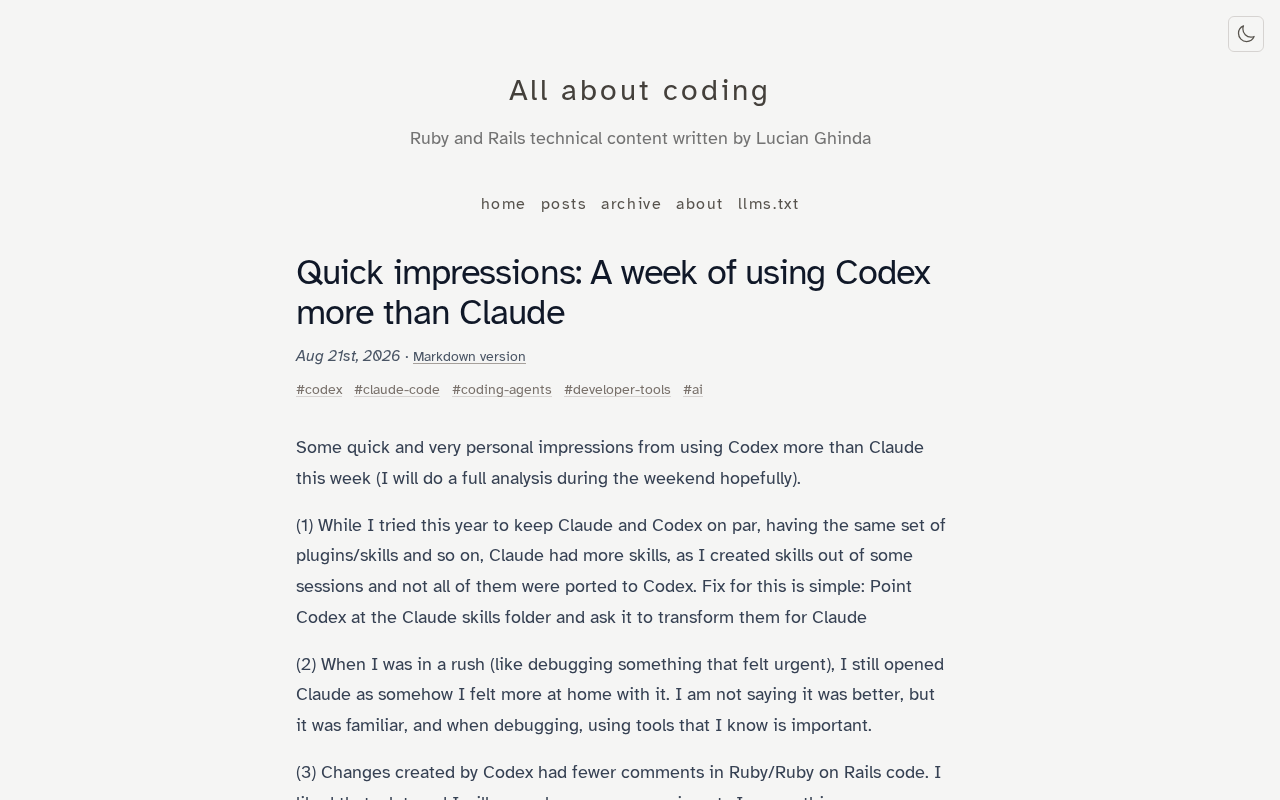
The Rise of Codex: From Supporting Role to Primary Programming Tool
OpenAI Codex's Technical Evolution
OpenAI Codex was originally released in 2021 as a fine-tuned version of GPT-3 and served as the core model behind GitHub Copilot. Trained on massive open-source code repositories, it supports over a dozen programming languages. With the release of GPT-4 and subsequent models, Codex has evolved from simple code completion to an intelligent agent capable of understanding complex instructions, generating complete functions, and even producing architecture-level code. In 2025, OpenAI launched a cloud-based asynchronous coding agent version of Codex that can independently write, test, and fix code in a sandboxed environment—marking a pivotal step in AI programming's shift from "assistance" to "autonomy."
The Shift in Developer Habits
The original poster's core observation was straightforward: over the past week, they used Codex noticeably more than Claude. This shift didn't happen overnight but formed gradually within their actual workflow. For many developers, the value of an AI programming tool isn't about one dazzling performance—it's about whether the tool can reliably integrate into their daily development rhythm.
When a tool gets invoked more frequently and proactively, it usually means it has achieved a state of "low friction" in terms of response speed, result reliability, or user experience. In the AI programming tools space, "low friction" is a core UX design pursuit. Sources of friction include: latency while waiting for responses, the cognitive burden of crafting precise prompts, the rework cost of heavily editing outputs, and the degree of integration with existing development environments (IDEs, terminals, version control). When these friction points are eliminated one by one, developers naturally develop the habit of "casually asking AI," and usage frequency rises accordingly. The author's experience suggests that Codex has achieved the qualifications to serve as a primary tool across these dimensions.
Why "Usage Frequency" Measures Tool Value
You might not have noticed, but the author chose "usage frequency" as the metric for evaluating tool value—a highly pragmatic perspective. In real-world development, a tool that occasionally produces perfect code but requires repeated prompt engineering is far less efficient than one that consistently delivers "good enough" results. Frequency reflects trust—the more developers trust an AI coding assistant, the more tasks they're willing to hand off to it.
Community Debate: Both Codex and Claude Have Their Champions
Core Arguments from Codex Supporters
Judging by the heat of discussion across 86 comments, this topic struck a nerve with many developers. Users supporting Codex generally believe that OpenAI has a unique edge in code generation accuracy and handling complex contexts, particularly showing stable performance in specific programming languages and framework scenarios.
Why Claude Supporters Refuse to Switch
On the other side, Claude's supporters are no small group. Developed by Anthropic, Claude's core differentiators include its ultra-long context window (supporting up to 200K tokens) and its Constitutional AI safety training methodology. In programming scenarios, a long context means Claude can "read" most of an entire codebase in a single pass, understanding inter-module dependencies and architectural design intent. Anthropic's Constitutional AI approach makes Claude more deliberate in its outputs, tending to generate highly readable code with explanatory comments. Claude Code, its command-line coding agent product, can directly manipulate the local file system and execute terminal commands, providing deeply integrated experiences for developers working on complex projects.
For developers who need to handle complex projects and value code readability and explanatory capability, Claude remains an irreplaceable choice. This disagreement perfectly illustrates that no single "one-size-fits-all" AI programming tool exists today. Different tools excel in different scenarios, and developer choices are highly dependent on individual workflows and project characteristics.
Deep Analysis: The Underlying Logic of AI Programming Tool Selection
Different Development Scenarios Call for Different Tools
A key insight can be distilled from this discussion: choosing an AI programming tool is fundamentally a scenario-matching problem.
- Rapid iteration and small tasks: Prioritize response speed and low onboarding cost—Codex-type tools may have the advantage
- Large codebases and architecture-level tasks: Prioritize context understanding and reasoning depth—Claude's long-context capability delivers more value
- Code explanation and learning scenarios: Require clear articulation and pedagogical output
Regarding the practical impact of context windows on programming, it's worth elaborating: the context window refers to the maximum amount of text a large language model can process in a single conversation. For programming scenarios, this parameter directly determines how much code the AI can "see" simultaneously. A typical medium-to-large project might have hundreds of thousands of lines of code, while most models' context windows can only accommodate a small fraction. This highlights the necessity of auxiliary techniques like RAG (Retrieval-Augmented Generation) and code indexing—intelligently retrieving relevant code snippets and injecting them into context to compensate for window size limitations. The larger the context window, the less manual work developers need to do in splitting and providing code snippets, and the lower the workflow "friction."
Tool-Switching Costs Are Dropping Rapidly
Another noteworthy phenomenon is that the cost of switching between different AI tools is declining rapidly. The fact that the author could naturally shift their primary tool from Claude to Codex within a week suggests that usage paradigms across these tools are converging, with increasingly gentle learning curves. This is great news for users, but for vendors it presents a user stickiness challenge—whoever leads by even one step in experience wins more usage time.
Competition Drives Continuous Evolution of AI Programming Tools
The intense competition between OpenAI and Anthropic ultimately benefits the developer community. Every tool iteration, every community discussion pushes these AI coding assistants to become more powerful and user-friendly. The "voting with their feet" phenomenon reflected in the original post is a direct manifestation of this healthy competitive ecosystem.
A Balanced Perspective: Personal Experience Is Not a Comprehensive Benchmark
It's important to emphasize that this post is fundamentally one developer's subjective experience, not a rigorous side-by-side evaluation. The author themselves positioned the article as "Quick impressions." Therefore, we should not interpret it as a conclusion that "Codex comprehensively surpasses Claude."
The more likely reality is: within this particular author's specific work scenarios and task types, Codex delivered a better overall experience. With a different developer or a different type of project, the conclusion could easily be reversed. This is precisely why the comments section featured such diverse voices.
Conclusion: Embracing the New Era of Multi-Tool Development
Perhaps the biggest takeaway from this Codex vs. Claude discussion is this: rather than agonizing over "which AI programming tool is better," it's more productive to build a flexible multi-tool workflow.
Multi-tool collaboration isn't simply stacking tools together—it's a structured development strategy. In practice, developers might use one tool for architecture design and technical proposal review, another for rapid boilerplate code and unit test generation, and a third for code review and bug localization. This pattern mirrors the "best tool for the job" principle in software engineering—selecting the most suitable tool for each sub-task. Notably, emerging protocols like MCP (Model Context Protocol) are providing standardized foundations for interoperability between different AI tools, making multi-tool collaboration increasingly seamless.
Mature developers are learning to dynamically select tools based on task characteristics—using Codex for rapid coding tasks, Claude for complex reasoning needs, and even orchestrating different tools to work together. In this era of rapidly evolving AI programming tools, maintaining an open mindset and continuously experimenting with new tools is itself a core competitive advantage.
The tool wars have no final chapter—the only certainty is that developers will have an ever-growing array of choices at their disposal.
Related articles

Apple Watch ECG Detects Atrial Fibrillation, Saves Triathlete's Life: A Real-World Story
Triathlete Connor's heart rate spiked to 219 bpm during a race. His Apple Watch ECG detected AFib, leading to open-heart surgery that fixed a hidden heart condition.

Norcross Maine Forest Fire Maps: A Century-Old Cartographic Legacy and Data Visualization Pioneer
Explore Archie G. Norcross's 1918–1922 Maine forest fire maps—a hand-drawn cartographic masterpiece that pioneered early data visualization and remains valuable for climate research, historical GIS, and AI fire monitoring.

Apogee: A Privacy-First Browser Summarization Extension Rebuilt with Local AI After Mozilla Killed Orbit
After Mozilla killed Orbit, an indie developer rebuilt a fully local AI browser summarization extension called Apogee using Ollama, WebGPU, and Transformers.js—no user data ever leaves your device.