Codex vs Fable: Which AI Agent Is Better at Finding Real Pain Points?

Codex executes flawlessly but thinks small; Fable thinks strategically but lands narrow — use both together.
This experiment unleashed Codex and Fable in a fully open-ended problem space with no task, no prompts, and no constraints — letting each AI Agent independently discover pain points and propose automation solutions. Codex delivered error-free execution but defaulted to conservative problem framing. Fable identified a genuinely high-leverage strategic opportunity but scoped its solution too narrowly. The real takeaway: combine strategic AI for problem discovery and efficient AI for execution to maximize both insight and ROI.
When AI Doesn't Just Execute Tasks — It Chooses What to Work On
A new benchmark is emerging in the AI Agent capability race: not "tell the AI what to do and it does it," but "step back and let the AI figure out what should be done." This experiment staged a fascinating showdown — putting Codex and Fable, two AI Agents, loose in a completely open-ended problem space with no guardrails.
What Are AI Agents and Open-Ended Problem Spaces? An AI Agent is an AI system capable of autonomously perceiving its environment, setting goals, and taking action — distinct from traditional question-and-answer AI. An Open-ended Problem Space refers to a task scenario with no preset goals and no explicit constraints, requiring the Agent to have Problem Formulation ability rather than just Problem Solving ability. This distinction is growing increasingly important in AI capability evaluation. Research from Stanford and other institutions suggests that genuinely general intelligence requires "metacognition" — the ability for a system to reflect on the boundaries of its own knowledge and proactively define problems worth solving.
The experiment rules were bold: no task specified, no prompts provided, no tools restricted. Both Agents were simply allowed to review local files, Slack messages, and any other materials describing business workflows. After that, they had to independently return a problem definition along with an automated solution.
This reflects a profound insight: most of us hold a verbal understanding of our business problems that doesn't match how we actually behave. Especially in team settings — whether you're a leader or a frontline contributor — you often can't see the hidden chaos right next to you. And that's where the real pain points live.
Codex: Perfect Execution, Conservative Problem Instincts
Codex demonstrated exceptional engineering execution in this showdown. The tester gave it a multi-layered composite task: first, discover information from Slack and all work contexts; second, write an automation script; third, clearly explain why the problem occurs and why this particular solution was chosen.
Interestingly, the test used Codex Ultra — a special mode that must be manually selected in the interface, with the system warning it will consume a large number of Tokens.
Tokens and the Consumption Logic of Codex Ultra A Token is the basic unit large language models use to process text — roughly equivalent to 0.75 English words or 1.5 Chinese characters. Codex Ultra, as an enhanced mode, involves a longer Context Window and more complex Chain-of-Thought reasoning, consuming significantly more Tokens as a result. Token consumption directly correlates with API call costs, which is why the system proactively warns users. In enterprise-level AI workflows, Token Economics has become an important cost management topic — strategically choosing when to use a high-consumption model versus a lightweight model directly affects ROI.
The result: Codex delivered an answer that ran end-to-end with zero errors. It audited media, Slack, and content storytelling patterns, ultimately proposing a solution: optimize handoff packages to get creators into the scripting phase faster.

But that's precisely where the problem lies — this is a "classic Codex-style problem definition": it might be a real problem, but it's the most boring, most conservative interpretation possible.
Key Insight: Codex Actively Self-Limits
When given complete freedom to choose any problem, Codex actually constrains itself to what it knows it can handle. Even with an abundance of Tokens available, Codex consistently gravitates toward conservative problems — ones that have already been clearly articulated and that it can confidently tackle.
In other words, Codex excels at efficient execution within a well-defined framework, but lacks the strategic instinct to proactively surface the sharpest pain points.
Fable: Messy Process, Sharp Strategic Mind
Fable presented a sharp contrast to Codex. The user experience was, frankly, "a complete mess" — multiple authorization dialogs popped up, and the workflow was quite cumbersome.
Yet at the strategic level, Fable demonstrated something that felt like the "character of a large model." Rather than stopping at surface-level handoff process optimization, Fable recognized that in the content creation industry, one of the hardest jobs is finding topics genuinely worth digging into, in a world flooded with AI-generated content.
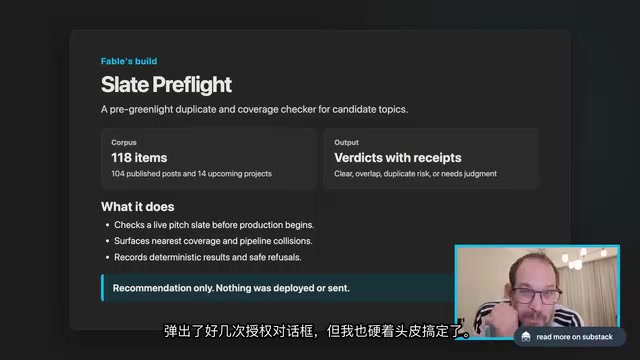
This struck at the core pain point. Topic selection decisions are "driven entirely by suffering, intuition, and trial and error" — and Fable proactively proposed: I can build something to do "pre-pipelining" for you, filtering and validating topic value in advance.
"Pre-pipelining": A Value Pre-Validation Mechanism for the Content Industry "Pre-pipelining" is a concept from data engineering, originally referring to pre-filtering and pre-validating data before it formally enters a processing pipeline. Fable extended this to mean a "value pre-validation" mechanism at the content topic selection layer — evaluating a topic's potential leverage through data signals (search trends, social engagement, audience profiles, etc.) before investing significant creative resources. This aligns closely with the Lean Startup concept of the Minimum Viable Product (MVP): using low-cost methods to validate assumptions before committing to certainty. In the content industry, the quality of topic selection decisions often determines more than 80% of final reach — making this step an extremely high-leverage point.
This idea "has leverage" — not a dry process concept, but a strategic entry point that truly touches the business's vital nerve.
The Unfortunate Reversal: Too Narrow a Problem Definition
However, Fable also had a clear weakness. Despite finding the right direction, its final problem definition was "just too narrow." It understood the intent but couldn't fully translate the strategic insight into a sufficiently broad solution.

The Essential Divide Between Two AI Mindsets
At its core, this showdown reveals a collision between two AI thinking modes:
- Codex represents "Execution Intelligence": clear frameworks, good toolchains, runs successfully on the first try — ideal as a daily workhorse. The vast majority of non-problem-identification work can be handed directly to it.
- Fable represents "Strategic Intelligence": capable of understanding the intent behind prompts, diving deep into the first, second, and third-order causal layers within a problem space, and identifying the real leverage points.
The Underlying Technical Differences Between Execution Intelligence and Strategic Intelligence The divide between "Execution Intelligence" and "Strategic Intelligence" corresponds in cognitive science to two different cognitive levels: Task Execution and Meta-task Planning. The former excels at path optimization toward clearly defined goals; the latter requires Goal Discovery capability. From a technical standpoint, this difference partly stems from biases in model training data — large volumes of code and documentation data reinforce the "given problem → output solution" pattern, while strategic reasoning requires more training signal from business decision-making and social science domains. The industry is currently attempting to bridge this gap through techniques like RLHF (Reinforcement Learning from Human Feedback) and multi-agent debate.
The overall verdict was decidedly ambivalent: "The tool Codex built is decent — I'd probably use it. But the tool Fable built has become a necessity; I can't do without it." If forced to choose one, the choice would be Fable — because that strategic perspective offers a fulcrum that can move the entire system.
The Combined Approach: Let Strategy and Execution Each Do Their Job
The most practical conclusion from this experiment may not be "who won," but rather how to make both work together.

A smarter workflow: run open-ended problem exploration with both Fable and Codex in parallel, get different problem definitions and approaches, then have a human serve as judge — "this one wins; this is the path I'm implementing." At the execution stage, hand things off to a lower-cost execution tool, since the running costs are far lower than using strategic-grade models throughout.
This reflects a mature AI collaboration philosophy: use the expensive, intelligent model for strategic decisions; use the efficient model for execution and delivery.
Model Routing: A Cost Optimization Architecture for AI Systems This workflow design embodies the concept of "Model Routing" in AI systems. Different-scale language models present significant Pareto trade-offs between reasoning capability and operating cost — API call costs for frontier models like GPT-4o or Claude Sonnet can be 10–100x those of smaller models. Mature AI product architectures dynamically route based on task complexity: assigning tasks that require deep reasoning, creative generation, and strategic judgment to high-capability models, while delegating structured execution, format conversion, and code running to high-efficiency models. Companies like Anthropic and OpenAI support this kind of differentiated deployment at the product level through tiers like "Haiku/Sonnet/Opus" and "mini/standard/o1," allowing enterprises to dramatically reduce inference costs while maintaining quality.
The Reusable "Auto-Magic Button" Skill
To make this workflow reproducible for everyday users, it can be packaged as a modular "Skill" callable by either Fable or Codex. The core design includes:
- Safety guardrails and boundary setting: For example, defining off-limits zones — preventing the AI from reading private Slack channels during research to protect sensitive data.
- Deep causal analysis: Guiding the AI to expand its understanding of the problem and explore multiple layers of causality.
- End-to-end delivery: Thoroughly completing the solution from start to finish, accounting for security, authentication methods, and business value.
- Privacy-first: Data stays in the user's own AI environment throughout — never transmitted externally.
The Engineering Background Behind Modular Skill Packaging and Safety Guardrails Packaging AI operations as reusable "Skill" modules is one of the core practices in today's AI Engineering field. This approach draws from functional programming and microservices architecture in software engineering: each Skill is a standardized input/output unit, callable by different underlying models and composable into more complex pipelines. Mainstream Agent frameworks like LangChain, AutoGen, and CrewAI all adopt similar modular design philosophies. Safety Guardrails are an important engineering practice in the AI Alignment field — through explicit boundary constraints, they prevent Agents from accessing data beyond authorized scope or performing unintended operations during autonomous execution, making them an indispensable component for enterprise-level Agent deployment.
The benefit of modular publication is that it's "extremely easy to swap and replace," making it a solid framework foundation for rapid iterative evolution.
Conclusion: AI Means You No Longer Have to Bear the Burden of Problem Discovery Alone
The idea this showdown really aims to convey is: you don't need to know how to do something in advance to get value from an AI Agent. You simply tell it: "look at how I work, pick an automation opportunity, and go."
For the many people who have access to powerful AI tools but have "done nothing" with them, this is an important mental liberation — the burden of surfacing all the problems doesn't have to rest on your shoulders alone. You can ask AI to help, have a conversation with it, push back, adjust perspectives, and ultimately complete the full journey from problem discovery to tool building within a single prompt.
As Agent capabilities grow stronger every day, who can identify the right pain point may matter more than who can move the fastest.
Key Takeaways
Related articles

The Truth Behind Codex 'Build a Website in 5 Minutes': AI Isn't Creating Sites—It's Helping You Copy Them
Exposing the truth behind viral Codex 5-minute website videos: creators aren't building original sites with AI—they're copying shared prompts or scraping others' work. Learn AI coding tools' real limits.

Getting Started with AI Agent Development: A Complete Guide from Concept to Practice
A comprehensive guide to AI Agent architecture and development, covering automated marketing, intelligent customer service, and investment analysis scenarios with single and multi-agent collaboration.

The Truth Behind Codex 'Build a Website in 5 Minutes': AI Isn't Creating Sites — It's Helping You Copy Them
Exposing the truth behind viral Codex 5-minute website videos: creators aren't building original sites with AI — they're copying shared prompts or scraping others' work.