Coding Assistant ≠ AI Agent: A Cognitive Error That Costs Tens of Thousands of Dollars
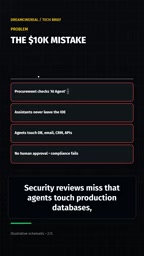
Confusing coding assistants with AI Agents leads to wrong tool selection and failed compliance audits; classify by access scope.
The article notes that many teams label coding tools like Cursor as "AI Agents," a naming confusion that has caused over $10,000 in procurement and audit losses. Coding assistants stay within the IDE with human-reviewed diffs and code-only toolsets; AI Agents work across CRM, email, databases, and APIs in autonomous loops without step-by-step human approval. Reviewers often think they're approving a coding tool but actually approve an autonomous system that can touch production databases, leaving compliance gaps. An Apidog CLI demo shows the gap: Agents can read OpenAPI specs, generate and run tests in CI with zero human involvement—coding assistants cannot. Procurement teams should first clarify access scope and approval requirements before deciding which category applies.
Many teams refer to coding tools like Cursor as "AI Agents," and this seemingly harmless label is costing enterprises real money—through incorrect tool selection and, ultimately, failed compliance audits.
The Cost of Confusion: More Than Just a Wrong Name
According to analysis from the YouTube channel Architecture Decisions, mistaking coding assistants for AI Agents can lead to losses exceeding $10,000. This figure comes from both incorrect procurement and audit failures: enterprises believe they are buying a "coding assistant Agent," so they approve it during procurement evaluation and security review under the standards for coding assistance tools—only to find that the deployed system actually has far broader system access than expected.
The root of the problem is that these two concepts differ fundamentally in their capability boundaries, yet their names are used interchangeably.
Coding Assistant: Always Confined to the IDE
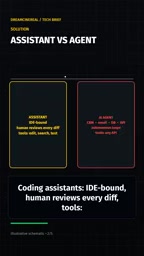
The Coding Assistant's scope of activity is strictly limited to the IDE. Its working model is a tight human-machine collaboration loop: the developer writes code, the assistant provides completions or suggestions, the developer reviews every diff, and tools, editing, search, and testing all happen within this closed loop.
Every change is gated by a human—this is the key characteristic of a coding assistant and the source of its safety. Its toolset is built around the code itself and does not touch external business systems.
AI Agent: Cross-System, Autonomous Loop
The defining characteristics of an AI Agent are entirely different. It works across systems—CRM, email, databases, APIs; anything that exposes an API is an object of its operations. It runs in an autonomous loop: read input, decide, execute, then read the results again, with no step-by-step human approval throughout the process.
This is exactly the point that security reviews tend to miss: reviewers believe they are evaluating a coding assistance tool, but what they actually approve is an autonomous system that can touch production databases, send emails, and modify CRM records. Without step-by-step human approval, the compliance chain lacks traditional control points, and audits naturally fail.
Autonomous Loop is the key mechanism that distinguishes an Agent from an ordinary automation script: the system reads environmental feedback each iteration, decides the next action, executes it, and observes the results again, until the goal is achieved or a termination condition is triggered—with humans setting goals and boundaries only outside the loop. This contrasts with the "Human-in-the-loop" model, in which every critical action requires manual confirmation. The risk of an autonomous loop is that once the model misjudges or a prompt is injected, erroneous actions can compound continuously without anyone noticing. Therefore, production-grade Agents typically require least-privilege permissions, action allowlists, observable logs, and a kill switch—and these are precisely the controls that compliance audits focus on.
Drawing the Line with Apidog CLI
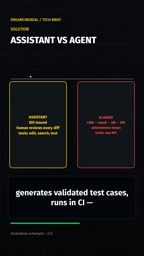
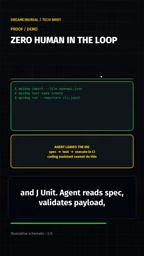
The video uses an Apidog CLI demonstration to illustrate the capability gap between the two. The demo flow is: first run Apidog import to import the openapi.json specification file, then use Apidog test case create to generate validated test cases, and finally use Apidog run together with the reporters CLI and JUnit output to execute the tests. The entire process runs in CI with zero human intervention.
The Agent reads the spec, validates the payload, creates tests, and executes tests—this chain is fully automated. A coding assistant cannot do this, because it never leaves the IDE, let alone read API specifications and drive external testing workflows.
OpenAPI Specification (formerly Swagger Specification) is a standard format for describing REST APIs in JSON or YAML, including information such as paths, request methods, parameters, request body structure, response status codes, and data schemas. Because it is machine-readable, an Agent can use it to automatically infer the interface contract, validate whether the payload conforms to the schema, and generate test cases covering both normal and exceptional branches. This is also the prerequisite that enables Apidog import in the demo to import with one click and drive the subsequent workflow—if an interface has no specification, the automation chain can only rely on manual writing or reverse-engineering from captured traffic, and the Agent's autonomy will be greatly diminished.
JUnit report format is the de facto universal output standard in the testing domain, recording test case names, durations, pass/fail status, and error stacks in XML structure, and is natively parsed by mainstream pipelines such as Jenkins, GitHub Actions, and GitLab CI. In the demo, outputting JUnit results through the reporters CLI means that the tests generated by the Agent are not simply run and discarded; instead, they can plug into existing CI gates, allowing failing test cases to automatically block merge requests—thereby truly incorporating automated testing into the evidence chain for quality and compliance.
Practical Recommendations for Teams
When evaluating "AI Agent" products, procurement and security teams need to ask a few clear questions: Which external systems will this system touch? Does each action require human approval? Does its toolset extend beyond code? If the answers point to cross-system access and autonomous execution, then it should go through the Agent review process rather than being approved as a coding assistant.
Conversely, if a team simply wants to improve coding efficiency, a coding assistant bound to the IDE, with every change reviewed by a human, is the right choice—there is no need to pay extra compliance costs for the "Agent" label.
Conceptual clarity is itself an architectural decision.
In procurement and security evaluation, a simple classification checklist can be used: first confirm the system's toolset boundary (does it only operate on code repositories and the IDE, or can it call external APIs, databases, and messaging systems), then confirm the execution mode (does every step require manual confirmation), and finally confirm the credential scope (which service accounts are used, and whether production environments can be written to). If any one of these three crosses the line, the system should go through the Agent-level approval, sandboxing, and audit logging process. In addition, it is advisable to require vendors in contracts to explicitly disclose the list of tools an Agent can call and its permission model, and to incorporate this into change management, so as to avoid capabilities silently expanding after launch and invalidating the review conclusions.
One-line Summary
Mistaking coding assistants for AI Agents leads to wrong tool selection and failed compliance audits; classification should be based on access scope.
Paragraph Summary
The article points out that many teams lump coding tools like Cursor under the term "AI Agent," and this naming confusion has already caused more than $10,000 in procurement and audit losses. Coding assistants are strictly confined to the IDE, with every change reviewed by a human via diff, and their toolset centers only on code itself; AI Agents, by contrast, operate across external systems such as CRM, email, databases, and APIs in an autonomous loop, with no step-by-step human approval. Security reviewers often mistakenly believe they are evaluating a coding assistance tool, but what they actually approve is an autonomous system capable of touching production databases, leaving the compliance chain missing control points. The article uses an Apidog CLI demo to illustrate the gap: an Agent can read OpenAPI specifications, generate and execute tests, and run in CI with zero human intervention, which a coding assistant cannot do. It recommends that procurement teams first clarify the system's access scope and approval requirements before deciding which category of tool to approve it under.
Related articles

Gemini 4 Neon Leak: A Potential Strong Contender Against Opus 5.5
A Hacker News thread suggests Gemini 4 Neon looks like an Opus 5.5 competitor. This article unpacks the product positioning behind this community signal, shifts in the top-model competitive landscape, and what it means for developers' model selection strategy.

Claude Fable 5.2's Self-Authored Short Film 'Fable' Sparks Discussion
A short film 'Fable,' credited to Claude Fable 5.2 for script, visuals, and directing, appears on Hacker News. This article analyzes the significance of full-pipeline AI creation, community reactions, and what it means for content creators.

Anthropic IPO Pricing: A Signal of AI Giants Going Public
Anthropic's IPO pricing draws attention. This article analyzes its potential impact on AI industry valuation, commercialization paths, and the competitive landscape, and highlights public-market expectations and challenges for AI companies.