Coding Is Easy, Making Money Is Hard? Ten Steps to Find Your First Paying Customer

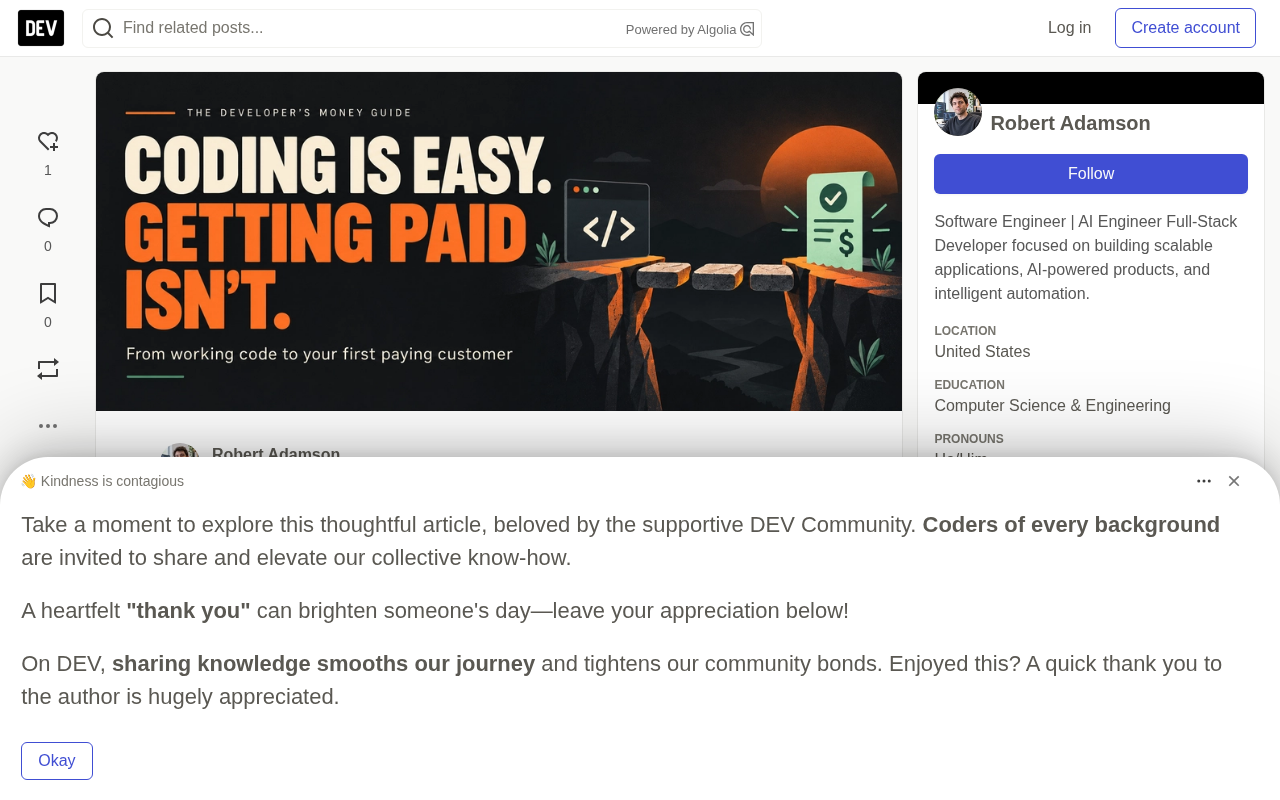
From choosing customers to getting paid: ten steps to help developers find their first paying customer.
Aimed at developers who can write software but haven't yet made money from it, this article lays out a ten-step path from zero to the first paying customer. The core is to first choose a monetization method (freelancing, fixed service, or software product), then lock in a five-person customer group you can directly talk to, dig into their current work through questions to uncover expensive or frustrating tasks, package that into a mini offer including who it's for, the problem, deliverables, price, and timeline, and proactively request a paid pilot. Build only one reliable end-to-end workflow for the first version, help the customer get started after delivery, validate value through usage data and willingness to pay, then replicate to similar customers. Finally, it stresses that unit economics must add up and provides a first-week action plan to replace guesswork with evidence.
Title
Coding Is Easy, Making Money Is Hard? Ten Steps to Find Your First Paying Customer
Meta Description
Can code but can't make money? This article offers a complete ten-step guide—from choosing a monetization path, locking in reachable customers, discovering high-cost problems, to designing a small offer, requesting a paid pilot, building a minimal workflow, and validating results—to help you find your first paying customer and achieve sustainable revenue.
Article Content
Building an app—connecting it to a database, adding authentication, integrating payments, and getting it live—isn't hard these days. What's hard is getting people to visit, getting them to say "cool," and yet having no one pay.
What's missing isn't more code—it's a real problem, a useful solution, and a reason to pay. If you can write software but haven't made a single dollar from it yet, the path below may help you find your first paying customer.
Step 1: Choose a Monetization Path
First, figure out what you're selling. There are usually three paths:
- Freelancing: Sell a completed project, like building a booking website for a client.
- Fixed service: Sell the same solution to different customers, like setting up appointment reminder systems for hair salons.
- Software product: Sell access to a tool, like a monthly-fee management app for repair shops.
If you need income quickly, starting with small paid projects is more practical—you don't need to build a product for hundreds of people first, just deliver a clear result for one. If you want to build a software business, it's also advisable to start with one customer; their workflow will tell you what to build.
Pick one path first; you can expand later.
Step 2: Choose a Customer Group You Can Reach
"Small businesses" is too broad. Get specific about people you can actually talk to: independent repair shop owners, private tutors, local cleaning companies, freelance photographers, small property owners...
Then ask yourself: Can I get in touch with five people in this group? Through existing contacts, local businesses, professional communities, or online groups, finding them isn't hard. The key is "reach"—an audience you can converse with is a useful starting point.
This article uses independent repair shops as an example.
Step 3: Find an Expensive or Frustrating Task
Don't start by asking "Would you use the app I'm building?" Start with their current work:
- What do you do manually over and over?
- What gets easily forgotten?
- Where do mistakes cost money?
- What software are you already paying for?
- Can you show me how you handled the last one?
Suppose a shop owner says: "We write repair details on paper, and sometimes forget to follow up with customers who haven't picked up their devices yet." That's a concrete entry point. Then dig deeper: How often does this happen? How do you handle it now? Is it serious enough to be worth changing the process?
Listen for real stories, not polite enthusiasm.
Step 4: Turn the Problem into a Small Offer
An "all-in-one business platform" is hard to explain and hard to build. A smaller offer is easier to understand:
"I can build you a repair tracker that lets you see active work orders, outstanding balances, and devices waiting for pickup at a glance."
Your offer should specify: for whom, what problem it solves, what you deliver, how much it costs, and when it's done. For example: "I will build a repair tracker for your shop with work order creation, status updates, and unpaid balance features. Pilot fee is $150, including setup and two weeks of support."
This price is just an example, not universal advice. Pricing needs to reflect effort, customer value, and ongoing support costs.
Paid Pilot is a validation method commonly used in lean startups and customer development: the customer pays upfront for a small, clearly scoped solution, and the provider delivers within a set timeframe and collects feedback. Compared to free trials or letters of intent, a paid pilot more realistically tests demand—if a customer is willing to pay, the problem is painful enough and the solution credible enough. A pilot typically includes a clear scope, timebox, price, and support terms, aiming to gain verifiable learning at minimal cost rather than delivering a complete product all at once. For developers, a paid pilot also brings early cash flow and real usage data, providing a basis for later productization or scaling sales.
Step 5: Request a Paid Pilot
A compliment only means they like the idea; a paid agreement is stronger evidence that the problem matters. You can ask directly: "Would you be willing to try a paid pilot with these three features?"
Before collecting payment, be sure to agree in writing: what's included, delivery date, price and payment schedule, how changes are handled, and support and cancellation terms. If the software isn't built yet, state that clearly.
If they decline, ask what's blocking them—price, timing, trust, or the problem itself. Use the answers to improve your offer, not to keep your head down writing code.
Step 6: Build Only One Complete Workflow
Using the repair tracker as an example, the first version might only support: create work order → update repair status → record payment → close work order. This flow must work end to end.
You don't need inventory forecasting, employee rankings, ten integrations, and a custom dashboard builder to deliver the agreed pilot. But you do need the foundations that make the tool reliable: correct calculations, appropriate access controls, secure handling of customer data, and ways to recover from errors.
Keep the feature list short and make the promised workflow reliable.
End-to-end Workflow refers to all the steps a user goes through to complete a full business goal, forming a closed loop from trigger to finish. Take repair tracking as an example: creating a work order, updating status, recording payment, and closing the work order constitute a minimal but complete flow. Doing only one part (e.g., being able to create work orders but not record payments) forces users to complete the remaining steps outside the tool, greatly reducing value. Prioritizing one reliable end-to-end workflow means data flows correctly at each step, states are consistent, and exceptions are recoverable—so the customer can truly hand the task to the tool instead of continuing to rely on paper or spreadsheets.
Step 7: Help Your First Customer Get Started
Sending a login link doesn't mean the job is done. Walk through a real task with the customer and observe where they pause: Is a field confusing? Is entering a work order too time-consuming? Are important details missing? Can they find yesterday's work order?
Fix what prevents the customer from getting value. For small business tools, setup and support are part of what the customer is paying for.
Step 8: Check Whether It's Actually Useful
After the customer has used it for a while, ask: Are you still using it? Which task became easier? What still needs to be handled outside the tool? Would you be willing to keep paying? Why?
With permission, compare results before and after. For example, they can now find unpaid repair records without digging through a pile of paper work orders—that's a concrete benefit you can tell another shop about. Don't fabricate savings or claim unmeasured results.
One useful customer story is more persuasive than a long feature list.
Step 9: Find the Next Four Customers
Use what you've learned to approach similar businesses. The opening can be simple: "I built a repair tracker that shows active work orders and unpaid balances in one place. How does your shop currently manage these?"
Keep conversations relevant and personalized, follow community rules, and respect those who aren't interested. When someone wants a demo, show their most important task first so they see how the tool fits into their day.
Track a few numbers: how many people you contacted, how many conversations you had, how many demos you gave, how many customers paid, how many customers kept using it. These numbers help you diagnose: few replies may mean the audience or message needs adjustment; many demos but few closes may mean the offer needs improvement.
Step 10: Make Sure the Numbers Add Up
Suppose five customers each pay $20 a month, for $100 in monthly revenue. Subtract hosting, payment processing fees, any paid services, and the time you spend on support, then ask: At this price, can I serve more customers without getting buried in unmanageable work?
You may need a setup fee, a higher price, a simpler product, or more limited support. Use subscription pricing when you provide ongoing value; one-time projects are better suited to one-time payments.
Making money is the first milestone; making money sustainably is the next.
Unit Economics is an analytical framework for measuring whether an individual customer or transaction is profitable. For software products, it typically looks at revenue per customer minus direct variable costs (hosting, payment processing fees, support time, etc.). If five customers each pay $20 a month for $100 in monthly revenue, and little remains after hosting and fees—plus support time—unit economics may be negative. Then you need to adjust pricing, add a setup fee, simplify the product to reduce support burden, or move to higher-value customers. Positive unit economics means each additional customer contributes profit, which is the foundation for sustainable business expansion.
A Simple Plan for the First Week
You don't need to complete a business in seven days, but you can use a week to replace guesswork with evidence:
- Day 1: Choose a customer group you can reach.
- Days 2–3: Have five conversations about their current work.
- Day 4: Pick one recurring problem.
- Day 5: Write a small offer with a price and clear scope.
- Day 6: Show a sketch or demo to interested people.
- Day 7: Request a paid pilot and learn from the responses.
If no one wants a pilot, investigate before building. Change the problem, the customer, or the offer based on what you heard.
Before You Start Your Next App
Write down the answers to these questions: Who will buy? What problem are they willing to pay for? How do I reach them? What's the smallest result I can reliably deliver? You don't need perfect answers, but they need to be concrete enough to test.
Your first revenue may come from a small tool for a local small business. Deliver it well, understand why they bought, and then use that knowledge to find the next customer.
Now, which step is harder for you: finding the problem, finding the customer, or asking for money?
Related articles

Chain of Thought Isn't Just for AI: How Humans Can Use CoT to Improve Thinking Quality
Chain of Thought isn't just a prompt trick for large models. Starting from a Hacker News discussion, this article analyzes why CoT works for human thinking too, breaks down actionable ways to transfer it, and highlights the key differences between human CoT and machine CoT.
Cloudflare Teams Up with OpenAI: Closi…
Cloudflare Teams Up with OpenAI: Closing the Loop from Vulnerability Discovery to Defense with AI
Cloudflare uses OpenAI Daybreak to investigate security vulnerabilities and generate reviewable remediation plans, while developers use Codex to boost coding efficiency and quality.

Orca Multi-Agent Orchestration in Practice: A Guide to Parallel Collaboration with Claude and Codex
Orca is Stable AI's free open-source agent workbench supporting 34 agents like Claude Code and Codex in parallel. Learn its Git worktree isolation, multi-model orchestration, and mobile management.