Cognition Partners with MongoDB: Devin Accelerates Enterprise Legacy System Modernization

Cognition embeds AI engineer Devin into MongoDB's platform to slash legacy system migration from years to months.
Cognition has partnered with MongoDB to integrate its autonomous AI software engineer Devin into MongoDB's Application Modernization Platform (AMP), targeting the high-pain problem of enterprise legacy system migration. Devin can independently analyze codebases, refactor application logic, and migrate workloads to MongoDB Atlas, with both parties pitching "months, not years" as their core value proposition. The partnership signals AI coding tools evolving from code assistance to owning end-to-end enterprise engineering projects — though the accuracy and safety of AI-led migration in complex real-world scenarios still awaits broader validation.
A Strategic AI Engineering Partnership
AI software engineering company Cognition has partnered with database giant MongoDB to integrate its autonomous AI software engineer Devin into MongoDB's Application Modernization Platform (AMP). The goal is straightforward: help enterprises migrate legacy applications to MongoDB Atlas cloud database, compressing what would typically take years of modernization work into just months.
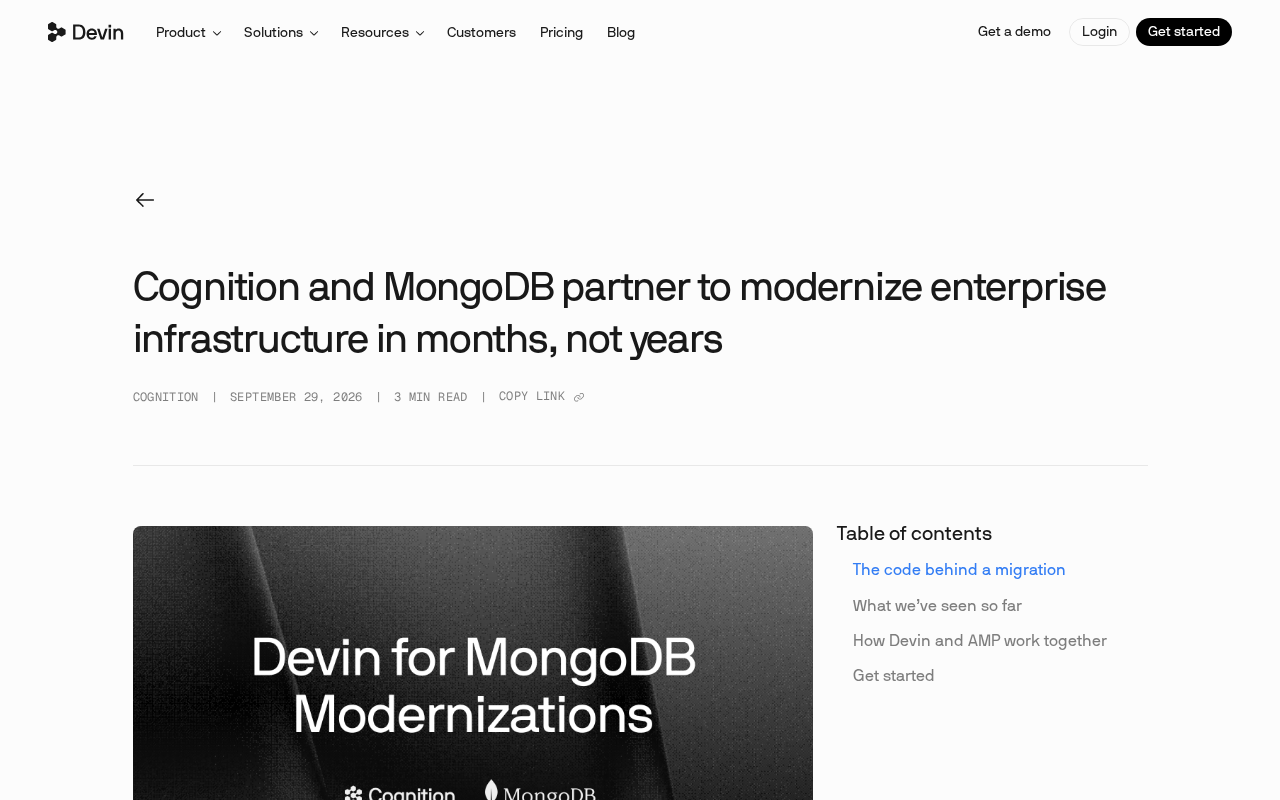
For large enterprises long burdened by technical debt, this is a compelling proposition. Legacy system migration has always been one of the most painful engineering challenges for IT departments — aging codebases, missing documentation, and tangled dependencies mean that touching one thing can break everything else. Cognition is betting that AI engineering capabilities can finally crack this hard problem.
What Role Does Devin Play in Enterprise Modernization
Devin is Cognition's autonomous AI software engineer, capable of independently understanding codebases, writing code, and executing migration tasks. Embedded within MongoDB's AMP platform, Devin can take on the heavy lifting of code analysis and refactoring throughout the application modernization workflow.
From Legacy Architecture to MongoDB Atlas
Traditional database migration isn't just about moving data — it involves large-scale rewrites of application-layer logic. Migrating from relational databases to a document-oriented database like MongoDB Atlas is especially complex, requiring redesigns of data models, query statements, and business logic. Devin's involvement means these repetitive, large-scale engineering tasks could be substantially automated by AI, freeing human engineers to focus on architectural decisions that require genuine judgment.
Relational databases (such as Oracle, SQL Server, and MySQL) and document-oriented databases differ fundamentally in their philosophy of data organization. Relational databases store structured data in rows and columns, maintaining relationships between entities through foreign keys and JOIN operations. MongoDB Atlas, by contrast, uses the BSON document format, nesting related data within a single document in a way that naturally aligns with object-oriented programming models. During migration, data spread across multiple related tables must be re-modeled — deciding what should be embedded versus referenced is itself an architectural judgment call that requires business understanding. SQL queries must also be rewritten into MongoDB's Aggregation Pipeline syntax, and database-side logic like stored procedures and triggers often needs to be moved into the application layer. This is precisely why such migrations have historically been time-consuming and high-risk: they are not simple data format conversions, but full-stack refactoring efforts that touch data models, query logic, and application code alike.
The "Months, Not Years" Value Proposition
The phrase both parties repeatedly emphasize — "in months, not years" — is the most direct commercial pitch of this partnership. Enterprise modernization projects routinely span multiple fiscal years, requiring enormous investment at high risk. If AI engineers can significantly compress that timeline, companies not only reduce costs but also gain faster access to the elasticity and performance advantages of cloud-native architecture.
What This Means for Enterprise IT Strategy
This partnership reflects a trend that's taking shape: AI coding tools are evolving from helping developers write code to taking ownership of end-to-end engineering projects. Devin's integration into AMP isn't a simple plugin — it embeds AI capabilities into enterprise-grade modernization workflows, making AI a core component of the migration solution itself.
For MongoDB, this strengthens Atlas's competitive position in the enterprise migration market by using AI to lower the barrier for customers moving to the cloud. For Cognition, this is a critical step in moving Devin beyond demos and into real enterprise deployment scenarios. Database migration is a well-bounded, clearly painful, and measurable use case — exactly the kind of environment suited to validating an AI engineer's real-world productivity.
Open Questions Worth Watching
Despite the promising outlook, AI-led migration engineering still needs to prove itself against real-world conditions. Legacy systems frequently contain large amounts of implicit business rules and edge cases. Whether AI can maintain migration accuracy and safety in complex, real-world projects remains to be demonstrated through more customer case studies. When evaluating such solutions, enterprises typically scrutinize data integrity during migration, rollback mechanisms, and how human review checkpoints are designed.
Most of the publicly available information currently comes from official statements by both parties; specific performance data, customer case studies, and pricing models have yet to be disclosed in detail. The real effectiveness of this partnership will need to be validated through actual enterprise migration projects going forward.
In AI-led code migration, "implicit business rules" are the hardest risk to capture. These rules typically appear as uncommented conditional branches, magic numbers, or historical patches scattered throughout old codebases — sometimes with no one on the development team able to fully explain why they exist. In large financial, healthcare, or government systems, these rules often correspond to compliance requirements or specific client agreements; if overlooked during migration, they can lead to data inconsistencies or even legal exposure. Data integrity verification typically requires engineering safeguards such as dual-write comparison and shadow mode operation — writing to both old and new systems simultaneously and comparing results, only completing the cutover once consistent behavior is confirmed. The quality of these design choices is a key indicator of how mature an AI-assisted migration solution truly is.
Summary
The Cognition–MongoDB partnership represents a landmark case of AI software engineering moving into serious enterprise application. Embedding Devin into an application modernization platform and directing AI engineering capabilities at legacy system migration — a high-value, high-pain scenario — is both a real-world test of Devin's productivity and a potential redefinition of how enterprises tackle technical debt. Whether the "months, not years" promise can be delivered will depend on performance in complex, real-world projects yet to come.
Related articles

Chain of Thought Isn't Just for AI: How Humans Can Use CoT to Improve Thinking Quality
Chain of Thought isn't just a prompt trick for large models. Starting from a Hacker News discussion, this article analyzes why CoT works for human thinking too, breaks down actionable ways to transfer it, and highlights the key differences between human CoT and machine CoT.
Cloudflare Teams Up with OpenAI: Closi…
Cloudflare Teams Up with OpenAI: Closing the Loop from Vulnerability Discovery to Defense with AI
Cloudflare uses OpenAI Daybreak to investigate security vulnerabilities and generate reviewable remediation plans, while developers use Codex to boost coding efficiency and quality.

Orca Multi-Agent Orchestration in Practice: A Guide to Parallel Collaboration with Claude and Codex
Orca is Stable AI's free open-source agent workbench supporting 34 agents like Claude Code and Codex in parallel. Learn its Git worktree isolation, multi-model orchestration, and mobile management.