Cognitive Biases Academy: A Free Platform for Learning About 190+ Mental Traps
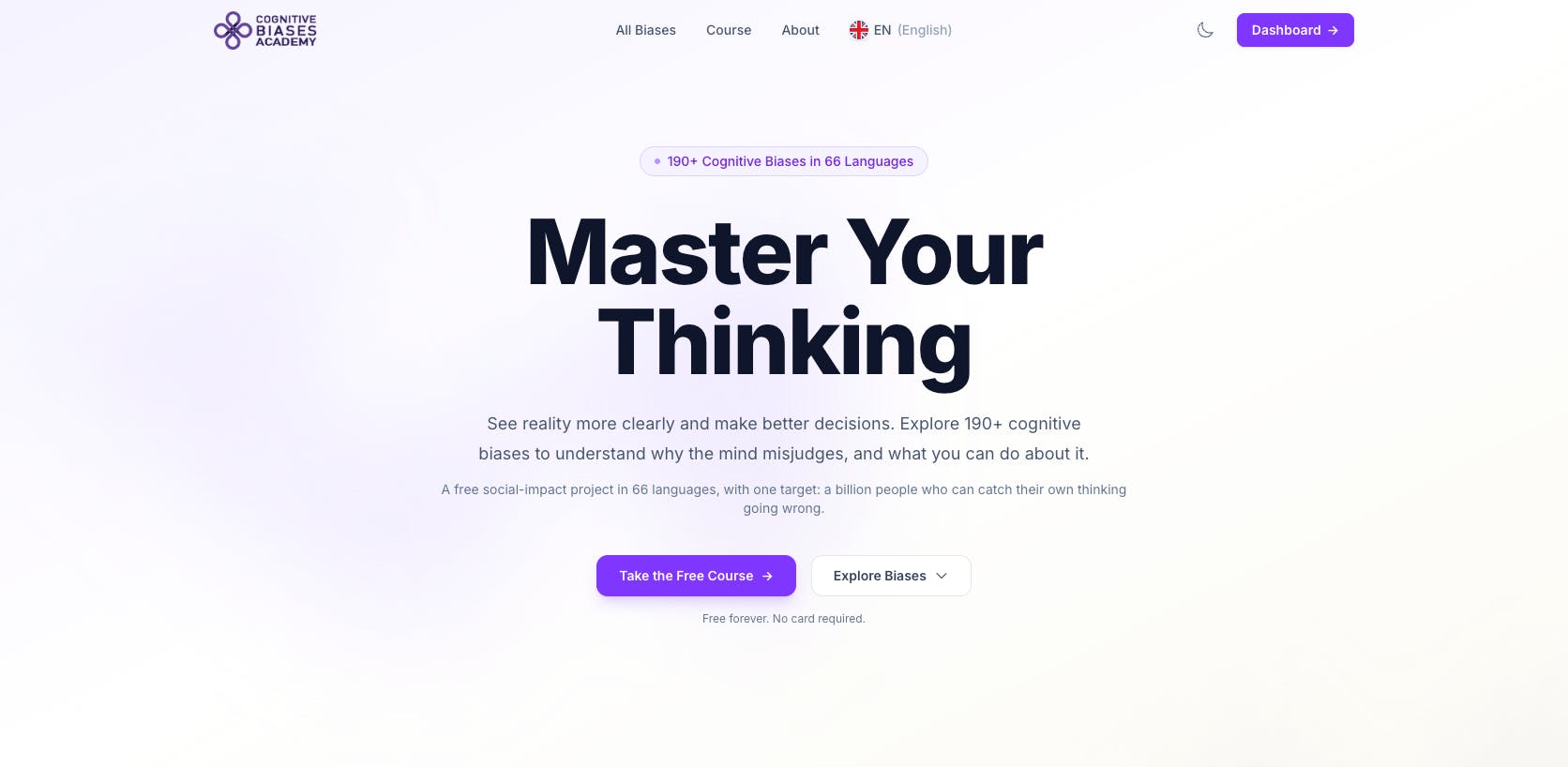
A free, multilingual platform teaching people to identify and overcome 190+ cognitive biases.
The Cognitive Biases Academy is a permanently free educational platform that systematically covers over 190 documented cognitive biases. Backed by 1,800+ academic references and available in 66 languages, it uses a three-step framework — tracing origins, diagnosing distortions, and enabling self-detection — to help users recognize mental traps in everyday thinking. Its ambitious mission targets one billion self-aware minds based on the "critical 10%" social tipping point theory.
Your Brain Is Wired to Make Mistakes
The human brain is not a precision instrument of pure rationality. Quite the opposite — it comes with systematic biases built in. According to the Cognitive Biases Academy, over 190 cognitive biases have been documented by academia to date. These aren't occasional mental glitches but "shortcuts" forged through eons of evolution. They helped our ancestors make rapid decisions in ancient environments, yet they frequently mislead us in today's information-saturated world.
From an evolutionary psychology perspective, this "systematic error-making" has a profound survival logic. On the African savannas of the Pleistocene (roughly 2.6 million to 10,000 years ago), when facing predator threats, a strategy of "better to have ten false alarms than miss one real threat" had greater survival value than calm analysis. Evolutionary psychologists Martie Haselton and David Buss systematized this asymmetric error management logic into "Error Management Theory." Nobel laureate in economics Daniel Kahneman further categorized these rapid decision-making mechanisms as "System 1" in his classic work Thinking, Fast and Slow — an automatic, intuitive, low-energy thinking mode, as opposed to the deliberative "System 2." The majority of the 190+ cognitive biases are products of System 1 being "out of its element" in modern complex environments.
The Cognitive Biases Academy is a free learning platform built around this very premise. It breaks down each documented bias in accessible language: where the bias comes from, how it distorts your judgment, and how you can detect it in yourself. This isn't a dry academic inventory — it's a "mental error-correction manual" designed for everyday people.
Three Core Features of the Cognitive Biases Academy
Completely Free, Permanently Open
Unlike many products that advertise as "free" but erect paywalls around key content, the Cognitive Biases Academy emphasizes free forever, no card required. This positioning makes it more akin to public knowledge infrastructure than a commercialized online course. For learners who want a systematic understanding of cognitive science without bearing subscription costs, this dramatically lowers the barrier to entry.
However, the "free forever" promise also raises questions about platform sustainability. In internet history, similarly positioned projects have taken different paths: Wikipedia has operated on a donation model for over 20 years, Khan Academy maintains free educational content through charitable foundations and corporate donations, while many open knowledge projects have eventually gone dark due to lack of stable funding. For a platform that needs to continuously maintain the currency of 1,800+ references and the accuracy of translations in 66 languages, operational costs are far from trivial. Possible sustainability paths include institutional licensing, research partnerships, or a community contribution model similar to Wikipedia's.
Academic Backing with 1,800+ References
The biggest trust risk for knowledge products is the proliferation of pseudoscience. The Cognitive Biases Academy establishes content credibility through over 1,800 academic references. Every bias description is grounded in published psychology and cognitive science research. This rigor distinguishes it from the typical "psychology crash course" content on the market, making it better suited as an introductory index for in-depth study of cognitive biases.
66 Languages, Global Reach
Cognitive biases are universal human thinking phenomena, yet quality educational content on the topic has long been predominantly in English. The platform translates all content into 66 languages, significantly expanding its accessible audience. This initiative reflects an underlying judgment: cognitive bias education should not be limited by language barriers, especially in the non-English-speaking world.
The Social Experiment Logic Behind "One Billion Self-Aware Minds"
The most striking aspect of the Cognitive Biases Academy is its ambitious mission — enabling one billion people to recognize errors in their own thinking. This number isn't arbitrary. The project cites a perspective from complex systems research: when approximately 10% of people in a society firmly hold a certain cognition or belief, it's sufficient to drive a shift in the rest of the population's views (the so-called "critical minority" effect).
This theory primarily originates from a 2011 study by the Social Cognitive Networks Academic Research Center at Rensselaer Polytechnic Institute. Published by Boleslaw Szymanski and colleagues, the research used computer simulations to discover that when the proportion of individuals holding a specific unshakeable belief in a social network reaches approximately 10%, that belief rapidly transforms from a minority viewpoint to a majority consensus. The core logic: committed belief holders won't be persuaded to change their position, while most people's stances are malleable — so when committed holders reach critical density, their sustained influence in social networks produces a cascade effect.
Do the math: 10% of the world's approximately 8 billion people comes close to one billion. In other words, the platform's goal isn't to make everyone a cognitive science expert, but to cultivate a sufficiently large "critical group" that elevates overall thinking quality through social contagion effects.
This is a rather ambitious social experiment hypothesis. It connects individual-level "metacognition" training with group-level belief propagation mechanisms. Of course, the "10% triggers a tipping point" theory is debated across different studies — critics point out that the model assumes idealized network structures and interaction rules. In reality, the emotional intensity of beliefs, degrees of social polarization, and the existence of filter bubbles all significantly alter this threshold. But as a product narrative and mission driver, it does imbue a science communication tool with a stronger sense of purpose.
What Real Pain Points Does the Cognitive Biases Academy Address
In today's world of information overload and algorithm-driven attention, cognitive biases are being amplified and exploited like never before:
-
Confirmation bias makes people only see what they want to see. Confirmation Bias was first documented by British psychologist Peter Wason in the 1960s through his famous "2-4-6 task" experiment — humans tend to seek, interpret, and remember information that supports their existing beliefs while ignoring or discounting contradictory evidence. In algorithm-dominated digital environments, social media optimizes for user engagement, and people naturally interact more with content that aligns with existing beliefs, creating a positive feedback loop. Scholar Eli Pariser named this phenomenon the "Filter Bubble," while Cass Sunstein used "echo chamber" to describe its social consequences: intensified group polarization and erosion of consensus foundations.
-
Availability bias makes people overestimate the probability of rare but sensational events. The Availability Heuristic was proposed by Kahneman and Tversky in 1973, referring to people's tendency to judge event frequency based on how easily information can be "retrieved" from memory. Events that are easy to recall are perceived as more frequent, and this retrievability is influenced by emotional intensity, vividness, and recency. A classic example: people systematically overestimate the probability of plane crashes while underestimating heart disease mortality risk, because air disaster coverage is far more visually striking than chronic disease statistics. In today's 24-hour news cycle and instant social media dissemination, exposure to sensational events is amplified many times over.
-
Anchoring effect influences every decision from shopping to investing. The Anchoring Effect was also proposed by Kahneman and Tversky in their groundbreaking 1974 paper. Their core finding: when making numerical estimates, people are disproportionately influenced by previously encountered numbers, even when that "anchor" is completely irrelevant to the question. Products displaying an "original price" alongside a "discount price," the advantage gained by whoever names a number first in salary negotiations, a stock's historical high becoming a psychological anchor for judging current valuation — behavioral economist Dan Ariely's experiments even demonstrated that when people wrote down their Social Security numbers before bidding on products, those with higher numbers systematically bid higher.
The value of the Cognitive Biases Academy lies in transforming "bias recognition" from an abstract concept into an actionable skill. Its three-step framework — tracing origins (where it comes from), diagnosis (how it distorts), and self-detection (how to spot it) — provides a clear self-training pathway.
Notably, this framework has solid cognitive science foundations. The term Metacognition was coined by American developmental psychologist John Flavell in 1976, referring to "cognition about cognition" — an individual's awareness, monitoring, and regulation of their own thinking processes. However, metacognition research simultaneously reveals a difficulty: merely "knowing" a bias exists doesn't eliminate it. This is called the "Bias Blind Spot" — people can easily identify cognitive biases in others while remaining blind to the same biases in themselves. Cognitive psychologist Keith Stanovich proposed that overcoming biases requires three conditions: knowing the bias exists (mindware installation), recognizing that the current situation might trigger the bias (situational detection), and having the motivation and ability to override System 1's default response (decoupling operations). The Cognitive Biases Academy's "origins-diagnosis-self-detection" framework corresponds precisely to these three levels.
For content creators, product managers, investors, and ordinary decision-makers alike, this systematic "mental health check" has direct practical value.
A Sober Assessment of the Cognitive Biases Academy
Looking at Product Hunt data, the product received 9 upvotes and 1 comment on its launch day, ranking 16th — not particularly high traction. This reflects a reality: cognitive science communication is a high-value but hard-to-spread domain. Unlike AI tools that can immediately demonstrate "productivity gains," its benefits are long-term and difficult to quantify.
Moreover, while "covering 190+ biases" and "66 languages" showcase content breadth, what truly determines whether it can achieve its "one billion minds" mission is content depth, interactive experience, and whether it can foster sustainable learning habits. The free model lowers barriers but raises questions about operational sustainability — without payment, what supports long-term content maintenance and translation updates?
Regardless, in an era increasingly reliant on quick intuitive reactions, a free, multilingual, academically-backed cognitive bias knowledge base is inherently commendable. Whether it can truly cultivate that "critical 10%" remains to be verified by time.
Key Takeaways
Related articles

DeepCell: One-Click AI Generation of Documents, Spreadsheets, and Slides
DeepCell tops Product Hunt with one-click generation of documents, spreadsheets, and slides, using the .deepcell format for linked updates, designed for System 2 tasks like modeling and sales reviews.

Doneas: 15-Minute Daily Accountability Calls That Keep Indie Developers From Procrastinating
Doneas is a daily accountability tool for indie developers: plan tasks on Monday, join a 15-minute call with five builders each day, and log deliveries on a public progress page. This article analyzes its core mechanics, effectiveness, and potential issues around retention and matching.

Fastlane 2.0: Fully Automated AI Ad Campaigns, From Creative to Optimization
Fastlane 2.0 is an AI ad automation tool: enter your website and it learns your brand, generates video and image ads, and runs and optimizes them on Meta, TikTok, Instagram, and YouTube.