Coinbase Autopilot: Building a Quality Loop for AI Customer Support

Coinbase Autopilot turns support bot maintenance into verifiable software engineering with versioned flows and shared test contracts.
Coinbase's Autopilot shifts support automation from "launching" to "ongoing maintenance." It builds a quality loop around the support bot: flows are versioned DSL decision trees, agents explore anomalies and malicious behavior, and deterministic services handle test fixtures, release checks, and consistent scoring. Its five-element test contract lets its own and partner bots be compared under one standard, while intent routing prioritizes fixes by volume, resolution rate, and CSAT. Humans stay in flow authoring and key judgment points. The write-up offers solid architecture but lacks post-deployment quantitative results.
Customer support automation is nothing new, but most teams have only solved "launching" — not "maintaining." Coinbase's engineering team recently revealed its Autopilot system, which shifts the focus from "getting the bot running" to "keeping the bot running correctly." It doesn't face customers directly; instead, it builds a quality loop around the support bot, letting agents author, test, probe, score, and analyze version-controlled customer support flows. This marks a shift in support automation from "a pile of prompts that pass a few manual spot checks" to "software that requires repeatable verification."
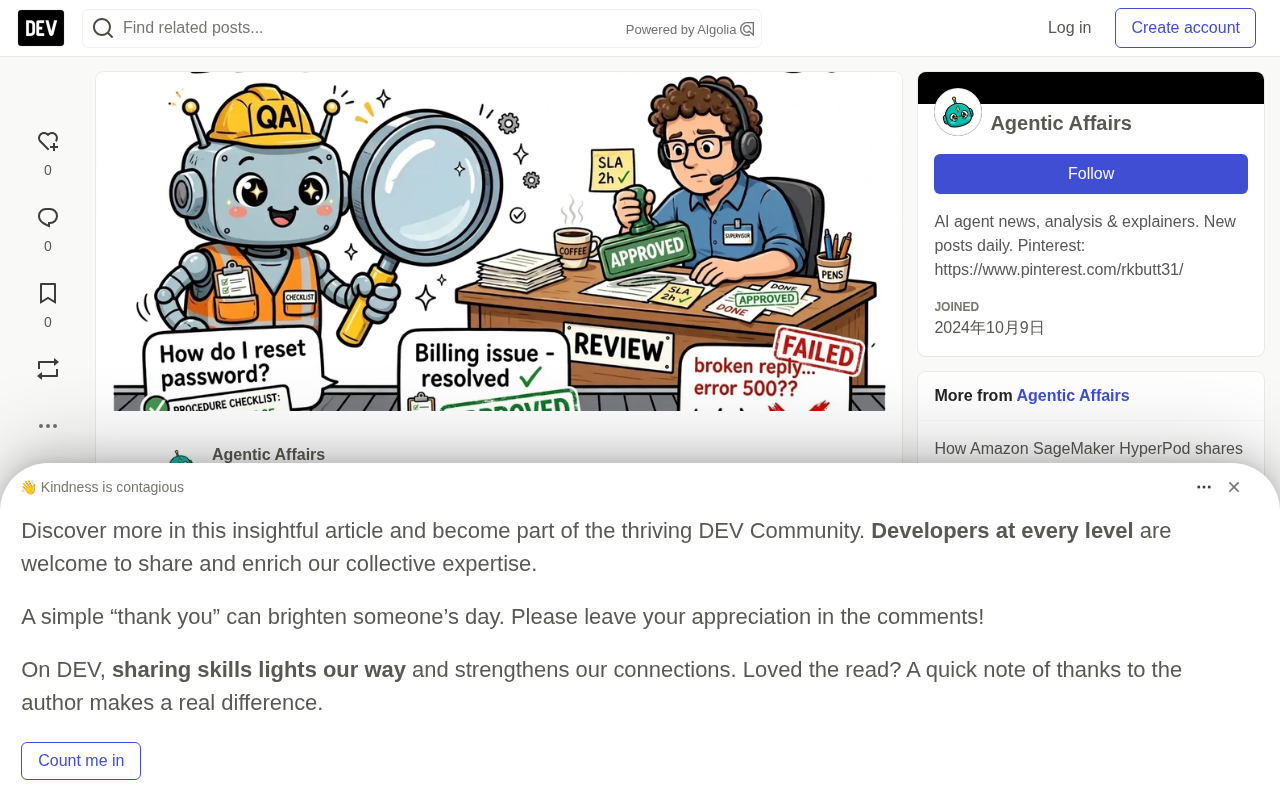
From Prompts to Verifiable Software: A Core Philosophy Shift
Traditional support automation often writes flows as natural-language prompts and calls it done after a few manual spot checks before launch. Coinbase takes a very different approach: the bot follows versioned decision trees covering data retrieval, branching conditions, and end states, expressed in a constrained domain-specific language (DSL). This means the flow itself is code, not prose. Once you modify a flow, swap models, or adjust a data interface, outputs can change silently. Autopilot treats correctness as an ongoing maintenance task rather than a one-time test.
Putting this philosophy into practice depends on a carefully designed architecture. Coinbase splits the system into two kinds of roles: agents handle exploratory work, and deterministic services handle scoring. Agents use language understanding and exploration to investigate anomalous customer behavior and probe malicious attempts; deterministic services provide test fixtures, release checks, and consistent scoring standards. If exploration isn't reproducible, it can't turn into actionable conclusions — this architectural divide is the cornerstone of the quality loop.
Domain-specific language (DSL) is a programming language designed for a specific problem domain, trading generality for expressiveness and safety. In support automation, a DSL can express flows like "look up order status → if not shipped → escalate to human" as constrained syntax rather than free-text prompts. Compared with natural-language prompts, a DSL's advantages are that its grammar can be validated by a parser, branches and end states can be statically checked, and flow changes can trigger automated regression tests. Because the DSL restricts the set of expressible operations, changes in models or data interfaces won't silently alter flow semantics — making versioned management of "flows as code" possible.
A deterministic service refers to a service component whose output doesn't depend on random sampling and always returns the same result for the same input. In LLM-driven systems, model inference itself is non-deterministic (temperature parameters, context order, and so on all affect output), so you can't directly use a model to score a model. Coinbase hands scoring, test fixtures, and release checks to deterministic services: given the same set of inputs and scoring rules, results are stable and reproducible. This way, agents can explore freely, but findings from exploration must pass through deterministic scoring before they become comparable, actionable conclusions — avoiding the maintenance trap of "different conclusions every run."
The Five-Element Test Contract: Making Bots Comparable
Another major innovation in Autopilot is the "shared test contract." Each flow and test contract specifies five elements: customer scenario, simulated account state, expected behavior, bot under test, and the aspect being evaluated. A single test plan can run against both Coinbase's own bot and partner bots using the same inputs and scoring standards.
This solves a long-standing pain point in support automation: the lack of comparability across bots. Previously, each team tested its own bot with its own standards, making results impossible to compare side by side. The shared test contract makes it possible to measure which implementations are better and provides a unified acceptance benchmark for partner integrations.
A test contract borrows from the idea of "contract testing" in software engineering: consumer and provider agree on an executable contract for interface behavior, and any change on either side must be verified against the same contract. Here, the contract is extended to five elements — customer scenario, simulated account state, expected behavior, bot under test, and evaluation dimension. Its key value is decoupling "what to test" from "who implements it": the same contract can accept both your own bot and a partner's bot, and scoring standards don't drift with the implementer. This contrasts with the traditional model of "each team builds its own test set," which can't be compared across teams because standards aren't unified.
Intent Routing: Fix the Highest-Impact Failures First
Not all failures are equally important. Coinbase classifies customer intents separately from flows and product areas, then prioritizes flows based on intent volume, resolution rate, and CSAT. High-frequency intents that perform poorly get attention first. This business-impact-based prioritization ensures quality investment lands where it matters most to customer experience.
At the same time, humans remain in the loop at key points. The bot escalates cases requiring judgment to humans, and humans also stay in the flow-authoring loop. Autopilot's explicit goal is to reduce manual maintenance work while preserving human judgment — not to replace judgment with automation.
Intent routing in support systems generally refers to the mechanism that identifies the category of a customer request and dispatches it to the corresponding processing flow. Coinbase adds two layers of distinction on top: first, it models customer intents separately from specific flows and product areas, so the same intent's performance can be tracked across multiple flows; second, it prioritizes by three dimensions — intent volume (frequency), resolution rate, and CSAT. The rationale is that a failure's impact equals "frequency × loss per occurrence," so even a few percentage points of decline in resolution rate for a high-frequency intent affects far more customers in absolute terms than a low-frequency intent. Directing quality-fixing resources toward high-frequency, underperforming intents means driving maintenance scheduling by business impact rather than technical difficulty.
The Boundaries of Evidence: Clear Architecture, Results Yet to Be Verified
To be honest, Coinbase's write-up provides solid architectural detail but lacks post-deployment quantitative results: no specific data on reduced testing time, no magnitude of change in resolution rate or CSAT. The baseline mentioned — "a UAT cycle can take days" — is a picture of the before state, not a verified before-and-after comparison.
This doesn't mean Autopilot's value is in doubt; it's a reminder that sound architecture doesn't guarantee proven results. For teams considering similar systems, Coinbase's practice offers a framework worth borrowing, but effectiveness still needs to be validated against your own scenarios.
Lessons for Support Automation Practice
The core contribution of Coinbase Autopilot is bringing software engineering's quality assurance mindset into support automation: versioned management, deterministic scoring, shared test contracts, and impact-based prioritization. For any team building or maintaining an AI customer support system, this framework offers a migration path from "it runs" to "it keeps running correctly." The key is accepting one premise: support automation isn't a one-time project — it's a software asset that requires ongoing maintenance.
One-line Summary
Coinbase Autopilot uses versioned flows and shared test contracts to turn support bot maintenance into verifiable software engineering.
Paragraph Summary
Coinbase's engineering team revealed Autopilot, which shifts support automation's focus from "launching" to "ongoing maintenance." It doesn't face customers directly but builds a quality loop around the support bot: flows are written as versioned decision trees in a constrained DSL, agents explore anomalies and malicious behavior, and deterministic services handle test fixtures, release checks, and consistent scoring. Its five-element test contract (scenario, account state, expected behavior, bot under test, evaluation dimension) lets its own and partner bots be compared under the same standard; intent routing prioritizes fixes by volume, resolution rate, and CSAT. Humans remain in flow authoring and key judgment points. The article also notes that the write-up has solid architectural detail but lacks post-deployment quantitative results.
Related articles

Chain of Thought Isn't Just for AI: How Humans Can Use CoT to Improve Thinking Quality
Chain of Thought isn't just a prompt trick for large models. Starting from a Hacker News discussion, this article analyzes why CoT works for human thinking too, breaks down actionable ways to transfer it, and highlights the key differences between human CoT and machine CoT.
Cloudflare Teams Up with OpenAI: Closi…
Cloudflare Teams Up with OpenAI: Closing the Loop from Vulnerability Discovery to Defense with AI
Cloudflare uses OpenAI Daybreak to investigate security vulnerabilities and generate reviewable remediation plans, while developers use Codex to boost coding efficiency and quality.

Orca Multi-Agent Orchestration in Practice: A Guide to Parallel Collaboration with Claude and Codex
Orca is Stable AI's free open-source agent workbench supporting 34 agents like Claude Code and Codex in parallel. Learn its Git worktree isolation, multi-model orchestration, and mobile management.