collecto.rs: Use AI Photos to Catalog All Your Collections

collecto.rs uses photo recognition to unify multi-category collection management, covering valuation, wishlists, and sharing.
collecto.rs is a free tool for collectors on iPhone, iPhone Duo, and web, aiming to centralize multi-category collections scattered across apps and spreadsheets. Its core selling point is photo-based auto-completion, which can recognize and name every card from a single page of a TCG binder at once. It includes 14M+ entries covering 60+ collection types and supports custom libraries through a universal collection item model. Beyond recording, it offers value tracking, a deal-finding wishlist, and sharing, attempting to cover record—valuation—purchase—display. The article notes it has only 66 upvotes and 1 comment on Product Hunt, still in a cold-start phase, with recognition accuracy and automatic valuation reliability yet to be verified.
A Collector's Pain Point: Scattered Items, Unclear Value
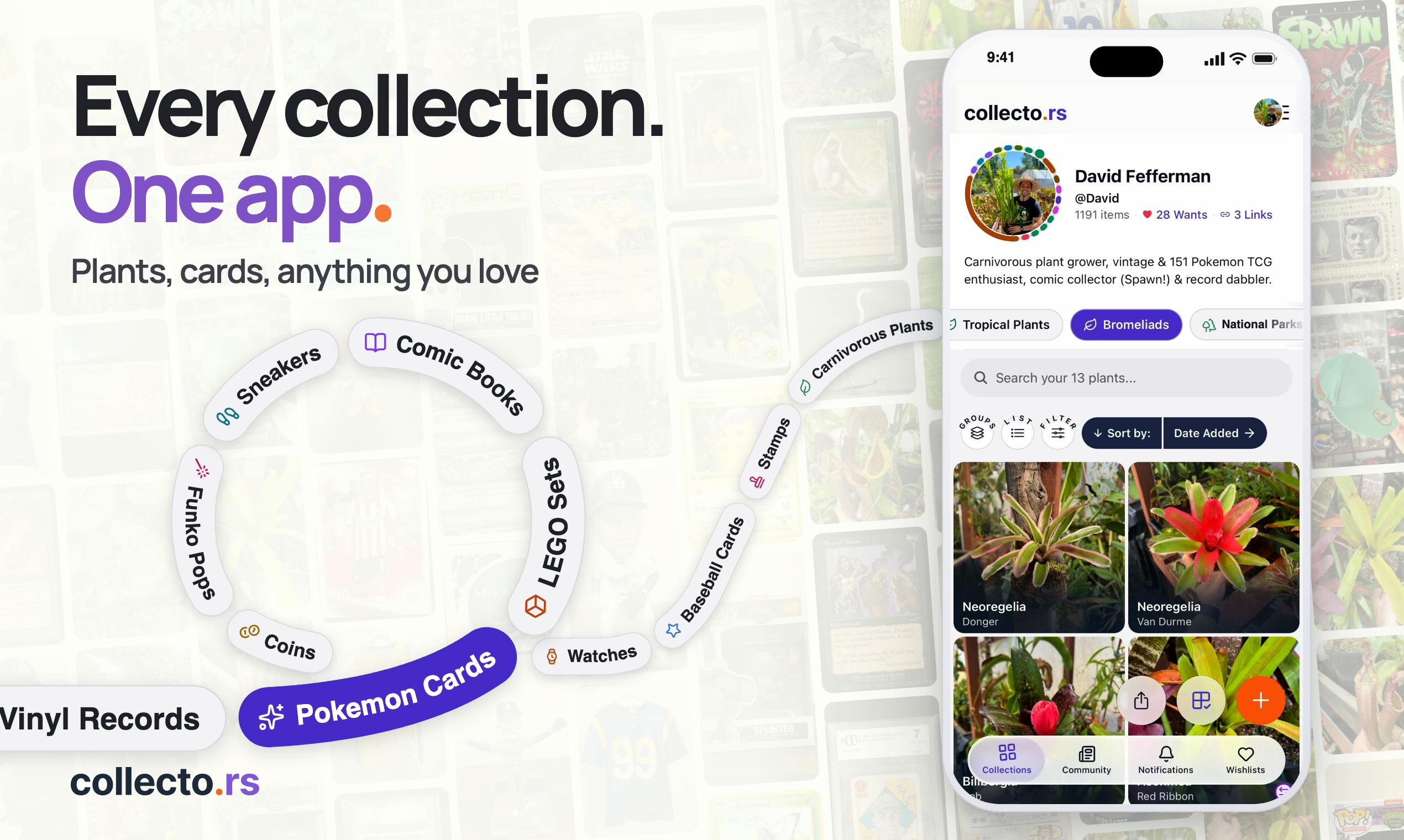
Collecting often starts with one beloved item and eventually grows into a "family" of five or six different categories. Pokémon cards, vinyl records, LEGO sets, coins, carnivorous plants—each is worth recording, but each ends up scattered across different apps, spreadsheets, or photo albums. collecto.rs, which appeared on Product Hunt today (tagline: "Catalog any collection, from Pokémon to pitcher plants"), is aimed squarely at this pain point. It wants to put all collections into one "showcase-worthy" home and minimize the cost of entry through photo recognition.
The project currently has 66 upvotes and ranks 17th on Product Hunt, with only 1 comment—still in an early exposure phase. The maker is David Fefferman, and the product is free, available on iPhone, iPhone Duo, and the web.
Core Feature: Snap a Photo, Let Recognition Do the Rest
The most direct selling point of collecto.rs is "Snap a photo and it fills in the details"—take a photo of your item and the system automatically completes the information. This is especially friendly for card collectors: point the camera at a page of TCG cards and it can recognize and name every card in one go, rather than having you manually enter each one.
This is a typical combination of visual recognition and a structured database. For ordinary collectors, the real value isn't the "AI" label but the fact that data entry shifts from "filling out forms" to "taking photos"—an order-of-magnitude efficiency difference for collections with hundreds or thousands of items.
Visual recognition here generally refers to deep learning-based image classification and object detection: a model first learns features from a large set of labeled images, then performs inference on user-uploaded photos to output "what this is and where it is." The card-binder scenario also involves layout segmentation and multi-object detection—locating multiple cards in a single image and classifying each one. The accuracy of such systems depends heavily on training data coverage and shooting conditions; glare, occlusion, and similar appearances are common sources of error.
A structured database refers to a data collection organized by fixed fields, such as a card's name, set, rarity, and release year. Recognition results need to be matched against database entries (usually via similarity search of image embedding vectors) to automatically fill in details. So the real performance of "photo-as-entry" depends on the quality of both the recognition model and the database.
14 Million Entries, 60+ Collection Types
The product includes 14 million+ entries covering 60+ collection types, including cards, vinyl, LEGO, coins, plants, and more. If what you collect isn't in the library, you can describe it yourself, and the platform will build the corresponding collection structure for you.
This design approach is worth noting: it doesn't turn 60+ types into 60 independent features, but abstracts a universal "collection item" model and lets specific types fill in the fields. This gives it broader applicability than single-category collection apps (say, only cards or only LEGO), at the cost of potentially less depth per vertical than specialized tools.
TCG stands for Trading Card Game, a category that includes Pokémon, Magic: The Gathering, and Yu-Gi-Oh!. TCG cards are usually released by set, and each card has a number, rarity (e.g., common, foil, alternate art), and version differences—the same character may have dozens of card faces. This "same item, many variants" structure makes card collection data modeling more complex than it looks: recognition must not only determine which card it is but also distinguish version and language.
This also explains why full-page recognition is most valuable to card players—when entering manually, players must check numbers and versions card by card, while visual recognition can batch-complete the initial screening, leaving only a few difficult items for manual verification.
Value Tracking, Wishlist, and Social Sharing
Beyond recording, collecto.rs offers three extended capabilities:
- Collection value tracking: gives collectors an intuitive sense of their collection's overall value, rather than "probably worth something."
- Wishlist with price comparison: the wishlist isn't just a "wanted list"—it actively finds deals (discounts), connecting collecting with purchasing decisions.
- Sharing: emphasizes "worth showing off"—collecting is not just a private record but also a displayable identity symbol.
Together, these three features show that the product is positioned not as a simple "digital storage box" but as something aiming to cover the full loop of record—valuation—purchase—display.
Observations and Judgments at an Early Stage
Looking at the Product Hunt data, 66 upvotes and 1 comment indicate the product is still in a cold-start phase with limited community discussion. The free strategy (iPhone, iPhone Duo, and Web) helps acquire users quickly, but it also means the monetization path is unclear—features like value tracking and deal discovery naturally have room for paid or commission-based models, though no public information currently points to this.
For potential users, the first thing worth verifying is recognition accuracy: photo recognition sounds great, but factors like card glare, similar plant leaves, and worn coins all affect results. The product page's "recognize a full page of cards at once" is a fairly strong promise, and actual performance needs to be tested on real collections.
Product Hunt is a community platform for new product launches where users can upvote, comment on, and save products, with votes and rankings calculated on a rolling basis on launch day. 66 upvotes and 17th place is typical early exposure: the product has entered the view of some enthusiasts but has not yet generated community discussion.
The cold-start phase usually refers to the period right after launch when the user base is small and word of mouth hasn't spread. At this stage, free strategies are often used to lower the trial barrier and quickly accumulate real usage data—especially for products that depend on recognition accuracy, which need large numbers of user-uploaded samples to feed back into the model. Only 1 comment means very little public feedback; the feature descriptions on the product page are essentially the vendor's own claims, lacking third-party verification.
Who It's For
If you happen to have cross-category collections and enough items that you can't be bothered to enter them manually, collecto.rs's photo entry and unified multi-type management are a direct draw. If you focus on a single category and already have a mature tool, there's little need to migrate. As for using it as a reference for collection value, it's best treated as an auxiliary—any automatic valuation should be combined with professional appraisal, especially for high-value cards and coins.
One-line Summary
collecto.rs uses photo recognition to unify multi-category collection management, covering valuation, wishlists, and sharing.
Paragraph Summary
collecto.rs is a free tool for collectors, available on iPhone, iPhone Duo, and the web, aiming to centralize multi-category collections scattered across different apps and spreadsheets. Its core selling point is photo-based auto-completion, which can recognize and name every card from a single page of a TCG binder at once, significantly reducing entry costs. The product includes 14 million+ entries covering 60+ collection types and supports custom libraries through a universal collection item model. Beyond recording, it offers collection value tracking, a wishlist that finds deals, and sharing—attempting to cover the loop of record—valuation—purchase—display. The article notes that the product has only 66 upvotes and 1 comment on Product Hunt, still in a cold-start phase, and that recognition accuracy and the reliability of automatic valuation remain to be verified in practice.
Related articles

GPT-6.2 and Astra Launch Together: OpenAI Has Finally Figured Out Its Release Cadence
OpenAI releases GPT-6.2 Sol and Astra together, with Plus users able to try them in ChatGPT Work and Codex. This article breaks down the positioning differences between the two models, Astra's practical use in long-document retrieval and rewriting, and how the simultaneous dual-model launch affects user workflows.

GPT-6.2 Dual-Model Hands-On: How Big Is the Gap Between Astra and Sol in Clock-Making and Game-Building?
GPT-6.2 Astra vs Sol hands-on: Blender clock, neon shooter, and Formula racing compared. Astra spends $419 with strong execution; Sol costs $197 but drops to 2 FPS. Both still trail Fable and Opus in games and aesthetics.

GPT-6.2 Astra and Sol Released: A Big Cost Drop, and How to Choose Between the Two Models
OpenAI releases GPT-6.2 Astra and GPT-6.2 Sol: Astra tackles professional tasks, Sol targets low-cost everyday use, with cost per task cut to under a third.