GPT-6.2 and Astra Launch Together: OpenAI Has Finally Figured Out Its Release Cadence

OpenAI releases GPT-6.2 Sol and Astra together, with Plus users able to try both and Pro users able to enable ultra-fast mode.
OpenAI opened its GPT-6.2 announcement with a playful jab at users nagging for updates and released two models simultaneously: GPT-6.2 Sol and Astra. Plus users can try them directly in ChatGPT Work and Codex, while Pro users can also enable ultra-fast mode in Codex. Sol is a capability iteration of the main model, while Astra focuses on targeted retrieval in long documents and rewriting official phrasing into plain language, enabling post-meeting organization to be completed during the meeting. The article argues that the two-model, two-entry-point release model reflects OpenAI's strategy of binding capability upgrades to tool scenarios, and that the release cadence itself is becoming part of the product experience. However, existing information mainly comes from a single source, and the models' division of labor and the actual performance of ultra-fast mode still await further verification.
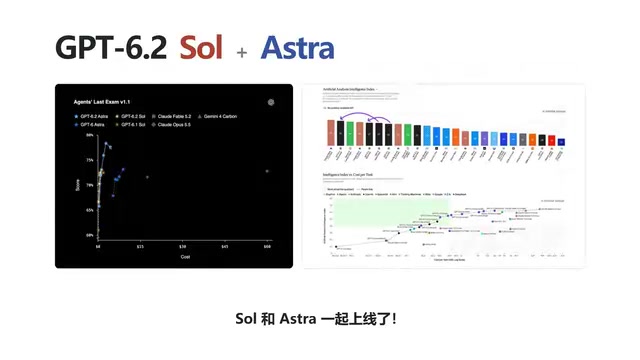
When OpenAI officially announced GPT-6.2, the first line was a playful jab at users nagging for updates—some asked very politely, others, well, they asked anyway. Behind the joke is the sustained attention users have paid to the release cadence lately. More importantly, this wasn't a single-point launch: GPT-6.2 Sol and Astra were released together, and Plus users can try them directly through two entry points—ChatGPT Work and Codex.
Two Models Side by Side, with More Direct Access Than Ever
According to a video analysis by a Bilibili creator, the most noticeable change this time is the entry-point design. Plus users can try the new models by opening either ChatGPT Work or Codex, with no extra application or waiting for a gradual rollout. For Pro users, the official team left a little surprise: they can enable an ultra-fast mode in Codex.
From a product strategy perspective, launching two models simultaneously means OpenAI is trying to bind capability upgrades to tool scenarios. Work leans toward everyday task handling, while Codex leans toward coding and engineering scenarios. With both lines getting the new models at the same time, users' perception of the new capabilities will be more concentrated.
The Word "Finally" Reveals the Sense of Cadence
The official copy deliberately includes the word "finally." This word isn't common in OpenAI's release language—it shows that internal expectations for this update were high, and it also indirectly responds to users' long-standing wait. The Bilibili creator laughed out loud upon seeing those two words; writing user sentiment into official copy is itself a kind of operational stance.
The positioning difference between ChatGPT Work and Codex
ChatGPT Work is a product entry point for everyday office tasks, emphasizing document processing, information organization, and general Q&A; Codex originates from OpenAI's code-generation model lineage and now exists as a standalone product form for developers and engineering scenarios, focusing on code understanding, generation, and engineering collaboration. The two share underlying model capabilities but differ in product interaction and default scenarios. This time, both models are connected to both entry points simultaneously, meaning OpenAI is adopting a "same model, multi-scenario reach" strategy for capability distribution, rather than training dedicated models for each scenario.
Gradual rollout and ultra-fast mode
Gradual rollout is a common launch method for AI products: first open to a small percentage of users, observe stability and feedback, then gradually expand. This time, Plus users can try it without applying, indicating that OpenAI has high confidence in the model's maturity. The "ultra-fast mode" that Pro users can enable in Codex usually refers to a more aggressive trade-off between inference latency and throughput, possibly involving shorter reasoning chains, higher concurrency, or dedicated compute scheduling; the specific implementation is not public, and actual experience must be based on user feedback.
Astra's Positioning: Information Retrieval and Compression
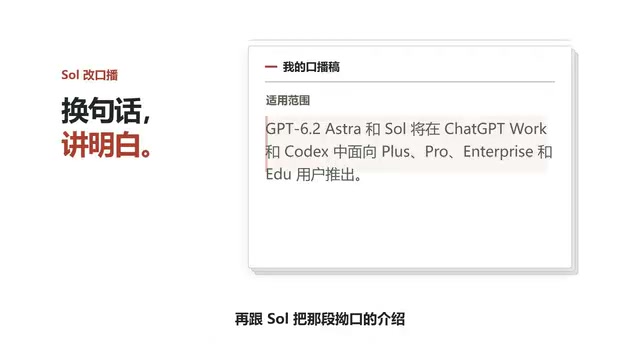
According to the Bilibili creator's usage scenarios, Astra's value centers on two things: flipping through long documents and rewriting expressions. For example, in a new product launch event, while the stage is still demonstrating features, users can have Astra flip through dozens of pages of materials, locate "who can use it" and "which page it's written on," pick out the points most worth presenting, and then turn the awkward official introduction into a few plain-language sentences.
This usage points to the same capability: targeted retrieval within large amounts of unstructured text, outputting conclusions that can be used directly. Compared with simple long-text summarization, Astra is more like an assistant that can replace manual flipping in high-information-density situations.

The Value of Time Difference in Launch Event Scenarios
What's really interesting is timeliness. The Bilibili creator's description is: if the demonstration on stage hasn't finished yet, you can already press the record button on this side. The efficiency gap in this scenario isn't linear—it moves "post-meeting organization" forward to "completed synchronously during the meeting." For content creators, media professionals, and anyone who needs to quickly digest product materials, this time difference is itself productivity.
Technical background of targeted retrieval and long-text processing
The capability described for Astra—locating "who can use it" and "which page it's written on" across dozens of pages of materials—falls at the intersection of retrieval-augmented generation (RAG) and long-context understanding. Traditional long-text summarization tends to cover the key points of the full text, whereas targeted retrieval requires the model to first understand the query intent, then perform semantic localization within the document, and finally output conclusions that can be directly cited. Such tasks place high demands on context window length, retrieval precision, and anti-hallucination capability. If Astra can complete page-flipping and localization synchronously during a launch event, it suggests its processing pipeline may have been optimized for low-latency "record-and-search" scenarios, rather than relying solely on offline batch summarization.
What This Update Means for Ordinary Users
Based on currently public information, the positioning of GPT-6.2 Sol and Astra does not fully overlap. The former is a capability iteration of the main model, while the latter leans toward workflows for material processing and expression conversion. Launching simultaneously means users can combine them under the same subscription, rather than switching back and forth between multiple tools.
It should be noted that existing information mainly comes from product observations from a single source. The division of labor between the two models on specific tasks, as well as the actual performance of ultra-fast mode, has not yet been cross-verified by more independent sources. The Bilibili creator's judgment is that "these two models were worth the wait," but how the real experience feels will depend on feedback from more users after they try them.
The Release Cadence Itself Has Become a Signal
OpenAI opens with a playful jab at users nagging for updates and closes with "finally." This way of expressing things shows that the sense of cadence in model releases is being managed as part of the product experience. For users, what's more worth watching than any specific feature is whether this "two models + two entry points" release model will become the norm going forward.
One-line Summary
OpenAI simultaneously releases GPT-6.2 Sol and Astra, with Plus users able to try both through two entry points and Pro users able to enable ultra-fast mode.
Paragraph Summary
When OpenAI officially announced GPT-6.2, it opened with a playful jab at users nagging for updates and simultaneously released two models, GPT-6.2 Sol and Astra. Plus users can try them directly through two entry points—ChatGPT Work and Codex—while Pro users can also enable ultra-fast mode in Codex. Sol is a capability iteration of the main model, while Astra focuses on targeted retrieval in long documents and rewriting official phrasing into plain language, enabling post-meeting organization to be completed during the meeting in scenarios such as launch events. The article argues that the two-model, two-entry-point release model reflects OpenAI's strategy of binding capability upgrades to tool scenarios, and that the release cadence itself is becoming part of the product experience. However, existing information mainly comes from a single source, and the division of labor between the models and the actual performance of ultra-fast mode still await further verification.
Related articles

GPT-6.2 Dual-Model Hands-On: How Big Is the Gap Between Astra and Sol in Clock-Making and Game-Building?
GPT-6.2 Astra vs Sol hands-on: Blender clock, neon shooter, and Formula racing compared. Astra spends $419 with strong execution; Sol costs $197 but drops to 2 FPS. Both still trail Fable and Opus in games and aesthetics.

GPT-6.2 Astra and Sol Released: A Big Cost Drop, and How to Choose Between the Two Models
OpenAI releases GPT-6.2 Astra and GPT-6.2 Sol: Astra tackles professional tasks, Sol targets low-cost everyday use, with cost per task cut to under a third.

The Father of Vibe Coding's Multi-Model Strategy: Replicate His AI Coding Setup for Free
The creator of Vibe Coding never trusts a single AI model—he uses multi-model division of labor, with one writing code and one reviewing. This article analyzes his free, replicable multi-model setup and the risks of single-model tools removing models.