Colossal Launches AI Platform to Accelerate Species De-Extinction

Colossal launches an AI platform to accelerate de-extinction research, and Diamandis sets up a fund to bet on its commercialization.
Colossal Biosciences has released an AI platform to accelerate genetic data comparison, experimental protocol simulation, and cross-species genomic analysis in de-extinction research. Simultaneously, XPRIZE founder Peter Diamandis launched a new fund dedicated to investing in startups using the platform, signaling that de-extinction is being packaged as an investable, scalable industry. The article examines Colossal's technical pathways for projects involving the woolly mammoth, thylacine, and dodo, and notes that AI is shifting from an assistive tool to a core discovery engine—similar to AlphaFold's breakthrough in protein folding. However, the commercialization path remains unclear, as resurrecting species takes decades and enormous investment, and ethical controversies persist. Overall, this intersection is attracting capital and entrepreneurial attention and is worth following closely.
When AI Meets Extinct Species: Colossal's New Bet
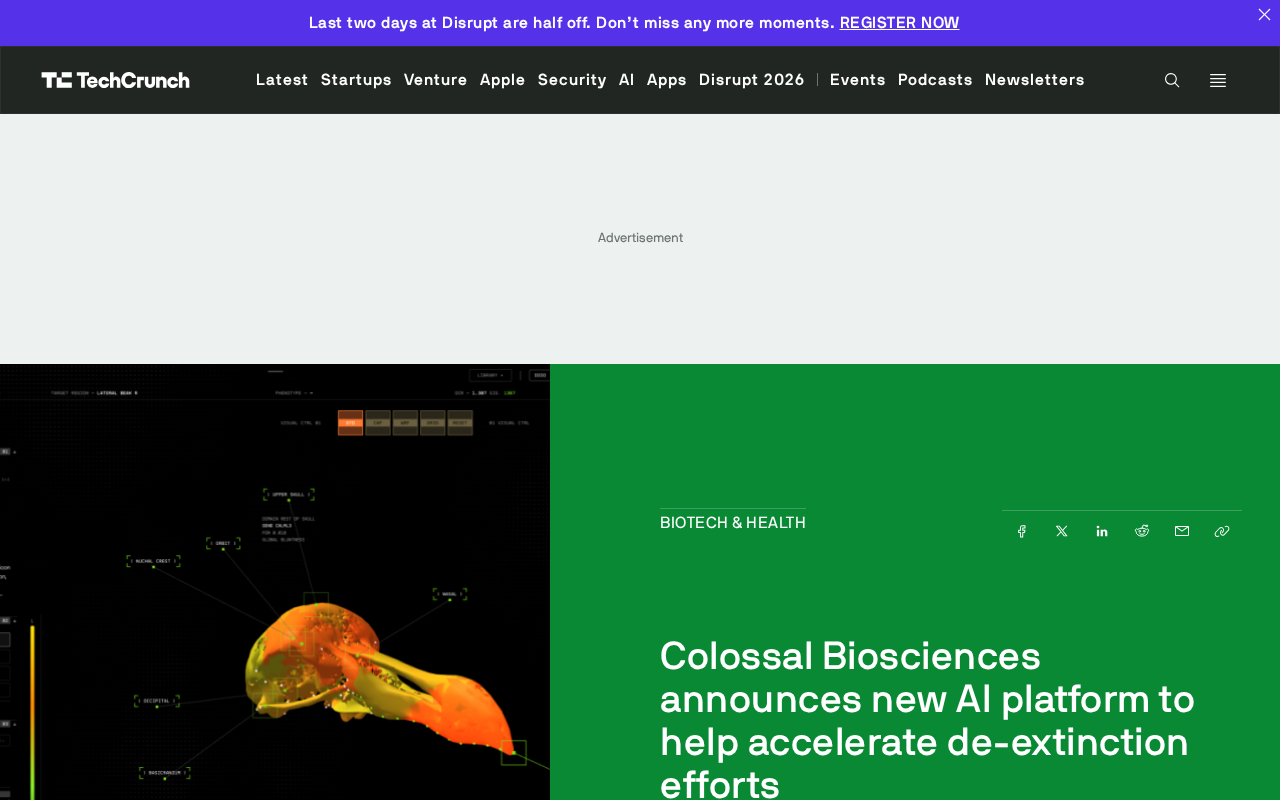
Last week, biotech company Colossal Biosciences announced the launch of a new AI platform designed to accelerate its "de-extinction" research. According to RSS feeds, the platform will help research teams more efficiently analyze genetic data, simulate species reconstruction pathways, and optimize experimental workflows. Almost simultaneously, XPRIZE founder Peter Diamandis launched a new fund dedicated to investing in startups that use the platform.
Together, these two announcements send a clear signal: resurrecting extinct species is no longer just a scientific fantasy confined to the lab — it is being packaged as an investable, scalable, AI-accelerated industry track.
What Exactly Is Colossal Doing?
Colossal Biosciences was founded by Ben Lamm and George Church, with the core mission of using CRISPR gene editing, stem cell technology, and synthetic biology to bring extinct species back to Earth. The company's previously announced flagship projects include the woolly mammoth, the thylacine (Tasmanian tiger), and the dodo.
From a technical standpoint, de-extinction is not simply "cloning" an extinct animal. It is closer to an extraordinarily complex genetic restoration project: first extracting genomes from closely related species, then comparing DNA fragments from the extinct species, and gradually editing a genome that approximates the original. This process involves massive data processing, multi-dimensional simulation of gene interactions, and lengthy experimental validation cycles.
Colossal's AI platform is essentially an "accelerator" bolted onto this long pathway. While the company has not yet disclosed the platform's specific technical architecture, it is reasonable to infer that its capabilities may cover the following areas:
Genetic Data Comparison and Pattern Recognition
DNA from extinct species is often severely fragmented. AI can rapidly identify key gene fragments within massive sequencing datasets and recognize regulatory regions associated with target traits.
Experimental Protocol Simulation and Optimization
Every step of gene editing carries uncertainty. AI models can simulate the potential outcomes of different editing strategies, reducing wasted experiments and concentrating limited lab resources on the most promising approaches.
Cross-Species Genomic Analysis
The genetic differences between the woolly mammoth and the Asian elephant, or between the thylacine and the Tasmanian devil, are intricately complex. AI can handle this kind of high-dimensional comparative genomics problem, helping researchers pinpoint the most critical editing sites.
CRISPR gene editing, formally known as "Clustered Regularly Interspaced Short Palindromic Repeats," is a mechanism of the bacterial innate immune system that scientists have repurposed into a programmable genetic scissors. Its core consists of a Cas protein (such as Cas9) and a guide RNA: the guide RNA identifies the target DNA sequence, and the Cas protein cuts the double strand at that location. When the cell repairs the break, it introduces insertions, deletions, or substitutions, thereby achieving gene knockout or site-specific modification.
In the de-extinction context, the value of CRISPR lies in "precise rewriting": researchers use the genome of a closely related species (such as the Asian elephant) as a chassis and edit in, one by one, the key differential sites inferred from the surviving DNA of the extinct species (such as the woolly mammoth). However, a single edit is easy — the hard part is modifying hundreds or thousands of sites simultaneously without causing off-target effects and genomic instability, which is a major reason AI has been brought in to optimize editing strategies.
Synthetic biology is a discipline that applies engineering thinking to biological systems, aiming to design and modify life the way one would build a circuit. It emphasizes the reuse and combination of standardized "biological parts" (such as promoters, coding sequences, and regulatory modules), and leverages computational tools for modeling and simulation.
In the de-extinction pathway, synthetic biology provides not only the editing of existing genomes but also the de novo synthesis of DNA fragments, the construction of artificial chromosomes, the design of regulatory networks, and the reconstruction of gene expression programs required for embryonic development in surrogate mothers or stem cell systems. Together with CRISPR and stem cell technology, it forms a complementary toolbox: CRISPR handles editing, synthetic biology handles building and tuning, and AI handles searching for feasible solutions across a vast space of possibilities. This also explains why de-extinction is viewed as a systems engineering challenge highly dependent on interdisciplinary infrastructure.
Peter Diamandis's New Fund: Signal or Bubble?
Peter Diamandis is known in the tech world as a "futurist" and founder of the XPRIZE Foundation, with a long track record of betting on disruptive technologies. His newly launched fund explicitly targets startups using Colossal's AI platform for de-extinction-related research.
This move deserves to be unpacked.
On the positive side, it suggests that the de-extinction tech stack is beginning to show signs of "platformization." Once core tools have unified interfaces, it becomes natural for application-layer startups to grow around them — for example, gene repair services focused on specific species, ecological restoration consulting, or even biodiversity data marketplaces.
But from a cautious perspective, the commercialization path for de-extinction remains unclear. Resurrecting a species requires decades of time and billions of dollars in investment. What is the end product? A self-sustaining population, or a "showpiece" that lives forever in a lab? Investors need to answer this question.
Diamandis's involvement at least shows that some capital is willing to bet on this question.
AI's Role in Biotech Is Shifting
Zooming out, Colossal's AI platform is part of a broader trend: AI is transforming from an "assistive tool" into a "discovery engine."
In drug discovery, AlphaFold has already proven that deep learning can solve the protein folding problem that traditional methods left unsolved for decades. In synthetic biology, AI is beginning to be used to design entirely new enzymes and metabolic pathways. De-extinction may be the next domain to be deeply transformed by AI — its high data complexity, steep trial-and-error costs, and vast search space are precisely the scenarios machine learning excels at.
Whether Colossal's AI platform can truly shorten the de-extinction timeline remains unclear, as no quantitative data has been made public. But it at least points in one direction: the competitiveness of future biotech companies may increasingly depend on the strength of their AI infrastructure.
AlphaFold is a protein structure prediction system developed by DeepMind. In the 2020 CASP14 assessment, it raised prediction accuracy to near experimental resolution, and is regarded as a landmark case of AI solving a long-standing scientific challenge. It matters because a protein's three-dimensional structure determines its function, and traditional structure determination via X-ray crystallography or cryo-electron microscopy is time-consuming and expensive. AlphaFold uses deep learning to infer spatial structure directly from amino acid sequences, dramatically reducing both cost and time.
For de-extinction, the significance of AlphaFold is not in directly resurrecting species, but in demonstrating a paradigm: when the search space is vast, experimental costs are high, and data patterns are complex, AI can serve as a "discovery engine." Similar logic is being transferred to gene regulation prediction, off-target editing assessment, and cross-species comparative genomics — which is the industry context behind Colossal's emphasis on an AI platform rather than a single experimental technique.
The Ethics of De-Extinction Won't Go Away
No matter how much technology accelerates, de-extinction can never escape ethical controversy. The core questions raised by critics include:
- Does resurrecting extinct species divert resources away from protecting currently endangered species?
- Can edited "new versions" of organisms find an appropriate place in ecosystems?
- If the technology only serves a handful of commercially valuable species, will biodiversity conservation become more utilitarian?
Neither Colossal nor Diamandis's fund has directly addressed these concerns. But as money and attention flow in, these questions will be raised with increasing frequency.
Conclusion: A Race Against Time
De-extinction is essentially a race against evolutionary time — using years or decades of technological intervention to fill a gap left by thousands of years of interrupted natural evolution. Colossal's AI platform and Diamandis's new fund are both new tools and new fuel in this race.
They don't guarantee success, but they do bring a goal that once existed only in science fiction one step closer to reality. For those watching the boundaries of AI applications and the frontiers of biotech, this is an intersection worth following closely.
One-line Summary
Colossal launches an AI platform to accelerate de-extinction research, while Diamandis sets up a fund betting on its commercialization.
Paragraph Summary
Colossal Biosciences has released an AI platform to accelerate genetic data comparison, experimental protocol simulation, and cross-species genomic analysis in de-extinction research. Meanwhile, XPRIZE founder Peter Diamandis has launched a new fund dedicated to investing in startups using the platform, signaling that de-extinction is being packaged as an investable, scalable industry. The article outlines Colossal's technical pathways for projects involving the woolly mammoth, thylacine, and dodo, noting that AI is shifting from an assistive tool to a core discovery engine — similar to AlphaFold's breakthrough in protein folding. However, the commercialization path for de-extinction remains unclear, as resurrecting species takes decades and enormous investment, and ethical controversies persist. Overall, this intersection is attracting capital and entrepreneurial attention and is worth following closely.
Related articles

JobRunner MCP Server: AI Agents Can Now Fix Failed Java Jobs
JobRunner launches an open-source MCP server enabling AI agents to view cluster status, diagnose failures, and recover Java jobs—incident response from any cloud coding environment or existing agent.

MLAI Digital Launches 9 Security Agents: MCP Server Safeguards the Full Lifecycle of Agentic AI
MLAI Digital launches Security MCP Server with nine built-in specialized security agents covering vulnerability discovery, attack simulation, prompt injection detection, API and infrastructure assessment, and accelerated remediation—embedding security validation across the full Agentic AI lifecycle from development to production.

Running Isaac Lab on H100 GPUs: Exploring Better Approaches
Exploring optimization methods for running Isaac Lab on NVIDIA H100 GPUs, including MIG configuration, mixed precision, TensorRT acceleration, and community experience to improve robotics simulation and reinforcement learning efficiency.